Model Update
GPT-6 Review: Release Date, Independent Tests, and Verdict
GPT-6 is here, but it is not an automatic upgrade for every task. OpenAI released GPT-6 Astra on September 3, 2026. Independent tests available during its first launch week suggest a real improvement on difficult, connected work, while also showing high latency, premium cost, and uneven value on routine prompts. The API model ID is gpt-6-astra.
Our verdict: Astra looks like a high-end worker for long, coupled workflows, not a default worker for everyday chat or bulk generation. Its strongest case is when one model must understand a large system, act across tools, preserve several constraints, and deliver something expensive to get wrong. GPT-5.6-class models remain more economical for bounded work.
Sources: launch announcement; model documentation; developer guidance; safety overview; availability guide; Artificial Analysis; production-derived coding comparison; hands-on API tests; Axios reporting; security expert commentary. Reviewed September 7, 2026.
Quick answer
| Question | Answer as of September 7, 2026 |
|---|---|
| Is GPT-6 released? | Yes. OpenAI released GPT-6 Astra on September 3, 2026. |
| What is the API model ID? | gpt-6-astra |
| Is GPT-6 in ChatGPT? | GPT-6 Pro is rolling out to eligible Pro, Business, and Enterprise plans. Availability varies by product and workspace settings. |
| Is it available in Codex and ChatGPT Work? | It is rolling out there; OpenAI says Plus access is included in Work and Codex, while Chat access differs. |
| What does the API cost? | Standard: $10 per million input tokens and $50 per million output tokens, with separate cached-input and cache-write rates. |
| What is the context window? | 1,050,000 tokens, with up to 128,000 output tokens. |
| Should every workload move now? | No. Use task-level evaluations and route only the work that earns the added cost and operational risk. |
What independent testing says
The early external evidence is more restrained than the launch language. It supports a capability gain, but not the idea that Astra wins every task or offers the best value by default.
| External test | Result | Practical reading |
|---|---|---|
| Artificial Analysis Intelligence Index | Astra max scored 55, ranked 3rd of 202 models in the current snapshot | Frontier-level, but not an uncontested number-one result |
| Artificial Analysis speed | 64.3 output tokens per second, ranked 93rd of 202 | Below the comparison median and slower than GPT-5.6 Sol max in the same tracker |
| Artificial Analysis cost per index task | $2.57 for Astra max versus $1.25 for Sol max | The four-point index gain cost roughly twice as much per test task |
| ComputingForGeeks debugging test | Astra, Sol, Terra, and Luna found the same three root causes | Astra's advantage was better caveats and verification, not a different diagnosis |
| Production-derived coding comparison | Astra and Terra both passed the existing suite; only Astra preserved coupled pagination state and added a test for it | A green suite can hide a contract error, and Astra showed better cross-component reasoning in this one task |
Artificial Analysis also measured a roughly 355-second time to first token for Astra at max effort in its current run. That is an extreme configuration, not a normal chat expectation, but it reinforces a useful rule: maximum reasoning is a deliberate research setting, not a default.
The production-derived coding test is especially instructive. Both agents passed 712 test files. The Terra implementation still lost the other pagination control's state in one interaction; Astra preserved both states and explicitly tested the relationship. This is evidence for Astra on tightly coupled implementation work, but it remains one vendor-published case, not a general win rate.
What hands-on reviewers found
Claire Vo's September 3 early-access review names concrete tasks: a ChatPRD feature that had resisted previous models, browser QA, a hardware integration, and 3D work. The episode page provides timestamps for the demonstrations. This is an experienced builder's report of selected successes, with early access disclosed; it does not provide repeated trials or an average failure rate. Its strongest contribution is a set of real tasks readers can use to design their own comparison.
Matt Shumer's September 3 review is more positive about everyday use than our cost-conscious recommendation: he adopted Astra as his default and praises backend engineering and understandable progress updates. He also reports weaker visual results than Claude, slower responses, and ambitious projects that stop making useful progress. His large demonstrations used substantial coordination and existing assets. Those qualifications matter when interpreting a project described as starting from one prompt.
These reviewers disagree with some early community complaints about intent and scope. The available evidence supports testing those behaviors on your own tasks; it does not establish that either experience is typical.
ComputingForGeeks ran the same debugging prompt through four OpenAI models using the live API. All four identified the same three causes. Astra took 75.5 seconds and cost about $0.194; Sol took 39.3 seconds and cost about $0.048. The reviewer judged Astra's extra caveat useful because it prevented an overly broad diagnosis, but concluded that routine confirmation questions did not justify the premium.
That result changes the buying question. Astra does not need to produce a wholly different answer to be valuable; one missing caveat can matter in a high-risk incident. But when all correct answers lead to the same action, the cheaper model wins.
Early community feedback is mixed. One experienced Codex user reported clever solutions but weaker judgment about scope, including proposing unnecessary infrastructure before agreeing on direction. Another developer described Astra as powerful but prone to over-engineering simple tasks. Other users reported much faster completion on difficult repository work. These are uncontrolled anecdotes affected by prompts, repositories, product limits, and expectations, so they show failure modes to test rather than a reliable satisfaction score.
One detailed community report said 12 ordinary repository turns across eight sessions ended with a cybersecurity-policy flag after substantial run time. This is not independently verified, but it is consistent with OpenAI's warning that additional safeguards can pause or stop legitimate work. Teams evaluating Astra should track late policy terminations as a reliability and cost metric.
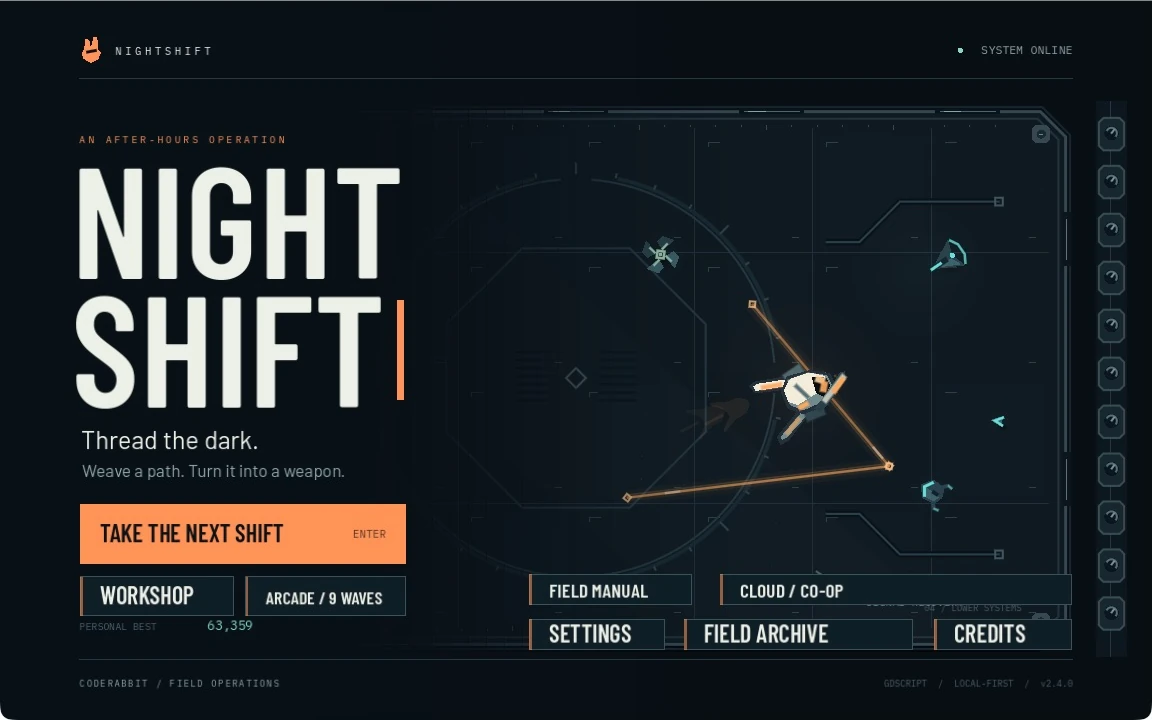
NIGHTSHIFT, built with GPT-6 through human direction and iteration, as presented by CodeRabbit.
What changed in GPT-6 Astra
Long context became more usable
The model page lists a 1,050,000-token context window and a 128,000-token maximum output. OpenAI reports 96.3% on its MRCR v2 eight-needle test in the 512K-to-1M range, compared with 73.8% for GPT-5.6 Sol. A large window is still not a reason to send every available file. Retrieval quality, source dates, conflicts, and reviewer visibility remain application responsibilities.
Computer use moved closer to real work
OpenAI reports a 72.6% score for Astra on its OSWorld 2.0 offline set, versus 65.7% for GPT-5.6 Sol. In the company's latency simulation, Astra completed those tasks in roughly 40 minutes rather than 75. The announcement shows intended uses such as updating records, filling forms, working in spreadsheets, preparing documents, and checking websites.
The right interpretation is not "safe autonomy." It is "more tasks are technically possible." Systems still need narrow permissions, action previews, confirmation for consequential changes, idempotency, and a recoverable audit trail. Our AI agent security checklist covers those boundaries in more detail.
Developers can steer work while it runs
GPT-6 Astra adds async tool calling and mid-turn steering in the Responses API. An application can keep independent work moving while a slow tool runs, then return the result using its call ID. A user can also send a correction during a WebSocket session without discarding completed work. These features are useful for long tasks, but the application must track pending calls, cancellations, timeouts, and late results.
Reasoning can change without rebuilding the prompt
The API supports low, medium, high, xhigh, and max reasoning effort. A conversation can receive a configuration update that changes effort while preserving the cached prompt prefix. Astra does not support a none reasoning setting.
Safety improved while monitorability became harder
OpenAI reports fewer harmful or out-of-scope actions than GPT-5.6 Sol in several internal evaluations. The company also says Astra is harder to monitor through its written reasoning because it has more control over what appears there. Both claims matter. Stronger measured behavior does not eliminate the need for controls, and weaker monitorability argues for judging observable actions, permissions, inputs, and results rather than treating hidden reasoning as an audit log.
Does GPT-6 mean AGI?
OpenAI calls Astra its most intelligent and aligned model. At the launch briefing, OpenAI president Greg Brockman said he personally believed it could mark the arrival of AGI, while leaving the judgment to users. That is a claim and an interpretation, not a settled measurement standard.
For buyers and builders, "AGI or not" is less actionable than four questions:
- Does it complete your representative tasks more accurately?
- Does it reduce total time and reviewer correction?
- Does it stay inside the permissions and scope you define?
- Does the quality gain justify its full cost per accepted result?
The independent picture does not settle the AGI claim. Astra scored near the top rather than first on Artificial Analysis, while showing a much larger advantage in one coupled coding task and in OpenAI's computer-use tests. The best AI models in 2026 are still task-dependent. A frontier score does not automatically make one model the best router target for extraction, classification, routine drafting, or high-volume support.
Where GPT-6 is available
OpenAI's launch post describes a staged rollout across ChatGPT, the API, Microsoft Azure, and Amazon Bedrock. The updated Help Center separates access by surface:
- ChatGPT Chat: GPT-6 Pro is rolling out for Pro $100, Pro $200, Business, and Enterprise plans. Allowances are limited and vary by plan.
- ChatGPT Work and Codex: GPT-6 Astra is rolling out for Pro users, and Plus includes access in these products during rollout.
- API: Developers use
gpt-6-astra. Free API tier access is not supported on the model page. - Managed workspaces: Administrators may need to enable access. Enterprise access is off by default at launch according to the announcement.
These details can change quickly. Check the linked OpenAI Help Center and model page before making a purchase or rollout commitment.
GPT-6 pricing in context
OpenAI lists Standard API pricing at $10 per million input tokens and $50 per million output tokens. Cached input is $1 per million tokens, and cache writes are $12.50 per million. Prompts above 272,000 input tokens use higher rates for the full request. Batch and Flex processing are listed at half the Standard rates; Fast mode costs twice the applicable rate.
Per-token price is not cost per completed task. Astra may use fewer output tokens or finish workflows in fewer attempts. In the independent debugging test, however, Astra cost about four times as much as Sol for the same core diagnosis. In the production-derived coding test, Astra may have avoided a separate review-and-repair cycle. Both outcomes are plausible. Measure accepted-output cost with retries, tool calls, reviewer time, policy stops, and failures included. The GPT-6 API guide provides a migration and evaluation template.
A practical GPT-6 evaluation framework
Run the same 20 to 50 representative tasks through your current model and Astra. Use frozen inputs and a blinded reviewer where possible.
| Dimension | What to record | Suggested gate |
|---|---|---|
| Correctness | Required facts, calculations, and constraints satisfied | No regression on critical fields |
| Completion | Task reaches the requested deliverable without rescue | Meaningful lift on hard tasks |
| Scope | Unauthorized or unnecessary actions attempted | Zero consequential violations |
| Review | Minutes and edits needed for acceptance | Lower median review effort |
| Reliability | Timeouts, tool errors, retries, and blocked runs | Within the workflow's SLO |
| Cost | Tokens, tools, retries, and reviewer labor per accepted result | Positive value at expected volume |
Do not begin with your easiest prompts. Include missing information, contradictory sources, prompt injection, stale data, tool failure, permission denial, and a user changing requirements mid-run.
Evaluation brief template
Decision: Should [workflow] move from [current model] to GPT-6 Astra?
Task set: [representative production cases]
Frozen inputs: [source IDs and dates]
Allowed tools: [names and permission scopes]
Required output: [schema or acceptance criteria]
Stop conditions: [missing evidence, denied permission, budget]
Review rubric: correctness, completeness, scope, clarity
Cost record: input, output, cache, tools, retries, reviewer minutes
Ship gate: [numeric thresholds and zero-tolerance failures]
When to use GPT-6 now
Start with hard, expensive tasks where stronger reasoning and computer use could remove several handoffs: complex coding, multi-source research, document production, spreadsheet work, or bounded operations across professional software. Keep faster and cheaper models for routine steps until data proves otherwise.
Avoid Astra as the automatic choice for short questions, bulk copy, mechanical edits, or tasks that already pass review on a cheaper model. Watch for over-engineering, long maximum-effort latency, late safety interruptions, and impressive-looking implementations that still need product-level inspection.
Ottermind helps turn that evaluation into a connected project: keep the brief, source set, model outputs, reviewer notes, and final deliverable together instead of comparing models through isolated chats. Start with one real outcome in an AI agent workspace, then expand only after the evidence supports it.
For practical next steps, read how to use GPT-6, the coding review, and the long-task guide.
FAQ
What is the GPT-6 release date?
OpenAI released GPT-6 Astra on September 3, 2026, with access rolling out in stages.
Is GPT-6 the same as GPT-6 Astra?
GPT-6 is the model generation; Astra is the released flagship model name. The API identifier is gpt-6-astra, while ChatGPT presents an eligible Astra-powered option as GPT-6 Pro.
Can ChatGPT Plus users access GPT-6?
OpenAI's current Help Center says Plus users receive Astra in ChatGPT Work and Codex as it rolls out. GPT-6 Pro in standard ChatGPT Chat is listed for eligible Pro, Business, and Enterprise plans. Availability can differ during rollout.
Is GPT-6 better than GPT-5.6 Sol?
OpenAI reports substantial gains on computer use, automation, coding, long context, science, and several safety evaluations. The value for a specific workflow still needs a controlled task-level test. See the full GPT-6 vs GPT-5.6 comparison.
Does GPT-6 support images, audio, and video?
The API model page lists text and image input, text output, and no direct audio or video modality support. Tool availability is a separate capability.
Is GPT-6 safe to run autonomously?
No model should receive broad consequential access based only on benchmark results. Use least privilege, explicit action boundaries, confirmation, monitoring, and recovery controls.