Model Comparison
GPT-6 vs GPT-5.6: Astra and Sol Compared for Real Work
GPT-6 Astra is the stronger choice for the hardest multistep work; GPT-5.6 Sol remains the more practical default when latency, availability, and cost matter more than frontier capability. OpenAI's reported results show Astra's largest gains in computer use, automation, long-context retrieval, scientific tasks, and cybersecurity. The upgrade is not equally valuable for every prompt.
Choose by accepted-task economics, not by model number. If a routine request is already correct, fast, and inexpensive on GPT-5.6, moving it to GPT-6 can increase cost without improving the outcome. If a workflow repeatedly fails at tool coordination, complex reasoning, long context, or professional artifact creation, Astra deserves a controlled evaluation.
Sources: GPT-6 announcement; model page; developer guidance; safety overview; Artificial Analysis on Astra; GPT-5.6 Sol comparison; live API debugging test; production-derived coding comparison. Reviewed September 7, 2026.
Quick comparison
| Decision factor | GPT-6 Astra | GPT-5.6 Sol |
|---|---|---|
| Best fit | Hard end-to-end workflows | Strong general work at lower operating cost |
| Context window | 1,050,000 tokens | Verify the current model page for the deployed variant |
| Max output | 128,000 tokens | Verify the current model page for the deployed variant |
| Reasoning effort | Low through max; no none | Broad reasoning controls, including current product-specific options |
| New workflow features | Async tool calling, mid-turn steering, in-conversation reasoning updates | Established tool and Responses API workflows |
| Standard API input price | $10 / 1M tokens | Lower; verify current model pricing |
| Standard API output price | $50 / 1M tokens | Lower; verify current model pricing |
| Availability | Staged rollout; no API Free tier | Broader across eligible OpenAI products |
| Independent intelligence score | 55 at max effort | 51 at max effort |
| Independent measured output speed | 64.3 tokens/second at max | About 76 tokens/second at max |
| Independent cost per index task | $2.57 at max | $1.25 at max |
| Operational posture | Reserve for high-value hard work first | Keep as the baseline for routine and mixed work |
The independent measurements are snapshots from Artificial Analysis and will move as providers and test suites change. They show a modest general-intelligence gain, slower output, and roughly double the benchmark-task cost, not a universal generational leap. Use current model pages when calculating a purchasing decision.
Independent tests versus the launch story
Claire Vo's early-access account describes progress on a ChatPRD feature she had struggled to complete with Sol and Fable. It supports trying Astra on previously blocked work, but selected successes cannot tell us the typical improvement over Sol. Keep the original task, repository state, and acceptance criteria when reproducing a comparison.
Matt Shumer's review favors Astra for everyday engineering while retaining Claude for visual work. His preference shows why a model can become someone's default despite premium token pricing: communication and reduced supervision can matter more than generation speed. It remains a personal assessment, not a controlled Astra-versus-Sol result.
Our recommendation therefore applies to budgeted team deployments: retain a working baseline, then test Astra on the cases that currently require the most intervention. Individual users with different workloads may reasonably choose differently.
OpenAI's largest reported gains appear on agentic, computer-use, and long-context evaluations. Artificial Analysis presents a narrower general result: Astra max scored 55 on its Intelligence Index compared with 51 for Sol max. Astra generated fewer total output tokens than the tracker median, but measured output speed was lower than Sol and time to first token at max effort was high.
One live API debugging test found that Astra and three GPT-5.6 variants all diagnosed the same problem. Astra supplied the best caveat and confirmation plan, but took about twice as long as Sol and cost roughly four times as much. This favors Astra when the missing caveat could lead to an expensive mistake, not when the task is simply to name a command or likely cause.
A separate production-derived coding test compared Astra with GPT-5.6 Terra rather than Sol. Both implementations passed the existing test suite, but Terra broke coupled pagination state while Astra preserved it and added a test for the relationship. The author changed routing rules to give Astra tightly coupled, multi-domain work, while keeping cheaper models for ordinary and mechanical changes. That is a more defensible deployment pattern than replacing every model.
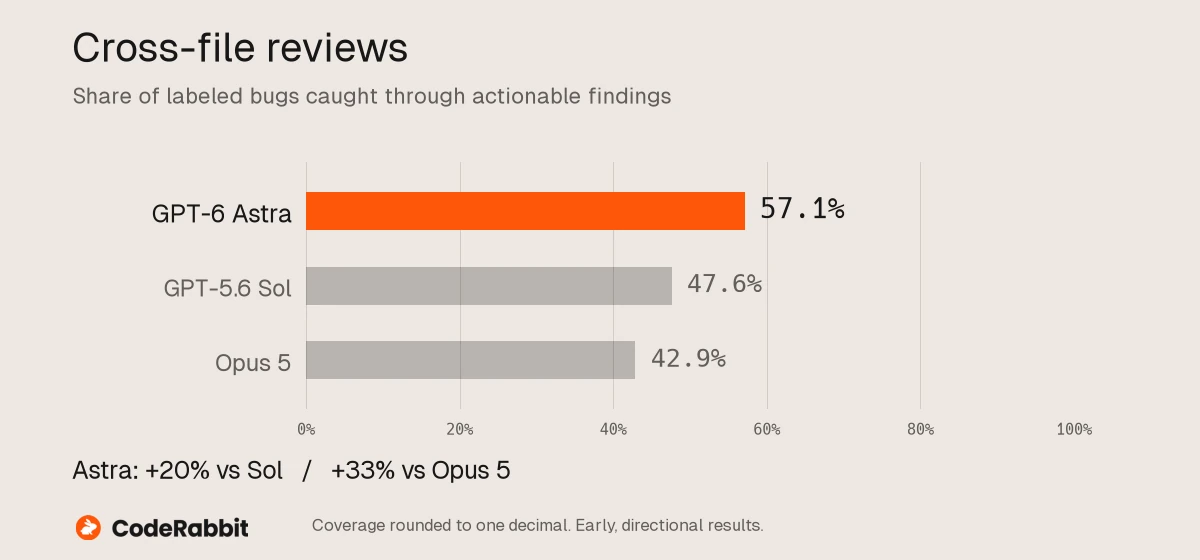
Cross-file review results published by CodeRabbit. Early findings, not a measure of overall review quality.
Where GPT-6 shows the clearest gains
OpenAI's launch evaluations provide the most useful like-for-like comparison because both models were tested by the same publisher. They still require caution: some are internal, scores are reported at maximum effort, and production system prompts and tools can change results.
| Evaluation | GPT-6 Astra | GPT-5.6 Sol | What it may indicate |
|---|---|---|---|
| OSWorld 2.0 offline | 72.6% | 65.7% | Better operation of desktop-style environments |
| AutomationBench | 41.4% | 18.1% | A large gain on multistep automation tasks |
| Terminal-Bench 4.0 | 57.9% | 37.3% | Better terminal-based engineering work |
| Internal database migration tasks | 63.9% | 42.7% | Potential lift on long, stateful code changes |
| FrontierMath Tier 4 v2 | 97.6% | 83.0% | Stronger advanced mathematical reasoning |
| MRCR v2, 512K-1M | 96.3% | 73.8% | Better retrieval across very long contexts |
| ARC-AGI-3 | 99.9% | 7.8% | A major reported gain on novel interactive tasks |
Astra does not dominate every published comparison against every competing model. DataCamp's benchmark review notes that it trails Claude Fable 5.1 on Humanity's Last Exam with tools and that the 99.9% ARC-AGI-3 result depends on a stateful provider-adapter harness, so a stateless API call should not be expected to reproduce the headline. Use these results to decide what to test, not what to deploy.
Computer use and agent workflows
This is the strongest reason to evaluate GPT-6. OpenAI designed Astra to work across code, browsers, documents, spreadsheets, presentations, and professional software. Async tool calling lets the model continue independent reasoning while an application executes a slow tool. Mid-turn steering lets a user correct or redirect a long session without restarting it.
GPT-5.6 Sol already supports tool use and agent workflows. Keep Sol when the sequence is short, permissions are narrow, and it meets the acceptance bar. Test Astra when the current workflow loses its place, mishandles evolving instructions, struggles with several software surfaces, or needs excessive retries.
The surrounding architecture does not disappear with a stronger model. Authentication, tool schemas, authorization, state, audit logs, approval, and rollback belong to the application. See AI agent architecture for that system boundary.
Context and memory are not the same thing
Astra's 1.05-million-token window can hold a large source set, but a context window is temporary request capacity. It is not automatically a durable, correct memory of a customer, project, or policy. Long-lived memory needs source identifiers, update rules, conflict handling, deletion, access control, and user visibility.
Use long context for a bounded corpus that must be considered together. Use retrieval for a larger changing corpus. Use durable project state for decisions and approved artifacts that must survive across runs. The AI knowledge management guide explains how to preserve provenance instead of treating generated summaries as the source of truth.
Cost: compare completed work, not tokens alone
GPT-6 Astra's Standard API price is $10 per million input tokens and $50 per million output tokens. Prompts over 272,000 input tokens receive higher rates for the full request. Cache, tools, Fast mode, Batch, and Flex processing use their own rates.
Astra can still be cheaper for a hard task if it uses fewer tokens, avoids retries, or reduces human review. Conversely, even a perfect response can be uneconomic if a high-volume classification task gains nothing from frontier reasoning.
The hands-on debugging test gives the tradeoff a concrete scale: about $0.194 and 75.5 seconds for Astra versus $0.048 and 39.3 seconds for Sol. All models reached the same core diagnosis; Astra's value was a more precise limitation and verification plan. That single prompt cannot establish an average, but it is a useful counterweight to token-efficiency claims.
Use this calculation:
accepted-task cost =
  model input + model output + cache + tool calls
  + failed attempts + reviewer time + correction work

upgrade value =
  errors avoided + labor saved + cycle time saved
  - incremental accepted-task cost
Measure both models on the same input set. Do not estimate reviewer time as zero; it is often the largest hidden cost.
Safety and control
OpenAI says Astra is more robust to jailbreaks, prompt injection, and out-of-scope behavior than GPT-5.6 Sol. In one internal simulation using more than 54,000 Codex tasks, Astra received roughly half as many flags for higher-severity misaligned behavior. OpenAI also reports a decline in monitorability of written reasoning relative to Sol.
Security experts interviewed by TechRadar argued that organizations should monitor observable actions and keep a way to stop an agent mid-action rather than relying on a model's written reasoning. An early community report also describes ordinary coding sessions stopped by cybersecurity classifiers after long runs. That report is anecdotal, but OpenAI itself warns that safeguards can interrupt legitimate work. Include false-positive stops and lost run time in the comparison.
That combination changes how teams should evaluate the model:
- Test actual actions and outcomes, not whether the reasoning trace sounds reassuring.
- Give every tool a narrow schema and explicit authorization boundary.
- Add adversarial source content and impossible tasks to the evaluation set.
- Require confirmation for sending, deleting, purchasing, publishing, or changing access.
- Keep an independent event log of inputs, tool calls, approvals, outputs, and reviewer decisions.
Use the AI agent security checklist before granting either model write access.
Which model should you choose?
Choose GPT-6 Astra when
- The task is complex enough that several retries or human handoffs are normal.
- Computer use or coordination across multiple tools is central to the outcome.
- The source set is extremely long and retrieval misses are costly.
- The deliverable is a high-value document, analysis, presentation, or code change.
- Your evaluation shows a measurable lift in accepted results.
Keep GPT-5.6 Sol when
- The current workflow already meets its quality and reliability targets.
- Response speed or high-volume economics dominate the decision.
- The task is short, repetitive, well structured, or easy to verify.
- GPT-6 availability or rate limits do not meet your service requirements.
- Your team has not yet built an evaluation and review process.
Route between them when
Most production systems should not make this a binary migration. Start on the cheaper baseline, then escalate based on observable signals: source volume, task risk, failed validation, tool count, or a user-requested quality level. Keep the routing rule simple enough to audit.
Side-by-side evaluation template
Workflow: [name]
Current model: GPT-5.6 Sol
Candidate: GPT-6 Astra
Cases: [20-50 representative tasks]

Score each 0-2:
- Correct facts and calculations
- Required constraints satisfied
- Complete, usable deliverable
- Authorized scope respected
- Sources and uncertainty visible

Record separately:
- Wall-clock time
- Input/output/cache/tool cost
- Retries and failures
- Reviewer minutes and edits

Ship only if:
- No critical safety or scope regression
- Quality lift is statistically and practically meaningful
- Accepted-task cost fits the volume forecast
A practical rollout plan
- Freeze representative production inputs and acceptance criteria.
- Run both models with equivalent tools and permissions.
- Blind the reviewer to model identity where practical.
- Inspect failures, not just averages.
- Route a small share of eligible work to Astra.
- Monitor accepted-task cost, corrections, incidents, and user overrides.
- Expand only the segments that continue to show value.
Ottermind can keep the source files, comparison outputs, reviewer decisions, and final deliverables inside one project. Use an AI agent workspace to evaluate the workflow as a whole rather than collecting screenshots from disconnected chats.
FAQ
Is GPT-6 Astra always better than GPT-5.6 Sol?
No. Astra is more capable on many published evaluations, but Sol may be faster, cheaper, more available, and already sufficient for routine work.
Is GPT-6 worth the higher API price?
It can be for difficult tasks if it reduces retries, review time, or failures. Calculate cost per accepted task with tool calls and human work included.
Does GPT-6 replace GPT-5.6?
Not automatically. OpenAI continues to make GPT-5.6 models available across products. A sensible system can route routine work to GPT-5.6 and reserve GPT-6 for the hardest cases.
Which model is better for coding?
OpenAI reports higher Astra scores on Terminal-Bench 4.0 and several coding evaluations, with especially large gains on its internal database migration tasks. Test both on your own repositories, instructions, and CI gates.
Which model is better for long documents?
Astra has a 1.05-million-token context window and stronger OpenAI-reported long-context retrieval. That does not replace document selection, citations, conflict handling, or human review.
Can I use the same prompts when migrating?
Begin with the same task contract for a fair baseline, then adjust only after inspecting failures. The GPT-6 API guide includes a migration checklist.