Technical Guide
AI Agent Architecture: Components of Reliable Workflows
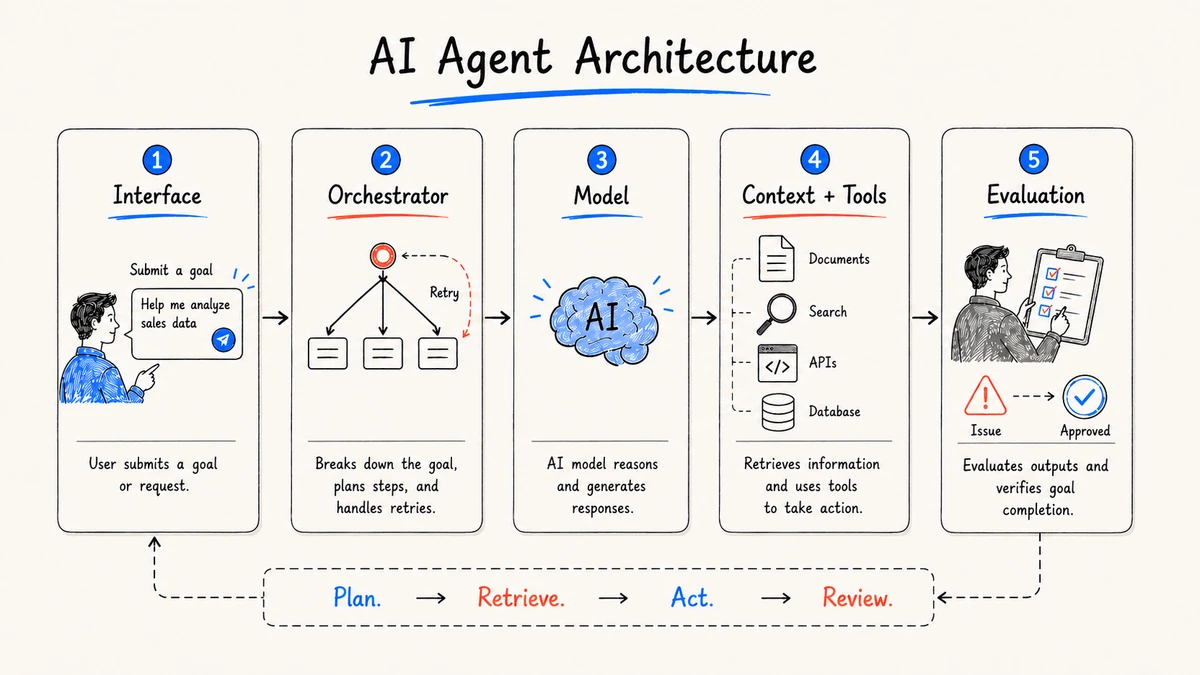
AI agent architecture is the design of the software around a model: state, retrieval, tools, orchestration, safety, and evaluation. A strong architecture makes uncertainty and failure visible instead of hiding them behind a conversational interface.
Research and disclosure: Architecture guidance is informed by OpenAI agent building blocks, Anthropic tool use, LangChain agent overview, and NIST AI risk management guidance, reviewed September 2, 2026.
Reference layers
| Layer | Responsibility | Design question |
|---|---|---|
| Interface | Receives goals and shows status | What does the user approve? |
| Orchestrator | Controls steps, retries, and stopping | Can every transition be logged? |
| Model | Interprets context and proposes actions | What output schema is required? |
| Context | Retrieves files, memory, and state | Are permissions applied before retrieval? |
| Tools | Performs external actions | Are calls scoped and idempotent? |
| Evaluation | Measures quality and safety | Which failures block release? |
State and memory
Keep transient run state separate from durable project memory. Store provenance and timestamps with retrieved facts. Do not treat a model's previous answer as authoritative memory without a review or source policy.
For a workflow-level distinction, compare this with the repository's agentic workflow guide. Architecture describes system boundaries; a workflow describes the ordered work the system performs.
Start with a reversible slice
Prototype one read-heavy task before adding write access. A source-grounded brief or classification result gives you useful traces without risking irreversible changes. Add one tool at a time and record its permission boundary.
Request and response contracts
Define a contract between each layer. The request should include the goal, user identity, allowed sources, and budget. The response should include status, structured output, citations, tool calls, and an explanation of what still needs review. Contracts make failures observable and keep UI code from guessing what a model meant.
For example, a research step might return:
{
  "status": "needs_review",
  "claims": [],
  "sources": [],
  "open_questions": ["The latest quarter is missing from the approved dataset."]
}
An explicit status is safer than returning a fluent paragraph that quietly hides a missing source.
Sync, async, and human checkpoints
Short classification can run synchronously. Long retrieval or document generation should be asynchronous, with progress and cancellation. Human checkpoints belong before irreversible actions and whenever confidence, permissions, or policy checks fail. Store the checkpoint decision as part of the run state so a later retry does not ask the same question without context.
Cost and latency budgets
Set a maximum number of model turns, tool calls, tokens, and elapsed time. Route simple extraction to a smaller model and reserve expensive reasoning for ambiguous cases. A budget is both an operating control and a product promise: users should know when a workflow will stop and ask for help.
Production readiness checklist
- Replayable traces for every tool call and model version
- Separate credentials and data for test and production
- Idempotent writes and a documented rollback path
- Evaluation cases run before every prompt or model change
- An owner who receives escalations and reviews incidents
Tool boundaries
Expose narrow functions instead of unrestricted credentials. Validate arguments before execution, set timeouts, and require confirmation for sending, deleting, purchasing, or changing access. Use idempotency keys so retries do not duplicate side effects.
Retrieval and grounding
Retrieve only what the user can access. Include source identifiers in the model context and require citations or evidence fields in the result. When retrieval is empty or conflicting, return an escalation state instead of filling the gap.
Evaluation and operations
Build a test set with normal, incomplete, adversarial, and multilingual cases. Track tool errors, escalation rate, latency, cost, and reviewer corrections. Version prompts, tools, model settings, and policies together.
FAQ
Do I need a multi-agent architecture?
No. Start with one agent and explicit tools. Add separate agents only when roles, permissions, or evaluation criteria genuinely differ.
Where does security belong?
Across every layer: identity, retrieval, tool permissions, secrets, logging, and human approval. It is not a final checklist item.
How do I reduce hallucinations?
Improve source selection, constrain outputs, require evidence, and make uncertainty actionable. Prompt wording alone is not a complete control.
What should I prototype first?
Prototype one bounded workflow with a reversible action and a clear reviewer. Prove the control path before adding more tools.