Explainer
What Is an Agentic Workflow? Planning, Tools, Memory, and Human Review
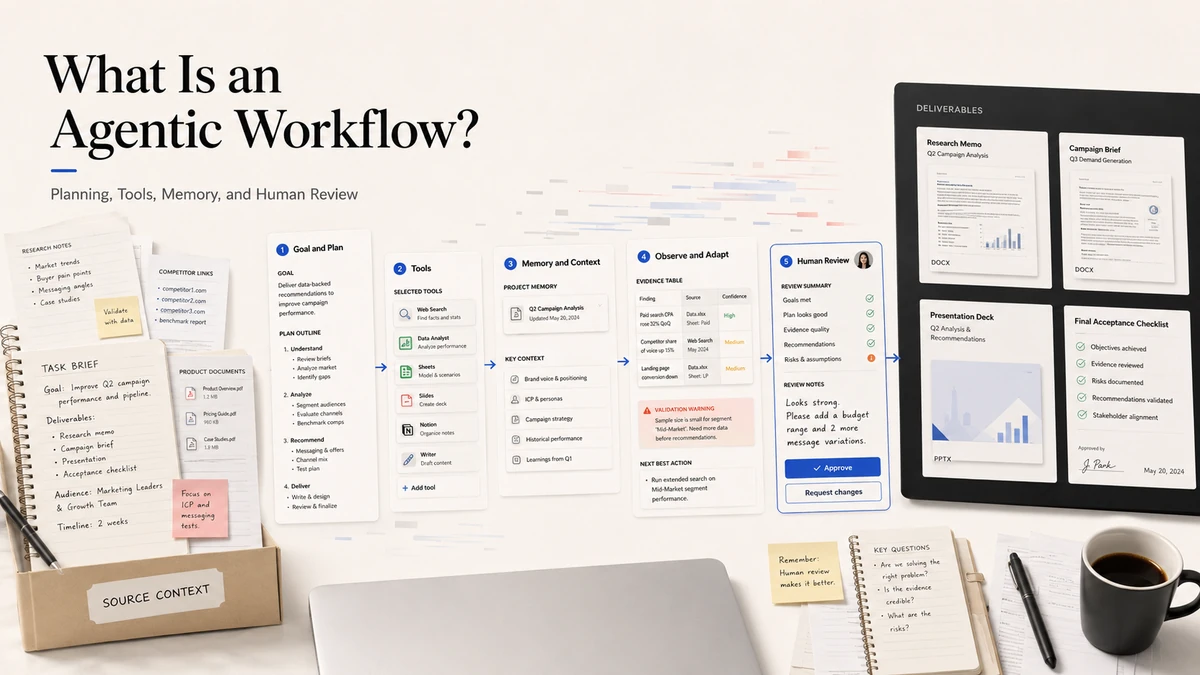
An agentic workflow is a multi-step process in which an AI system can decide how to pursue a goal, use tools, inspect results, and adjust its next step within defined boundaries. Unlike fixed automation, the full path does not need to be specified in advance. Reliable agentic workflows combine that flexibility with scoped memory, visible intermediate work, stop conditions, and human review.
This guide is for teams deciding how to turn a brief and source material into a report, plan, campaign, presentation, or other reviewable deliverable. It explains the operating model, not just the technology behind it.
Research and disclosure: Ottermind publishes this explainer. We reviewed primary guidance from Anthropic and OpenAI on August 25, 2026. The workflow contract and campaign execution trace below are original editorial frameworks. The example is illustrative, not a measured Ottermind benchmark.
What makes a workflow agentic?
A workflow becomes agentic when the AI has bounded discretion over how the work gets done. It may choose which source to inspect first, which tool fits a subtask, whether a result is sufficient, or which next step will close an information gap.
That does not mean the workflow is fully autonomous. The goal, accessible data, allowed tools, acceptance criteria, permissions, and approval points can still be defined by people.
Anthropic makes a useful architectural distinction: in a workflow, models and tools follow predefined code paths; in an agent, the model dynamically directs its process and tool use. In practice, many useful systems combine both. A fixed workflow can contain an agentic research step, while an agent can operate inside a fixed sequence of review gates.
Use these five questions to identify an agentic workflow:
- Is there a goal and a definition of done beyond producing the next response?
- Can the system choose among steps or tools based on what it finds?
- Can it observe tool results and revise its approach?
- Does it preserve the context needed to continue the task?
- Can it stop, escalate, or ask for a decision when a boundary is reached?
If the path never changes, you probably have fixed automation. If the system only returns text without pursuing an outcome, you probably have a chatbot interaction.
Agentic workflow vs. automation vs. AI agent
| System | Who defines the path? | Best for | Typical output |
|---|---|---|---|
| Chatbot | The user directs each turn | Questions, explanations, and isolated drafts | A response |
| Fixed automation | A person defines rules and branches in advance | Stable, repeatable processes | A record update or standardized artifact |
| Agentic workflow | People set the goal and boundaries; AI chooses some steps | Multi-step knowledge work with variable inputs | Intermediate work plus a deliverable |
| Open-ended AI agent | The AI directs much of the process within permissions | Tasks where the correct path is hard to predict | Actions, artifacts, and a task log |
The categories can be combined. A campaign process might use deterministic code to collect approved files, an agentic step to synthesize research, a fixed approval gate, and another agentic step to adapt the approved brief into channel assets.
The right choice is the least complex system that can handle the variability of the work. Fixed automation is usually more predictable. Agentic behavior becomes valuable when judgment, unstructured inputs, tool selection, or adaptation would otherwise require a person at every step.
For a broader product-level view, compare the best AI agent workspaces.
The five-part anatomy of an agentic workflow
Planning, tools, memory, observation, and human review work as one loop. Removing any one of them changes what the workflow can safely accomplish.
| Part | Purpose | Inspectable evidence |
|---|---|---|
| Goal and plan | Translate the brief into stages, decisions, and a stopping condition | Task plan and acceptance criteria |
| Tools | Retrieve information, transform files, calculate, create, or act | Tool calls, sources, and outputs |
| Memory and context | Preserve relevant facts, instructions, decisions, and prior work | Source pack, project state, and decision log |
| Observation and adaptation | Compare results with the goal and decide what comes next | Checks, revisions, exceptions, and updated plan |
| Human review | Resolve preference, risk, authority, and accountability | Approval, correction, rejection, or escalation |
1. Goal and planning
The goal should name a deliverable, audience, decision, and acceptance criteria. "Research our market" is an activity. "Create a sourced market memo and a ten-slide positioning deck for the launch review" defines work that can finish.
A useful plan exposes the trusted sources, stages, intermediate artifacts, tools, checks, questions only a person can answer, and exit conditions for success, failure, and escalation. Plans should also be revisable. If research reveals that a required source is unavailable, the system should update the plan or ask for help rather than silently inventing a substitute.
2. Tool use
Tools let an agentic workflow move beyond model-generated prose. OpenAI groups agent tools into data tools, action tools, and orchestration tools. For knowledge work, those might include web search, file reading, spreadsheets, code execution, document creation, image generation, or another specialist agent.
Tool availability is not the same as tool permission. A workflow may be allowed to read a folder but not delete files, draft an email but not send it, or prepare a page but not publish it. More tools are not automatically better. A small, relevant toolset is easier to understand, test, and audit.
3. Memory and context
Memory prevents every step from starting over, but the word covers several different things:
| Memory type | What it retains | Example |
|---|---|---|
| Working context | Information needed during the current run | Current brief, source notes, and open questions |
| Project memory | Durable decisions and artifacts for follow-up work | Approved positioning, audience, and latest deck |
| Procedural memory | Reusable instructions for how work should be done | Brand rules, review checklist, and output template |
Memory should be selective and correctable. Old pricing, superseded decisions, or an accidental preference can make later outputs confidently wrong. Store source dates, distinguish facts from preferences, and let current evidence override stale memory.
4. Observation and adaptation
An agentic workflow runs a loop: plan, act, observe, and adjust. The observation may be a search result, a validation error, reviewer feedback, a missing file, or an output that fails the acceptance criteria.
Adaptation can mean retrying with a corrected input, choosing another source, narrowing the scope, revising an outline, or stopping. A retry limit and a maximum number of steps prevent a workflow from spending indefinitely without making useful progress.
The important artifact is not hidden reasoning. It is visible state: what the system tried, what result it received, what changed, and why the next action is allowed.
5. Human review
Human review is not an admission that the workflow failed. It is the mechanism that keeps authority and judgment with the responsible person.
Put review where the workflow crosses one of four boundaries:
- Intent: the brief is ambiguous or two reasonable directions conflict.
- Evidence: a claim is consequential, disputed, or unsupported.
- Quality: the work will represent a person or company externally.
- Action: the next step sends, publishes, purchases, deletes, pays, or changes a system of record.
Anthropic describes an agent loop that plans, acts, observes, and repeats until the task is done or human input is needed. Its guidance also emphasizes letting people control tool permissions and review plans before execution. The practical goal is meaningful review, not an approval prompt after every harmless read.
A worked example: research to campaign deliverables
Consider a marketing team preparing a product launch. The inputs are competitor links, customer interview notes, product documentation, brand guidance, and a launch date. The requested outputs are a market research memo, positioning recommendation, campaign brief, landing-page draft, and internal review deck.
This is a good candidate for an agentic workflow because the source material is unstructured, the path depends on what research reveals, and the final work must stay connected across formats. It is not a good candidate for unattended publication.
The workflow contract
| Field | Definition for this task |
|---|---|
| Goal | Prepare a review-ready launch package for the marketing lead |
| Trusted inputs | Supplied product docs, current website, interview notes, and approved brand guide |
| Allowed tools | Read files, browse named sources, organize evidence, calculate, and create editable drafts |
| Prohibited actions | Invent customer quotes, change product claims, contact people, buy media, or publish |
| Required checkpoints | Source map, positioning decision, campaign brief, and final package |
| Definition of done | Every key claim has a source; assets match the approved brief; open risks are listed |
This contract is the workflow's source of truth. It gives the agent room to decide how to research and assemble the work without transferring the marketing lead's authority.
The execution trace
The following trace shows what a person should be able to inspect. It is an original editorial example, not a record of a timed product test.
| Step | Agent decision or action | Visible artifact | Human role |
|---|---|---|---|
| 1 | Inventory the inputs and flag outdated or conflicting material | Source map with dates and gaps | Confirm the source of truth |
| 2 | Split research across customer, competitor, and category questions | Evidence table with citations | Correct scope if needed |
| 3 | Draft two positioning options from supported evidence | Options with trade-offs and unsupported assumptions | Select or revise the direction |
| 4 | Convert the approved direction into a campaign brief | Audience, message, channels, constraints, and KPIs | Approve the brief |
| 5 | Create a landing-page draft and deck from the same brief | Connected editable artifacts | Review claims, tone, and hierarchy |
| 6 | Check the package against acceptance criteria | Claim check, missing items, and risk log | Authorize handoff, not publication |
The value is not that the AI produced five things. It is that each deliverable inherits the same approved evidence and decisions, while the person can inspect where judgment entered the process.
Common agentic workflow patterns
You do not need a multi-agent system for every task. Start with the simplest pattern that matches the work.
Sequential workflow
Each stage uses the previous result: source map, analysis, outline, draft, review. Use it when the stages are known and quality improves through smaller steps.
Routing
The system classifies the input and chooses a specialized path. Use it when requests fall into distinct categories, such as research, document analysis, or presentation creation.
Parallel work
Independent subtasks run at the same time and are later reconciled. Use it for source gathering or multiple perspectives, but define how conflicts will be resolved.
Evaluator-optimizer loop
One step creates an output and another checks it against explicit criteria. Use it when feedback is specific enough to improve the result, such as claim verification or deck structure review.
Dynamic agent loop
The agent chooses and revises its own steps until it reaches an exit condition. Use it when the route cannot be predicted in advance. Add limits, logging, and escalation because the same flexibility that helps with exceptions can also create cost and risk.
Where agentic workflows fail
The goal has no stopping condition
"Make this better" invites endless activity. Define the artifact, audience, required evidence, format, and final decision.
Memory is treated as truth
Saved context can be stale or wrong. Date important facts, preserve source links, and make corrections easy.
Tools have broader access than the task requires
An agent that only needs to prepare a draft should not also have permission to publish it. Apply least privilege and separate creation from consequential action.
Intermediate work is invisible
A polished final document can hide a weak source or mistaken assumption. Require source maps, claim tables, outlines, validation results, or change logs at the stages where errors compound.
Review happens only at the end
If the positioning is wrong, checking only the finished deck wastes every downstream step. Review decisions early, then review execution at the end.
The system keeps retrying without learning
Retries need a changed input, strategy, or constraint. Use step limits and escalate when repeated attempts produce the same failure.
How to design an agentic workflow
- Name one deliverable and the person who will use it.
- Identify trusted inputs and rules for resolving conflicts.
- Separate facts, instructions, preferences, and permissions.
- Choose the smallest set of tools required.
- Define visible intermediate artifacts.
- Put human review before irreversible or representative actions.
- Set success, failure, retry, and escalation conditions.
- Preserve approved decisions and final artifacts for follow-up work.
- Test the workflow with a representative low-risk task.
- Measure accepted deliverables, not just generated output.
For a practical way to define goals, context, constraints, and acceptance criteria, use the Ottermind AI prompt guide. For research-heavy work, the AI research assistant guide explains how to evaluate retrieval, citations, analysis, and report creation.
A reusable agentic workflow brief
Goal and deliverable:
Create [artifact] for [audience] so they can [decision or next action].

Trusted context:
Use [files, links, data, and prior decisions].
When sources conflict, follow [priority rule].

Allowed tools and actions:
- You may [read, search, calculate, organize, draft, create].
- You may not [send, publish, purchase, delete, or change records] without approval.

Plan and checkpoints:
1. Inventory the source material and list gaps.
2. Propose a plan with intermediate artifacts.
3. Pause for review at [decision points].
4. Revise from approved decisions.
5. Produce the final editable deliverable and a risk log.

Acceptance criteria:
- Every material claim is traceable to a source.
- Assumptions and missing information are visible.
- The output follows [format, audience, and brand constraints].
- Stop and ask when [risk or authority boundary] is reached.
Start with a bounded workflow
The best first agentic workflow is not the most autonomous one. It is a real, bounded task where flexible planning and tool use improve the path, intermediate artifacts make quality visible, and a person remains responsible for the important decisions.
In Ottermind, start with source files and one deliverable you already need: a research memo, campaign brief, report, or presentation. Ask for the source map and plan first, approve the direction, and then continue into the connected artifacts. That is agentic work you can inspect, not automation you merely hope worked.