Technical Guide
AI Knowledge Management: Make Team Information Usable
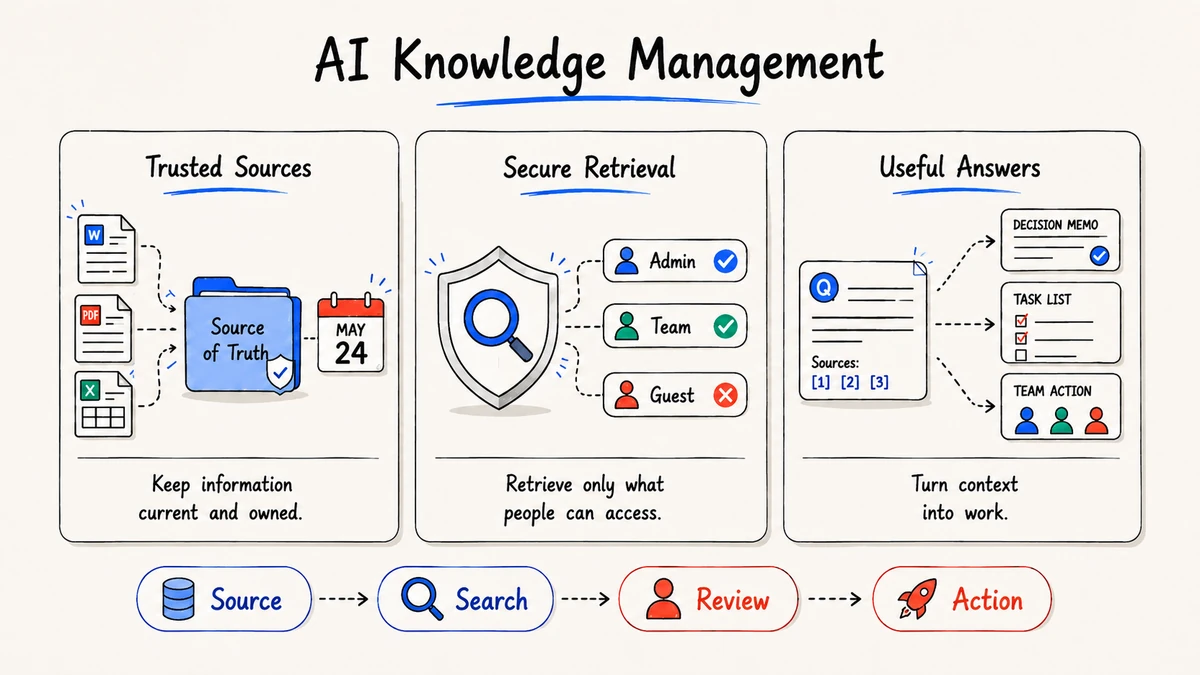
AI knowledge management combines searchable information with model-assisted retrieval, synthesis, and action. The goal is not to put every document in a chatbot; it is to help people find trustworthy context without weakening permissions or ownership.
Research and disclosure: Guidance reflects Microsoft grounding guidance, Google grounding concepts, Notion AI security information, and NIST AI risk management guidance, reviewed September 2, 2026.
Start with information architecture
Name the collections, owners, audiences, retention rules, and review dates. Archive duplicates and label drafts. Retrieval quality depends more on source structure and permissions than on a clever prompt.
Treat the collection as a product with a service owner. Publish a source-of-truth policy: which system wins when records disagree, how quickly corrections are applied, and where users report an answer that lacks evidence.
A trustworthy retrieval flow
Question -> permission check -> retrieve current sources -> cite passages
-> synthesize with uncertainty -> human review -> update the source record
Require the assistant to show where an answer came from and to say when no approved source answers the question. A confident uncited paragraph is not knowledge management.
Operating checklist
- Assign an owner to every critical collection.
- Keep effective dates and superseded versions visible.
- Apply access rules before retrieval, not after generation.
- Log corrections and unanswered questions.
- Review connector scopes and retention terms quarterly.
- Test with contradictory and sensitive documents.
From knowledge to action
The useful output may be a decision memo, project brief, support reply, or task list. Define who approves it and where the final record lives. Do not let a generated summary silently become policy.
Measure usefulness, not volume
Track time to a reviewed answer, repeated-question rate, citation corrections, and unanswered-question backlog. A larger index or more generated summaries is not evidence that the team can decide faster.
A rollout plan for a small team
Week 1: inventory
List the systems people already trust, the questions they repeat, and the documents that change often. Choose one collection with a clear owner and remove obvious duplicates before indexing anything.
Week 2: ground answers
Connect only the approved collection. Require citations, effective dates, and an explicit “not found” response. Ask a small group to test real questions, including questions they know the system cannot answer.
Week 3: add a deliverable
Turn a grounded answer into a brief, support reply, or task list with a named approver. Keep the generated draft separate from the source record until it passes review.
Week 4: measure and adjust
Review unanswered questions, stale sources, permission failures, and correction time. Improve the collection and retrieval rules before adding more connectors or autonomous actions.
Source lifecycle policy
Every critical page should have an owner, effective date, review cadence, and superseded version. When two systems disagree, document which one wins for each field. When a source is deleted or access changes, verify that cached indexes and generated summaries no longer expose it.
A useful answer contract
Ask the assistant to return the answer, source links, source dates, confidence, assumptions, and open questions. This makes a response useful to a reviewer and gives the team a consistent way to report retrieval failures.
FAQ
Is AI knowledge management the same as a company wiki?
No. A wiki stores and organizes information. AI can add retrieval and transformation, but it introduces probabilistic output and therefore needs evidence and controls.
How do I prevent data leaks?
Use least-privilege connectors, group permissions, redacted test data, and audit logs. Verify that retrieval respects the same access policy as the source system.
Should every document be indexed?
No. Index approved, useful, current material first. More documents can increase noise and expose content that should not be broadly searchable.
How do I prove value?
Measure search time, repeated questions, time to a reviewed deliverable, and correction rates for a defined workflow.