Technical Guide
GPT-6 Coding Review: Cross-File Bugs, Small Edits, and Real Tests
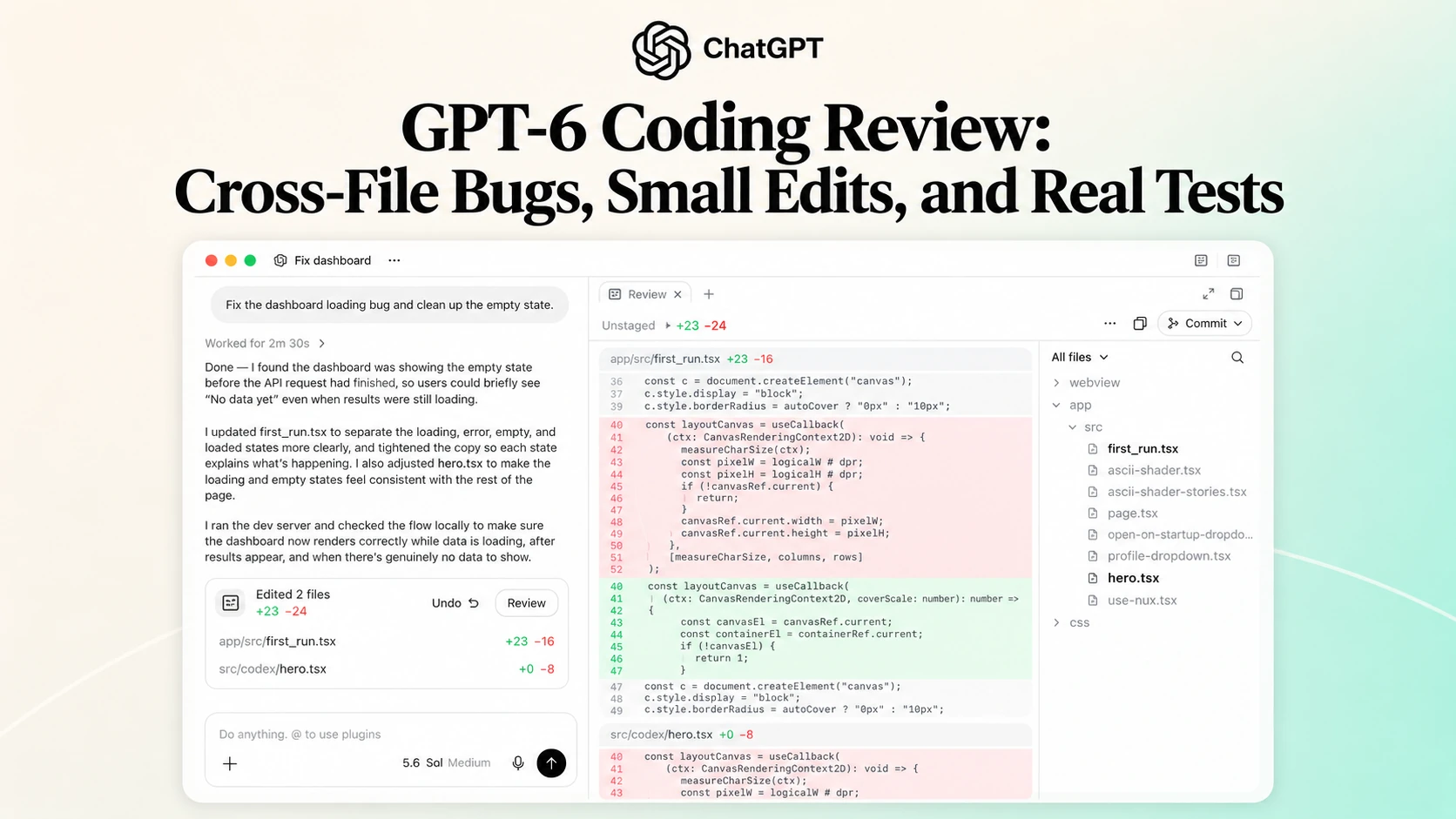
GPT-6 Astra's most interesting coding advantage is its ability to connect information across a codebase. Early tests suggest a larger benefit on difficult cross-file review than on simple edits. That makes it a candidate for investigating a change's consequences, while routine implementation still deserves a cost and speed comparison.
Two useful external evaluations ask different questions: CodeRabbit measures whether review findings catch labeled bugs, and Real Python checks behavior on five fixed prompts. Together they offer a more practical starting point than a single coding leaderboard.
Sources: CodeRabbit evaluation; Real Python tests; OpusBooster coding comparison. Reviewed September 7, 2026. Results and experiences are attributed to their authors below.
What CodeRabbit measured
In its September 4 evaluation, CodeRabbit reports the following actionable bug coverage:
| Review set | Astra | Sol | Difference |
|---|---|---|---|
| Overall | 61.3% | 59.0% | 2.3 percentage points |
| Harder cross-file subset | 57.1% | 47.6% | 9.5 percentage points |
The approximately 20% relative improvement on the harder subset is not a 20-percentage-point increase. Nor does it mean every team will ship 20% fewer bugs. The metric measures identified bugs in that evaluation, and the two rows represent different difficulty distributions.
The result supports testing Astra on changes whose consequences are spread across files. It does not establish that every review comment is correct, that all important bugs are found, or that small patches need the most expensive model.
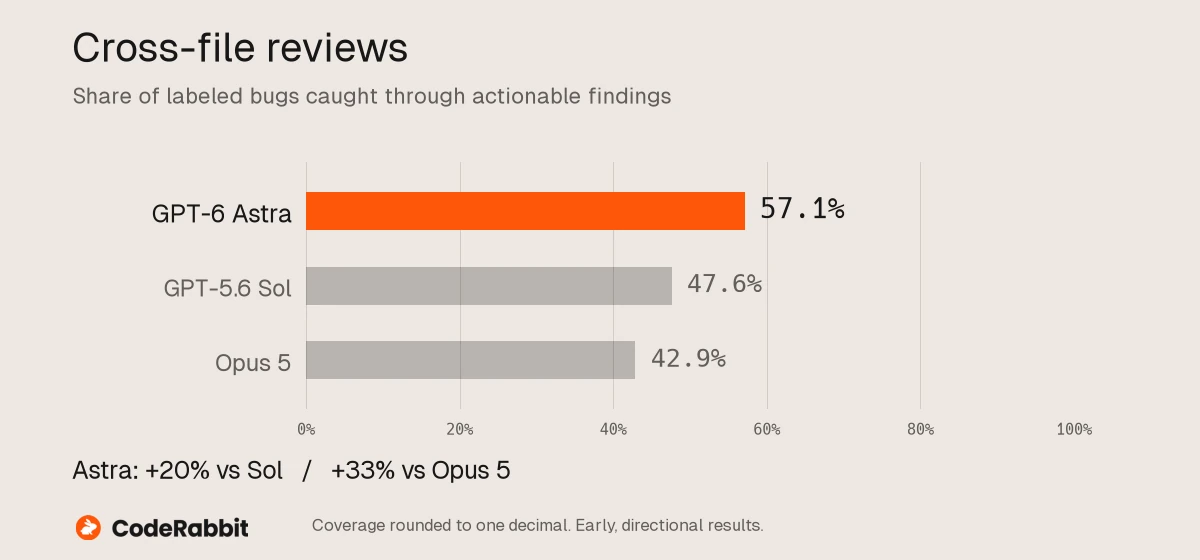
Cross-file review results published by CodeRabbit. Early findings, not a measure of overall review quality.
What Real Python tested
Real Python's five-prompt run used Astra through OpenRouter at default reasoning, with one attempt per prompt and no system prompt. It published outputs readers can inspect.
The model recognized that an invented standard-library function did not exist. On a small flag addition, it touched 11 lines against a seven-line minimum. The five tasks cost $0.31 in that run. These results provide a useful test shape: check invented APIs, patch size, and execution, rather than accepting code because it looks plausible.
A five-prompt sample cannot predict performance across your repository. It can, however, reveal the kinds of small behaviors a broad benchmark may overlook.
Why passing tests can miss the feature
A production-derived Astra-versus-Terra comparison found both implementations passed the existing suite, while one still mishandled related pagination state. Astra preserved the relationship and added a corresponding check.
The general lesson is to review the contract the task changes. Existing tests may never exercise the interaction that makes the new feature useful. Ask whether the tests cover the user's journey, not only the newly written function.
Read the patch behind a benchmark score
Real Python publishes the small-edit diff as well as its line count. The extra lines include formatting for the argument definition, so the difference from the minimum does not by itself demonstrate harmful over-engineering. The useful question is whether the patch changes behavior outside the request. Its real-work follow-up was still unfinished when checked, so the five fixed prompts should be evaluated on their own merits. See the test and patch.
This distinction matters when evaluating any coding agent. A longer patch can improve clarity, while a short patch can hide a compatibility break. Review what the added code does, which existing behavior it changes, and whether the new tests would fail without the fix.
Use benchmark results to select candidates, then inspect artifacts to decide whether their work fits your repository. Treat a product demo, a bug-coverage evaluation, and a fixed-prompt test as answers to different questions.
Worked example: review a shared pagination change
Consider an illustrative page with two independently paginated lists. A user moves the first list to page three and then advances the second list. The expected result is that the first list stays on page three. Each paginator can work correctly on its own while the combined behavior fails.
A reviewer should trace the URL builder, query parsing, component state, and browser navigation. If the new link contains only the second list's parameter, it may erase the first list's selection. A unit test of either paginator alone might miss that.
Initial URL: /results?customersPage=3&invoicesPage=1
Action: advance invoices to page 2
Expected: /results?customersPage=3&invoicesPage=2
Also check: reload, back navigation, and an invalid page value
This is the kind of relationship the OpusBooster case makes worth investigating. It is also a good reminder to write an acceptance example before implementation. The example gives both the agent and the reviewer a concrete target, while leaving room to use the repository's existing helper functions.
Separate finding coverage from review quality
A reviewer that catches more known bugs can still produce distracting false positives. Your local evaluation should record the findings a maintainer accepts, the findings they reject, and the time spent checking both. A vague concern without a trigger condition can cost more attention than it saves.
| Review outcome | What to record | Why it matters |
|---|---|---|
| Confirmed defect | Reproduction and affected behavior | Shows a useful finding |
| Incorrect finding | Why the code is valid | Measures review noise |
| Unresolved concern | Missing evidence or environment | Prevents uncertainty becoming a bug claim |
| Missed defect | Historical bug or later reproduction | Exposes coverage gaps |
Have a maintainer judge findings without seeing the model name when practical. Keep task difficulty visible: a small configuration change and a migration across several services should not be averaged into a single unexplained score.
Give the agent enough context to review consequences
Start with the change request and diff, then make affected callers and tests available. Include compatibility requirements that are easy to miss, such as an older API client, a persisted data format, or a public command whose output is parsed by scripts.
Avoid dumping unrelated repository material into the prompt. Ask the model to trace the affected paths and explain what it needed to read. That produces a more inspectable review and helps you notice when an important dependency was never considered.
For a shared type change, require checks of both producers and consumers. For a database migration, include the upgrade and rollback assumptions. For a user-interface change, name the state transitions the user expects. Our AI agent architecture guide covers how context and tools fit around the model.
Match testing to the change
OpenAI's GPT-6 prompting guidance notes that coding tasks can trigger more testing than a small change requires. Define the relevant verification before the run: the focused test, the behavior it proves, and the condition that would justify a broader suite.
A spelling correction and a shared authentication change need different validation. On a small patch, repeated full-suite runs may add little evidence. On a shared behavior change, one unit test may be insufficient. Ask the model to explain the scope of its checks in terms of affected behavior.
Start with the tests covering the changed behavior.
Run broader checks if the change affects a shared contract
or the focused result reveals a wider regression.
Report which behavior each check verifies.
If a check cannot run, provide its command and the blocker.
Do not let an agent make a failing suite green by weakening assertions unrelated to the requested behavior. Inspect deleted tests and changed expectations as part of the patch review. A passing status is useful only when the tests still express the intended contract.
Compare the cost of an accepted change
Record model usage, tool time, retries, and maintainer review time for each case. Then compare the cost of getting to an accepted patch. A cheaper first attempt can become expensive after two repair rounds; an expensive model can also waste time on an unnecessary redesign.
Use a small routing experiment: send difficult cross-file reviews to GPT-6 and keep routine patches on the current model. Expand only if accepted findings or reduced correction work justify it. Avoid transferring a win on code review directly to implementation, documentation, or visual design without testing those tasks separately.
Four cases for your own coding evaluation
| Case | Task | Acceptance check |
|---|---|---|
| Small edit | Add an option to an existing command | Existing output is unchanged when the option is absent |
| Cross-file change | Alter a shared data field | Every producer and consumer agrees on the new contract |
| Debugging | Investigate a reproducible failure | The fix resolves the reproduction and preserves nearby behavior |
| Review | Examine a historical buggy change | Findings identify real defects without speculative noise |
Use a clean starting snapshot for each candidate. Keep the same instructions, allowed tools, and task budget. Record the actual patch, test changes, reviewer corrections, and time to acceptance. For model-level tradeoffs, see GPT-6 vs GPT-5.6.
Code review prompt template
Review this change against its intended behavior: [goal].
Trace affected callers, data consumers, and error paths.
For each finding, provide:
- The concrete condition that triggers the bug
- The affected behavior and supporting file references
- A reproduction or a test that would expose it
Prioritize actionable defects. Mark uncertainty explicitly.
Do not edit files during this review.
Implementation prompt template
Implement [behavior] using the repository's existing patterns.
Read the relevant code and tests before choosing an approach.
Preserve [invariants and compatibility requirements].
Verify [specific user journey] as well as the focused tests.
Return the change, verification results, and remaining limitations.
Make the invariants concrete: keep the other filter selection, preserve existing command output, or avoid changing the public response shape. Specific constraints are easier to test than requests to "write production-quality code."
When the upgrade pays off
Try Astra when a task needs careful reasoning across several modules or when reviewer time dominates the cost. Keep a cheaper baseline for repetitive changes that are easy to verify. Avoid using the number of generated lines or comments as a productivity metric: unnecessary changes can increase review work.
For a mixed project involving research, requirements, and implementation planning, organize the brief and supporting material in Ottermind. Keep code verification in the repository and connect its results to the broader project decision.
FAQ
Is GPT-6 better at code review?
CodeRabbit's early evaluation found higher actionable bug coverage, with a larger advantage on its harder cross-file subset. Test the same behavior on your own code.
Does a higher score mean I can skip review?
No. Coverage remains incomplete, and a useful finding still needs validation before changing code.
Is Astra always best for a small patch?
The published evidence does not establish that. Compare patch correctness, unnecessary changes, speed, and cost.
What should I measure besides tests passing?
Check the feature contract, regression risk, removed coverage, reviewer corrections, and time to an accepted patch.
Where should developers start?
Use the task cases above, then consult the GPT-6 API guide for integration details.