Explainer
Context Engineering for AI Agents: A Practical Reliability Framework
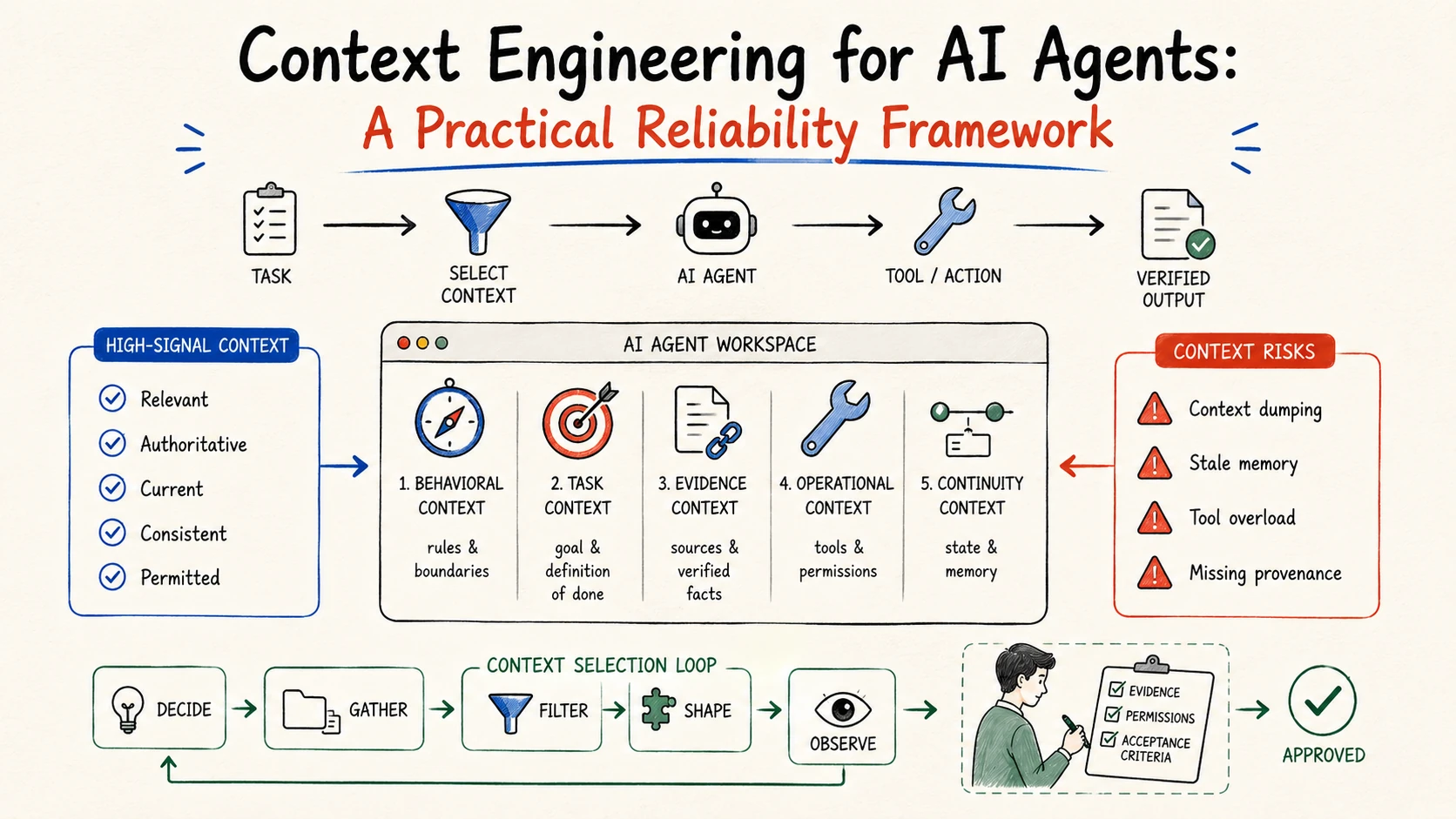
Context engineering for AI agents is the practice of deciding what information, instructions, tools, state, and memory an agent receives at each step of a task. The goal is not to fill the largest possible context window. It is to give the model the smallest sufficient set of high-signal context so it can choose the right next action and produce a verifiable result.
This guide is for teams designing or evaluating agents that research, analyze files, use tools, and create deliverables over multiple steps. It explains the difference between prompt and context engineering, introduces a practical context-selection framework, and includes a reusable brief for testing a real workflow.
Research and disclosure: Ottermind publishes this explainer. We reviewed primary guidance from Anthropic, LangChain, and the OpenAI Agents SDK, plus the Lost in the Middle research paper, on August 28, 2026. The five context layers, Context Selection Loop, worked example, and templates below are original editorial frameworks, not measured Ottermind benchmarks.
Why context engineering matters for AI agents
A one-shot model call has a relatively stable input: instructions arrive, the model responds, and the interaction ends. An agent changes the problem. It may search, read files, call tools, observe results, revise a plan, and continue for many turns. Every step creates more candidate context for the next step.
That growing pool can contain useful evidence, but it can also contain stale plans, duplicated tool output, failed attempts, conflicting instructions, or irrelevant history. Passing all of it forward is not neutral. It raises cost and latency, makes important evidence harder to find, and can steer the model toward an obsolete assumption.
Anthropic describes context as a finite resource with diminishing returns. Its guidance recommends finding the smallest set of high-signal tokens that still gives the model enough information to behave correctly. Research on long-context models supports the need for selection: the Lost in the Middle study found that models could perform worse when relevant information appeared in the middle of a long input, even when the full input fit within the advertised context window.
The engineering question is therefore not "How much can the model read?" It is:
What does the agent need to know for the next decision, where should that information come from, and what should be left outside the model context?
Context engineering vs. prompt engineering
Prompt engineering and context engineering overlap, but they operate at different scopes.
| Discipline | Primary question | Typical scope | When it changes |
|---|---|---|---|
| Prompt engineering | How should the task and behavior be expressed? | Instructions, examples, role, output format | When the task or desired behavior changes |
| Context engineering | What should the model see for this step? | Instructions, evidence, messages, tools, state, memory, permissions, and format | Before and between model or tool calls |
A prompt may tell an agent to create a sourced market memo. Context engineering determines which product documents, interview notes, search results, prior decisions, tool descriptions, and acceptance criteria are visible when the agent plans, researches, or drafts that memo.
Prompt quality still matters. The distinction is that an agent's context is dynamic. Search results arrive. Files change. A reviewer approves one option. A tool fails. A new constraint becomes relevant. Good context engineering updates the model-visible state without turning the entire task history into an undifferentiated transcript.
For a practical structure covering goals, input material, constraints, and acceptance criteria, use the Ottermind AI prompt guide. Context engineering begins where that initial brief meets a changing, multi-step workflow.
The five layers of agent context
Treating context as one large text block hides important ownership and lifecycle differences. A more useful model separates five layers.
| Context layer | What it contains | Example | Main failure risk |
|---|---|---|---|
| Behavioral context | System instructions, policies, boundaries, tool guidance | Cite material claims; do not publish without approval | Vague or conflicting rules |
| Task context | Goal, audience, deliverable, constraints, definition of done | Create a five-page market memo for a launch review | Activity without a stopping condition |
| Evidence context | Source files, retrieved passages, records, and source metadata | Current product docs and dated interview notes | Irrelevant, stale, or untraceable evidence |
| Operational context | Available tools, schemas, permissions, environment, and tool results | Search is allowed; CRM writes require approval | Too many tools or excessive permissions |
| Continuity context | Current plan, decisions, working state, summaries, and durable memory | Positioning option B was approved after review | Stale state treated as current truth |
The layers do not all belong in the model context in full. OpenAI's Agents SDK, for example, distinguishes local application context from LLM-visible context. User IDs, database connections, policy helpers, or secrets may be necessary for tools to operate but should not automatically be sent to the model.
That separation is both a quality and security control: keep operational dependencies in application state, then expose only the information the model needs to make the current decision.
The Context Selection Loop
The Context Selection Loop is an Ottermind editorial framework for deciding what an agent should see before each meaningful step.
1. Name the next decision
Do not assemble context for the whole project at once. Start with the decision immediately in front of the agent.
Examples:
- Which three sources should be trusted for the market definition?
- Is the available evidence sufficient to recommend a positioning direction?
- Which tool can extract the required fields without changing the source file?
- Does the draft satisfy the approved claims and format?
A precise decision makes relevance testable. If a context item cannot affect that decision, it may not belong in the next model call.
2. Gather candidate context by layer
Inventory candidate instructions, task requirements, evidence, tools, and state. Keep source metadata attached. A useful evidence item is not just a paragraph; it also includes where it came from, when it was published or retrieved, and whether it is authoritative for the claim.
Do not confuse retrieval with selection. Search can return twenty plausible pages. Context engineering decides which passages are relevant enough to enter the agent's working context.
3. Filter with five tests
Evaluate each candidate item against five questions:
- Relevance: Can this information change the next decision?
- Authority: Is this the right source for the claim or instruction?
- Freshness: Is it current enough for this task?
- Consistency: Does it conflict with a newer decision or stronger source?
- Permission: Is the model allowed to see and use it?
An item can be relevant but still fail the authority or permission test. A competitor's pricing summary is relevant to a comparison, but the current official pricing page is usually the stronger source. A customer record may be relevant to support work but inappropriate for an unrelated model call.
4. Shape the selected context
Selection chooses the material. Shaping makes it usable.
- Put the goal, constraints, and required output where they are easy to find.
- Label sources and separate evidence from instructions.
- Remove duplicated tool output and navigation noise.
- Summarize long histories while preserving approved decisions, unresolved questions, and source links.
- Use structured fields when the agent must compare or validate items.
- Isolate specialized subtasks when their evidence would distract the main task.
LangChain groups common context-engineering strategies into writing, selecting, compressing, and isolating context. These strategies are not competing choices. A long-running agent may write important state to durable storage, retrieve selected items for the next step, compress an old history, and isolate a specialist's work in the same run.
5. Observe and update
After the model or tool acts, inspect what changed.
- Did the result answer the current question?
- Did it introduce a new fact, decision, or conflict?
- Should any temporary context be discarded?
- What must be written to state or durable memory?
- What is the next decision?
This closes the loop. Context engineering is not an input-preparation task performed once. It is a control process that runs alongside the agent.
A worked example: research files to a decision memo
Consider a product team asking an agent to prepare a competitor decision memo. The source pack contains six product pages, three customer interview transcripts, an old strategy deck, a spreadsheet of feature requests, and notes from the latest roadmap meeting.
The weak approach is to attach every file and ask for a recommendation. The model may blend outdated strategy with current decisions, overweight repeated marketing claims, or omit the acceptance criteria entirely.
The context-engineered approach works in stages.
| Stage | Next decision | Selected context | Excluded or stored elsewhere | Visible output |
|---|---|---|---|---|
| Intake | What is the deliverable and source of truth? | Request, audience, decision deadline, acceptance criteria, file inventory | Full file contents | Task contract and source map |
| Evidence review | Which claims are supported? | Relevant current product passages, interview excerpts, roadmap decisions | Duplicate pages and superseded deck sections | Claim table with sources and conflicts |
| Analysis | Which options remain credible? | Approved evidence table, constraints, scoring method | Raw transcript chatter | Options with trade-offs and unknowns |
| Drafting | How should the decision be communicated? | Selected option, supporting evidence, audience, memo format | Rejected options except the decision record | Sourced memo draft |
| Review | Is the memo ready for use? | Draft, acceptance criteria, unresolved risks | Irrelevant research history | Validation report and revision list |
This example does not prove that one model or product will always perform better with this workflow. It shows how to make the agent's information environment inspectable. A real implementation should compare outputs on representative tasks and record accuracy, intervention count, latency, cost, and reviewer acceptance.
Context engineering best practices
Start with the smallest sufficient context
More context can help when it adds missing evidence. It can hurt when it adds distractors. Begin with the strongest model, a clear task contract, and the minimum evidence needed to attempt the step. Add information in response to observed failures rather than fear of omission.
Keep facts, instructions, and state separate
An instruction says what the agent should do. Evidence supports a claim. State records what has happened. Mixing them makes conflicts hard to resolve. Use explicit sections or structured records so the system can apply the right priority rules.
Preserve provenance through compression
Summaries save tokens but can erase uncertainty or attribution. A useful summary retains source links, dates, approved decisions, disputed points, and open questions. Do not compress "source A says X and source B disputes it" into "X is true."
Give tools narrow, useful contracts
Tool descriptions and results are part of the agent's context. Return only the fields needed for the task, use predictable schemas, and make errors actionable. A search tool that returns an entire HTML page creates more context-management work than one that returns a clean title, URL, date, and relevant excerpt.
Tool visibility is also a permission boundary. Show the model only the capabilities relevant to the current stage, and enforce permissions inside the tool or application rather than relying on prompt text alone.
Store decisions, not every token
Durable memory should preserve useful, correctable information: approved preferences, recurring constraints, final artifacts, and lessons with a source or date. Saving every interaction makes later retrieval noisy and can preserve mistakes as if they were policy.
Evaluate context changes with the same task
When testing a new retrieval rule, summary format, tool description, or memory strategy, hold the task and acceptance criteria constant. Compare the resulting accuracy, unsupported claims, tool choices, interventions, latency, cost, and reviewer acceptance. Otherwise, you cannot tell whether the context change improved the agent or merely changed the workload.
Common context engineering failures
Context dumping
The system forwards every message, file, and tool result. Important evidence competes with irrelevant history, while cost and latency grow.
Better: select context for the next decision and keep the complete record outside the model window.
Premature compression
The system summarizes before it knows which details will matter. Qualifications, source conflicts, and exact requirements disappear.
Better: preserve raw evidence until the decision is clear, then compress with provenance and open questions intact.
Stale memory
An old preference, price, plan, or product fact silently overrides current evidence.
Better: attach dates and source types, distinguish facts from preferences, and define when current evidence supersedes memory.
Tool overload
The model sees dozens or hundreds of tools with overlapping descriptions. It chooses an inefficient tool or constructs invalid arguments.
Better: expose a small stage-appropriate set, use distinct contracts, and keep permission enforcement outside the model.
Hidden state changes
The agent updates a plan, memory, or record without leaving an inspectable decision trail.
Better: record what changed, which evidence supported the change, and whether human approval was required.
No definition of done
The context contains abundant background material but no acceptance criteria. The agent continues researching or returns a polished answer that cannot be evaluated.
Better: name the deliverable, audience, required evidence, format, and stopping condition before execution begins.
A reusable context engineering template
Use this brief to design one agent step or a short multi-step workflow.
Task and next decision:
Complete [specific task]. The next decision is [decision the agent must make].

Definition of done:
- Deliverable: [artifact or action]
- Audience: [person or team]
- Required evidence: [sources or fields]
- Acceptance criteria: [quality and format checks]
- Stop or escalate when: [risk, missing evidence, or authority boundary]

Behavioral context:
- Follow [policies, source priorities, and constraints].
- Do not [invent, send, publish, purchase, delete, or change records].

Evidence context:
- Use [selected files, passages, records, or links].
- Treat [source] as authoritative for [claim type].
- Preserve citations and flag conflicts.

Operational context:
- Available tools: [small relevant tool set].
- Required permissions: [read, draft, write, approve].
- Return tool results as [schema or fields].

Continuity context:
- Current state: [completed steps and active plan].
- Approved decisions: [decision log].
- Open questions: [gaps that affect the next step].

After the step:
Return the result, sources used, assumptions, failed checks, state changes,
and the recommended next decision.
The template is intentionally explicit. Once a workflow is reliable, some fields can be generated from application state rather than repeated in model-visible text.
How to evaluate context quality
Do not evaluate a context strategy only by whether the agent produced an answer. Measure whether the answer can be trusted and used.
| Measure | Question |
|---|---|
| Task success | Did the output meet the acceptance criteria? |
| Evidence use | Are material claims traceable to the selected sources? |
| Tool efficiency | Did the agent choose valid tools without avoidable calls? |
| Intervention rate | How often did a person need to correct scope, facts, or actions? |
| Context efficiency | How much model-visible context was needed for an accepted result? |
| Continuity | Did the next step receive the approved decisions without stale noise? |
| Safety and permission | Did actions stay inside the allowed boundary? |
The correct target is not minimum tokens at any cost. It is the least context that reliably produces the required behavior for the task.
Start with one bounded agent task
Context engineering becomes concrete when you can inspect the inputs, decisions, tools, state, and output of a real task. Start with one bounded workflow such as turning a source pack into a research memo, campaign brief, report, or presentation. Define the acceptance criteria, run the Context Selection Loop at each stage, and compare the result with a prompt-only baseline.
For the broader execution model, read What Is an Agentic Workflow?. To see how memory, tools, review, and finished work fit inside a product category, compare the best AI agent workspaces. For research-heavy tasks, the AI research assistant guide explains what to check in retrieval, citations, analysis, and report creation.
In Ottermind, bring the source files, links, constraints, and required deliverable into one workspace. Ask for a source map and plan before drafting, review the evidence and direction, then continue into the report, page, or presentation that the task requires. The goal is not a larger prompt. It is a better-controlled path from context to completed work.