Explainer
What Is AI Agent Orchestration? How Agents, Tools, and People Coordinate
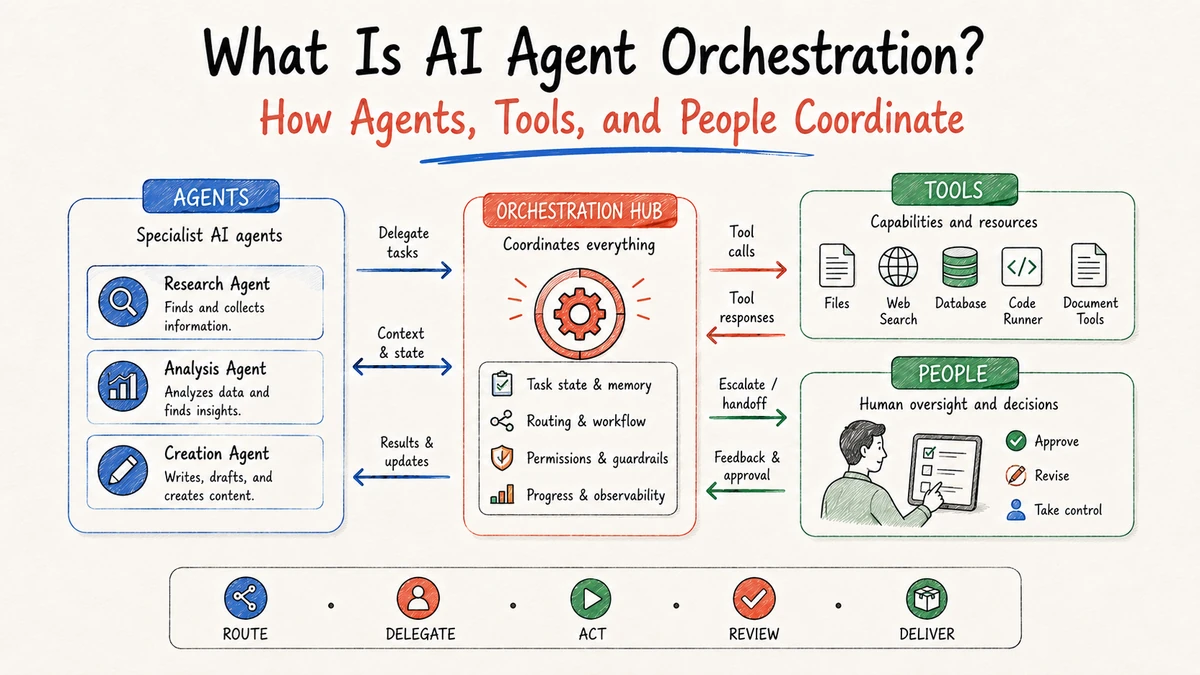
AI agent orchestration is the coordination layer that decides how a goal moves through agents, tools, data, and people. It assigns work, passes the right context, controls which actions are allowed, tracks progress, handles failures, and determines when a person must review or take over.
Orchestration can happen inside one agent or across many agents. The important feature is not the number of agents. It is whether the system has a reliable way to move from a request to a finished, reviewable outcome without losing context or authority between steps.
Research and disclosure: Ottermind publishes this explainer. We reviewed primary guidance from OpenAI, Anthropic, and Microsoft on August 27, 2026. The orchestration contract and launch example below are original editorial frameworks, not a measured Ottermind benchmark.
What does AI agent orchestration mean?
An AI agent can interpret a goal, choose an action, use a tool, observe the result, and decide what to do next. Orchestration governs how that loop fits into a larger piece of work.
Suppose a team needs a launch brief. A research agent can collect evidence, an analysis agent can compare positioning options, and a writing agent can draft the brief. But those capabilities do not automatically create a dependable process. Someone or something still needs to answer these questions:
- Which agent should work first?
- What sources and decisions should each agent receive?
- Can two tasks run in parallel, or does one depend on the other?
- Which tool calls are read-only, and which need approval?
- How are conflicting outputs reconciled?
- What counts as done, and who accepts the result?
The orchestration layer answers those questions. Depending on the design, it may be deterministic code, a manager agent, a graph of states and transitions, a queue of events, or a combination of these.
Orchestration is not the same as an agent
The terms are related but not interchangeable.
| Concept | Primary job | Example |
|---|---|---|
| Model | Generate, classify, reason, or evaluate | Compare two supported claims |
| Agent | Pursue a bounded goal and choose among allowed actions | Research a market question |
| Tool | Retrieve data or affect an external system | Search files, query a CRM, or create a deck |
| Workflow | Define the stages needed to reach an outcome | Research, approve direction, draft, and review |
| Orchestration | Coordinate execution, context, permissions, and handoffs | Route the request, run research in parallel, pause for approval, then resume |
A single agent with three tools still needs orchestration: it must select a tool, supply valid inputs, interpret the result, and stop safely. A five-agent system needs more orchestration because it also has to divide responsibility, transfer state, resolve overlap, and control cost.
For the broader execution loop, see What Is an Agentic Workflow?. To compare agents with simpler systems, read AI Agent vs. Chatbot vs. Automation.
The six parts of an orchestration system
Reliable orchestration makes six kinds of coordination explicit.
1. Goal and task state
The system needs a durable representation of the objective, current stage, completed work, open questions, and definition of done. Without task state, every agent receives an isolated prompt and the user becomes the integration layer.
State should record outcomes, not hidden reasoning. Useful records include the approved brief, source map, tool results, decisions, errors, artifact versions, and pending approvals.
2. Routing and delegation
Routing decides which capability should handle the next unit of work. Delegation defines that unit precisely.
A good assignment names the objective, trusted inputs, allowed tools, boundaries, output format, and completion criteria. “Research competitors” is vague. “Using the five supplied sites, produce a dated table of pricing, target users, and supported integrations; flag missing fields and do not infer them” is delegable.
Anthropic reports that unclear delegation caused research subagents to duplicate searches or leave gaps. The lesson applies beyond research: specialization only helps when ownership is distinct.
3. Tool access and execution
Tools connect the orchestration to files, search, databases, code, business applications, and artifact creation. Each tool needs a clear contract:
- what it does and does not do;
- required and optional inputs;
- the shape of a successful result;
- permissions and approval requirements;
- expected errors, timeouts, and retry behavior;
- whether the action is reversible.
Tool selection may be agentic, but permission enforcement should not depend on a model remembering a sentence. Apply access controls outside the prompt. An agent that needs to draft an announcement does not automatically need the ability to send it.
4. Context and handoffs
A handoff is more than naming the next agent. It transfers responsibility together with enough state to continue correctly.
Use a compact handoff contract:
| Field | Question it answers |
|---|---|
| Objective | What outcome now belongs to the receiver? |
| Inputs | Which sources, artifacts, and decisions are authoritative? |
| Completed work | What has already been checked or approved? |
| Open issues | What is missing, uncertain, or disputed? |
| Permissions | What may the receiver read, create, change, or request? |
| Expected return | What artifact or decision must come back, in what format? |
| Exit path | When should the receiver finish, retry, escalate, or hand off again? |
Passing the entire transcript is rarely the best handoff. It increases cost and can bury the current decision under obsolete discussion. Pass the smallest complete context, while retaining links to the underlying evidence.
5. Checks, recovery, and observability
The orchestrator must observe whether each step succeeded and decide what follows. Some checks can be deterministic: a file exists, required fields are present, a calculation balances, or a tool returned an error. Other outputs need rubrics, source verification, or human judgment.
Record agent runs, tool calls, handoffs, approvals, latency, token or compute use, and final outcomes. A final answer alone cannot show where a distributed task failed.
Recovery rules should distinguish between a transient tool error, an invalid input, insufficient evidence, a quality failure, and a permission boundary. Retrying the same action with the same input is not recovery.
6. Human participation
People are part of orchestration whenever they provide intent, resolve ambiguity, approve consequential actions, judge quality, or accept accountability for the outcome.
Human review should occur before the decision it can still change. Ask for positioning approval before producing five campaign assets, and require send approval before contacting customers. A useful checkpoint shows the proposed action, supporting evidence, expected effect, and available choices: approve, revise, reject, or take over.
Common AI agent orchestration patterns
OpenAI describes centralized manager and decentralized handoff patterns. Microsoft documents a wider set, including sequential, concurrent, handoff, group-chat, and manager-led orchestration. In practice, most useful systems combine patterns by stage.
| Pattern | How coordination works | Best fit | Main risk |
|---|---|---|---|
| Single agent with tools | One agent owns the task and selects tools | Bounded work with one coherent context | Tool confusion or an overloaded prompt |
| Sequential | Each step receives the prior step's output | Work with clear dependencies | Early errors propagate downstream |
| Concurrent | Independent tasks run at the same time | Broad research or independent checks | Duplicate work and conflicting state |
| Manager and workers | A central agent delegates and synthesizes | One user experience with specialist work | Manager becomes a bottleneck or weak synthesizer |
| Handoffs | Control moves between peer specialists | Triage and cases with clear ownership changes | Context loss or endless bouncing |
| Evaluator-optimizer | One step creates; another checks and returns feedback | Outputs with explicit quality criteria | Endless revision without an exit threshold |
| Group collaboration | Several agents contribute to shared state or discussion | Problems needing distinct perspectives | Conversation grows without a decision owner |
Start with one agent and a small, well-described toolset. OpenAI recommends expanding to multiple agents when instruction logic becomes too complex or overlapping tools remain difficult to select reliably. Adding agents before that point usually adds latency, cost, and more places for context to fail.
Centralized vs. decentralized orchestration
The most consequential architectural choice is often who owns the task at any moment.
Centralized: a manager keeps control
In a manager-and-workers design, one agent maintains the plan and user interaction. Specialists appear as tools: the manager calls them, receives their results, and synthesizes the final output.
Use centralized orchestration when the task needs one consistent voice, global priorities, or a single point that can compare all results. The manager should receive structured returns and retain authority to reject incomplete work.
The trade-off is concentration. A weak manager can decompose the task badly, overlook a specialist's caveat, or compress useful evidence into an unsupported conclusion.
Decentralized: specialists hand off control
In a handoff design, the current agent transfers execution and relevant context to another agent. This works well when ownership naturally changes, such as support triage moving a billing case to a billing specialist.
Use decentralized orchestration when the receiving specialist should interact directly with the user or control the next part of the process. Add limits that prevent circular handoffs, define who can close the task, and preserve a visible chain of responsibility.
Neither design is universally better. A launch workflow might use a central manager for research and synthesis, then hand the approved package to a publishing specialist while still requiring a human release decision.
A worked example: orchestrating a product launch package
Imagine a marketing lead requests a research memo, positioning recommendation, landing-page draft, and internal presentation. The team supplies product documentation, interview notes, competitor links, brand rules, and a deadline.
The orchestration contract
| Field | Definition |
|---|---|
| Outcome | A sourced, internally consistent launch package ready for review |
| Decision owner | Marketing lead |
| Orchestrator | Maintains the plan, shared context, dependencies, and status |
| Specialists | Research, positioning, copy, and presentation agents |
| Read tools | Supplied files, approved web sources, and prior project artifacts |
| Create tools | Evidence table, editable document, page draft, and slide deck |
| Prohibited actions | Invent evidence, contact customers, change product claims, or publish |
| Required gates | Source acceptance, positioning selection, and final release review |
| Done | Claims are traceable, artifacts use the approved direction, and open risks are listed |
The execution
- The orchestrator inventories inputs and asks the marketing lead to resolve two conflicting product claims.
- After the source of truth is recorded, customer and competitor research run concurrently with separate scopes.
- The orchestrator merges the evidence, removes duplicates, and sends a structured evidence pack to the positioning agent.
- The positioning agent returns two options, assumptions, and trade-offs. The marketing lead selects one and edits a claim.
- Copy and presentation agents work in parallel from the same approved brief. Neither can publish.
- An evaluator checks claim traceability, required sections, and consistency between artifacts. Failed checks return to the responsible specialist, with a maximum of two revision cycles.
- The orchestrator packages the outputs, change log, and open risks for final human review.
The agents provide specialized judgment. Tools retrieve evidence and create artifacts. Deterministic checks enforce contracts. The person supplies authority and preference. Orchestration keeps those contributions connected.
When should people enter the loop?
Use human involvement where context or consequence makes automated continuation inappropriate.
- Goal setting: a person defines the outcome, audience, constraints, and success criteria.
- Ambiguity: trusted sources conflict or the request supports materially different interpretations.
- Preference: the system can present valid options but cannot own the business choice.
- High-impact action: sending, publishing, purchasing, deleting, paying, or changing a system of record.
- Exception: the workflow reaches a state its tools, permissions, or policies cannot resolve.
- Acceptance: an accountable owner decides whether the deliverable is fit for use.
Do not turn every tool call into an approval. Excessive gates train people to click through without inspecting anything. Scope approval to the action that creates risk, preserve state at the pause, and resume without replaying completed work.
Why AI agent orchestration fails
Too many agents, too early
Specialists sound organized, but every additional agent creates another interface, context boundary, failure mode, and cost center. Use multiple agents only when specialization, isolation, or parallelism produces a measurable advantage.
Vague task boundaries
If two agents receive “analyze the market,” they may duplicate work and still miss a required question. Give each one exclusive ownership or define how overlapping results will be compared.
Shared state has no source of truth
Concurrent agents can overwrite or act on inconsistent state. Separate working copies, make authoritative fields explicit, and reconcile changes before downstream work begins.
Handoffs transfer conversation, not responsibility
A long transcript does not say what the next agent owns. Use an explicit handoff contract and include open issues, permissions, and exit conditions.
Tools are powerful but poorly specified
Similar tool names, unclear parameters, and broad permissions make incorrect actions more likely. Improve tool contracts before adding another routing agent.
No stop condition
Agents can keep searching, debating, handing off, or revising. Set budgets, retry limits, quality thresholds, deadlines, and escalation paths.
The system is visible only at the end
Distributed work needs traceable steps. Without tool results, handoff records, artifact versions, and approvals, a polished final output can hide a broken process.
How to design an orchestration system
- Define the outcome, accountable owner, and acceptance criteria.
- Map the current human process, including decisions and informal handoffs.
- Keep deterministic steps deterministic.
- Start with one agent and the fewest tools that can complete the work.
- Split agents only around distinct expertise, permissions, context, or parallel tasks.
- Give every delegation and handoff a structured contract.
- Store shared decisions and artifacts in inspectable task state.
- Place approval before consequential or representative actions.
- Define checks, budgets, retry limits, and escalation paths.
- Test components separately and the orchestration end to end.
- Measure accepted outcomes, not the number of agent actions.
Useful measures include completion rate, human correction rate, unsupported-claim rate, approval reversals, handoff count, repeated tool failures, latency, cost per accepted result, and the percentage of runs that escalate for the right reason.
Do you need an AI agent orchestration platform?
Not always. A small application can coordinate one agent and a few tools with ordinary code. A platform becomes useful when teams need durable task state, several tools or agents, resumable approvals, access controls, artifact management, tracing, evaluations, and repeatable handoffs across projects.
Evaluate the operating experience, not the architecture diagram:
- Can a person see what is happening and why the task paused?
- Are sources, decisions, intermediate work, and final artifacts connected?
- Can permissions differ by tool, agent, project, and action?
- Can the task resume after an approval or failure without starting over?
- Can owners correct shared context and replace stale decisions?
- Does the system show cost, errors, and outcomes across the full run?
The AI agent workspace guide compares products from the perspective of context, execution, review, and deliverables. For a practical first task, see How to Automate Tasks with AI.
Coordinate the work, not just the models
AI agent orchestration is successful when the whole task becomes more reliable, not when more agents appear in a diagram. The right design gives each agent a clear job, each tool a narrow contract, each handoff enough context, and each person meaningful control over decisions and consequences.
Start with one bounded outcome. Make state and evidence visible. Add parallelism or specialist agents only where they improve quality or time. Keep approval close to authority. That is how agents, tools, and people coordinate without turning flexibility into confusion.