Explainer
What Is Agentic AI?
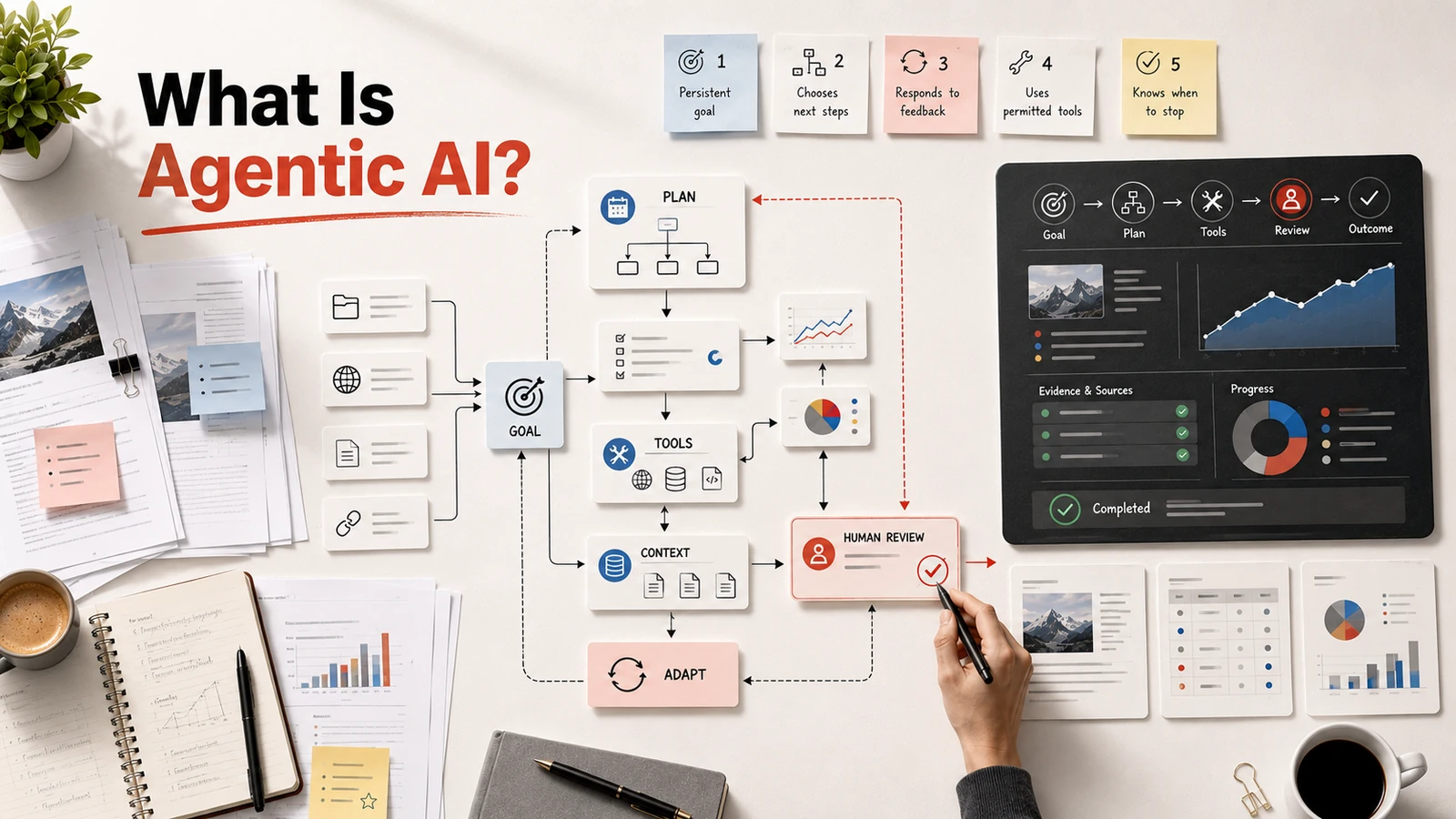
Agentic AI refers to AI systems that can pursue a goal with limited step-by-step direction. Instead of only producing a response, the system can decide what to do next, use permitted tools, observe the result, and continue or change course. Its agency is bounded: people still define the objective, available actions, approval points, and conditions for stopping.
The term is useful when it describes observable behavior. It becomes empty marketing when any chatbot, tool call, or long prompt is labeled agentic without showing what the system can decide and how its work is controlled.
Definition sources and product disclosure: Stanford HAI, Google Cloud, AWS, and Cisco describe agentic AI through goal-directed planning, action, feedback, and adaptation, although their category boundaries differ. Ottermind is an AI agent workspace and publishes this article; its inclusion below is a product disclosure, not an independent benchmark.
A plain-English definition of agentic AI
The word agentic comes from agency: the capacity to act toward an objective. Applied to software, it describes how much discretion a system has over the path between a request and a result.
Imagine two ways to prepare a market brief. In the first, a person asks an AI to summarize one source, then supplies the next source, asks for a comparison, corrects the structure, and finally requests a brief. The AI is useful, but the person operates the process.
In the second, the person supplies the objective, approved sources, constraints, and definition of done. The system inventories the material, identifies a missing fact, chooses an allowed research tool, prepares an evidence map, and returns a draft with unresolved questions. The system has agency over part of the route, while the person retains authority over the conclusion.
That distinction matters more than whether the product has a chat interface or calls itself an agent.
Agency is not the same as autonomy
The two words are often treated as synonyms, but separating them makes agentic AI easier to evaluate.
- Agency is the ability to make choices that move a task toward a goal.
- Autonomy is the degree to which those choices can be made and executed without human intervention.
A system can therefore be agentic without being fully autonomous. A research agent may choose which supplied document to inspect first but require approval before searching the public web. A coding agent may edit files and run tests but be unable to merge the change. A campaign agent may prepare assets but not publish them.
This is usually a strength, not a limitation. The useful design question is not “How autonomous is the AI?” It is “Which decisions benefit from AI discretion, and which decisions must remain with a person?”
Five tests for genuine agentic behavior
No single feature proves that a system is agentic. Use these five tests together.
1. Does the goal persist beyond one response?
The system should maintain a task objective while it works through intermediate steps. If every response ends the task and a user must restate what happens next, the experience is closer to a conventional assistant.
2. Can the system choose between valid next steps?
Agency requires some decision latitude. The system might choose which source to inspect, which tool fits a subtask, whether available evidence is sufficient, or whether it should ask a question. A fixed sequence can be valuable automation, but it is not agentic merely because AI appears in one step.
3. Does new information change its behavior?
An agentic system observes its environment through tool results, files, feedback, errors, or changing state. Those observations should be able to alter the route. Repeating the same failed action is not adaptation.
4. Can it affect work outside the model response?
Agentic systems commonly use tools to retrieve information, calculate, transform files, create artifacts, run code, or interact with another application. Tool access can be read-only or action-oriented. The important point is that the system can use an allowed capability as part of pursuing the goal.
5. Can it recognize completion, uncertainty, or a boundary?
The system needs a way to finish. It should be able to compare the current result with acceptance criteria, identify unresolved information, stop at a permission boundary, or escalate a decision. Activity without a stopping condition is not reliable agency.
What agentic AI is not
The category is easier to understand by removing several common misconceptions.
It is not consciousness or intention
An agentic system does not need human-like motives or self-awareness. “Goal” refers to an objective represented in software, and “decision” refers to selecting an action under instructions and constraints.
It is not simply a large language model
A model can provide language, reasoning, or multimodal capabilities, but the surrounding system supplies the goal, tools, state, permissions, and execution loop. Agentic behavior belongs to the complete system, not to the model name alone.
It is not every chatbot with tool access
A chatbot can search the web or retrieve a document while still relying on the user to direct the process turn by turn. Tool calling is one ingredient; continuing toward an outcome is the stronger test.
It does not require multiple agents
One bounded agent can display agency. Multiple specialized agents may help when work can be divided cleanly, but they also introduce handoff, conflict, cost, and evaluation problems. More agents do not automatically produce a better result.
It does not mean unattended execution
Agentic systems can run with different levels of supervision. Sending, publishing, purchasing, deleting, granting access, or changing an official record should be treated differently from reading a file or preparing a draft.
Agentic AI exists on a spectrum
“Agentic” is not a switch that turns on when software reaches a particular feature count. It is more useful to describe the degree and consequence of the choices a system can make.
| Level | What the system controls | Example | Human control |
|---|---|---|---|
| Response | The content of one answer | Summarize a supplied document | Person chooses every next step |
| Assisted action | One named tool or bounded operation | Search specified sources and return findings | Person defines the route |
| Bounded agent | Several steps within one task | Investigate a question and prepare a sourced memo | Person sets tools, limits, and acceptance criteria |
| Connected agentic work | Decisions across related artifacts | Carry approved findings into a brief and presentation | Person approves material decisions and final outputs |
| Consequential execution | Actions that affect people or systems | Send, publish, purchase, delete, or update records | Explicit authorization, auditability, and recovery are required |
The highest level is not inherently the best. The right level is the minimum agency needed to handle the variability of the task. Predictable steps should remain deterministic when possible.
How related terms fit together
Agentic AI is often confused with the software components and environments used to implement it.
| Term | Role |
|---|---|
| Agentic AI | The broader approach of giving AI bounded agency toward a goal |
| AI agent | A software actor with an objective, instructions, context, and tools |
| Agentic workflow | The process that connects agent decisions with fixed steps, checks, and human review |
| AI agent workspace | The environment where context, tools, agents, artifacts, and follow-up work remain connected |
This article owns the definition of the category. For the detailed execution model, including planning, memory, tool use, workflow patterns, and review gates, read What Is an Agentic Workflow?. For the practical differences between an agent, a chatbot, and fixed automation, use AI Agent vs Chatbot vs Automation. To compare products rather than concepts, see Best AI Agent Workspaces.
Examples of agentic AI
The same definition can apply across very different kinds of work.
- Research: decide which approved sources address a question, identify contradictions, and prepare a cited memo with open issues.
- Software development: inspect a repository, select relevant files, implement a bounded change, run checks, and report the diff for review.
- Customer service: gather account context, interpret a request, consult policy, propose a resolution, and escalate exceptions outside its authority.
- Operations: monitor changing inputs, evaluate permitted alternatives, and prepare or execute the next allowed action.
- Knowledge work: turn files, notes, and links into connected artifacts that share the same approved facts and decisions.
These examples become credible only when the claimed action can actually be observed. “Can write a support reply” and “can resolve a support case” are not the same capability.
How to evaluate an agentic AI claim
Product pages often use the same words for systems with very different behavior. Before accepting an “agentic” label, ask:
- What goal survives between steps? Look for a task state, not just conversation history.
- Which decisions can the system make? The answer should be more specific than “it reasons.”
- Which tools and data can it access? Separate available capabilities from granted permissions.
- What observation can change its plan? Ask how errors, missing information, and reviewer feedback affect the next step.
- What evidence does it leave? Sources, artifacts, action logs, test results, and unresolved risks are more useful than a completion message.
- Who decides that the work is acceptable? The system may detect completion, but a responsible person should own consequential acceptance.
- How can it be stopped or corrected? Check step limits, approvals, cancellation, rollback, and memory correction.
This test avoids two opposite mistakes: dismissing all agentic AI as marketing, or assuming every agentic product can complete work safely because it produced a convincing demo.
Why agentic AI matters
Generative AI reduced the effort needed to create an individual output. Agentic AI aims at a different cost: the coordination required to move between outputs, tools, decisions, and handoffs.
That can be valuable when a task has variable inputs and a stable desired outcome. A person can specify the destination and review the important decisions without manually operating every intermediate step. Context can also remain attached to the work as one artifact becomes the input to another.
The trade-off is a larger failure surface. An error can travel through several steps; a tool can turn a bad suggestion into a bad action; stale memory can influence later work; and a polished deliverable can hide weak evidence. Agentic AI therefore increases the importance of permissions, provenance, evaluation, and clear ownership.
McKinsey describes the opportunity as moving from systems that mainly chat to systems that act across workflows. Anthropic offers a useful engineering counterweight: start with the simplest design that works and add agentic complexity only when it improves outcomes. Both points matter. Acting is the opportunity, and unnecessary autonomy is the risk.
How Ottermind fits
Ottermind is an AI agent workspace for work that begins with a goal, files, links, notes, and project context, then needs to become a usable deliverable. The agentic value is not simply generating more text. It is keeping the task objective and source material connected while work progresses into research, a brief, a report, a presentation, or a follow-up task.
The person remains responsible for the source of truth, permissions, important judgments, and final use of the result. Start with a bounded task and a reviewable artifact rather than granting broad action rights. The practical implementation is covered in How to Automate Tasks with AI.
Frequently asked questions
Is agentic AI a model?
Usually not. A language or reasoning model may power decisions, but an agentic system also needs instructions, state, tools, an execution loop, and controls. The behavior comes from how those parts are assembled.
Is agentic AI the same as autonomous AI?
They overlap, but autonomous emphasizes how independently a system operates. Agentic emphasizes its ability to choose actions toward a goal. A system can be agentic while still requiring approval for important steps.
Does agentic AI learn by itself?
Not necessarily. A system can adapt its plan during one task without permanently learning from that experience. Updating long-term memory, models, or policies is a separate capability that needs its own controls.
Does agentic AI require an LLM?
No in the broad history of AI agents, but many current agentic products use foundation models because they help interpret natural-language goals, handle varied inputs, and select tools. Other models and deterministic software can participate in the same system.
Can agentic AI work without tools?
It can show limited agency by planning or revising an answer, but tools make the distinction more meaningful because they let the system observe information and affect work beyond a single response.
Bottom line
Agentic AI is best understood as bounded decision-making in pursuit of a goal. The defining question is not whether software calls itself an agent, but whether it can maintain an objective, choose among allowed actions, respond to new information, and stop with evidence that a person can review. Useful agency reduces coordination. Reliable agency keeps authority, limits, and accountability visible.
Sources
- Stanford HAI: What is agentic AI?
- Google Cloud: What is agentic AI?
- IBM: What is agentic AI?
- AWS: What is agentic AI?
- Cisco: What is agentic AI?
- Microsoft: What is agentic AI?
- McKinsey: Agentic AI explained
- Anthropic: Building effective AI agents
- OpenAI: A practical guide to building agents
- HIX AI: What Is Agentic AI?