Review
Skywork AI Review 2026: Powerful Output, Serious Billing Concerns

Skywork AI looks strongest when a user needs a research-heavy first draft of a presentation, document, spreadsheet, or website. Public reviewers often praise its structure, breadth, and ability to turn scattered material into a usable artifact. The buying risk is separate: credit consumption, subscription renewal, cancellation, refunds, and support dominate negative feedback. Test one representative job before paying annually.
Verdict first
Skywork is worth a controlled trial for consultants, researchers, marketers, educators, and small teams that regularly turn source material into presentations or other structured deliverables. Its appeal is not a single model. It is the combination of research, specialized agents, editing surfaces, and multiple output formats in one workspace.
Do not treat a polished result as verified research, and do not choose a paid plan from the headline price alone. The public evidence points to two different experiences: users can like the work Skywork produces while strongly disliking how credits, renewals, cancellation, refunds, or support behave.
Our verdict is therefore conditional: promising for bounded artifact creation, but unsuitable for an unattended or cost-sensitive workflow until you have verified output quality, credit usage, export behavior, and the exact subscription terms shown at your checkout.
What Skywork AI is
Skywork describes itself as an all-in-one AI workspace. Its current mobile listings include AI Slides, Documents, Sheets, Chat, Images, Videos, Podcasts, VoiceNote, scheduled tasks, reusable Skills, and the SkyClaw cloud agent (Google Play, App Store). The web product also promotes research, websites, and long-running work.
That puts Skywork in the same broad category as Manus and Genspark rather than a design-only presentation maker. A user starts with a goal or source material, the system researches or processes it, and a specialized agent produces an editable artifact. This distinction matters: the product is trying to reduce the handoffs between research, drafting, formatting, and delivery, not merely provide another chat response.
Skywork also publishes open-weight AI models. This Review covers the consumer and professional workspace at skywork.ai, not the Skywork model family or API performance.
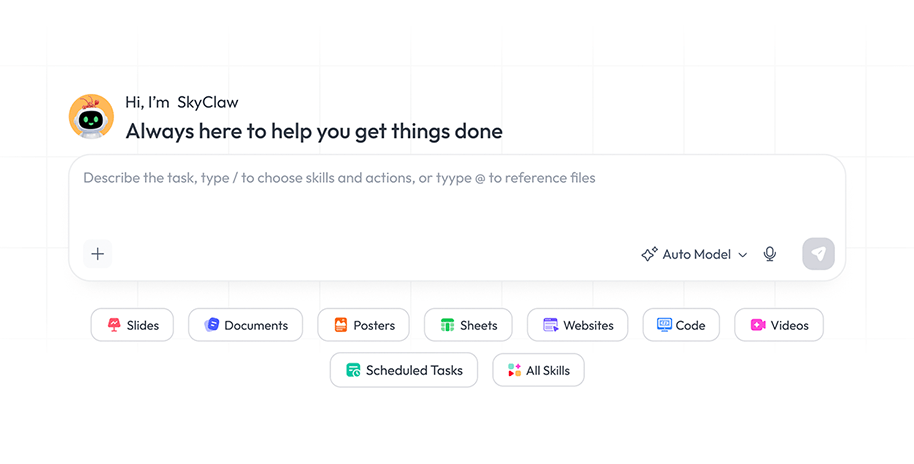
Official product image: Skywork homepage OpenGraph image, accessed August 28, 2026. The interface and available agents may change.
How this Review was researched
This is a public-evidence Review, not a claim that Ottermind personally tested every Skywork feature. Research was completed on August 28, 2026, using:
- Skywork's product pages, mobile listings, membership documentation, and terms
- Current US App Store, Google Play, and Trustpilot aggregates
- Individual written reviews from multiple countries and purchase channels
- Professional reviews that disclose their test scope
- Community discussions about slides, research, credits, cancellation, and support
Ratings are snapshots, not permanent scores. Written reviews are self-selected experiences and do not establish a platform-wide failure rate. Professional tests may also reflect a particular plan, prompt set, product build, and editorial incentive. We use each source for what it can support rather than combining them into a made-up universal score.
What reviewers like about Skywork
Research and structure are the clearest strengths
Positive reviewers repeatedly describe Skywork as useful for organizing an underdeveloped idea into a more professional structure. The current US App Store includes praise for output quality and integrations, while reviews in other markets mention effective spreadsheets and help turning scattered ideas into an actionable project.
An eesel AI Review highlights research-heavy slides as Skywork's strongest surface: the system can combine source discovery, charts, and a full deck rather than only decorate an outline. The same Review notes a practical tradeoff reported by community users: structured, evidence-led slides may be more useful for academic or analytical work but less visually polished than a design-first presentation product.
That pattern is credible because it matches the product design. Skywork's official Slides page emphasizes generated structure, editable slides, and research-supported business, academic, and investor presentations. The useful buyer question is not “Can it make slides?” It is “Does its first draft reduce enough research and formatting work to justify verification and revision time?”
Multiple formats can reduce handoff work
Reviewers also value moving from one source set into several formats. A research brief may become a document, deck, sheet, or website without rebuilding the context in a different application. A disclosed 18-day professional test by Upstream found value in document-to-slide-to-sheet workflows, while also reporting that one postmortem draft invented an unstated root cause.
This is the central benefit and limitation in one example. Cross-format continuity can save time, but continuity also spreads an unsupported assumption into more outputs unless a person checks the evidence before reuse.
Specialized agents make the product easier to approach
Skywork separates Slides, Documents, Sheets, Websites, Images, Video, and other jobs instead of asking users to select a model and assemble every tool themselves. For non-technical users, choosing the intended deliverable can be easier than designing an agent architecture.
The workspace model is most valuable when the task has clear source material, a defined audience, and an inspectable output. For a broader selection framework, compare the best AI agent workspaces by context, execution, repeatability, reviewability, role fit, and handoff.
What users complain about most
Credit usage can make revision costs unpredictable
Credit consumption is the most consistent product-value complaint. Users do not only object to the existence of credits; they object when an apparently small correction consumes more credits, a generation ends without an acceptable file, or the allowance disappears before one deliverable is ready.
Written App Store reviews in France and Germany describe repeated corrections consuming the available balance without producing an acceptable final file. Google Play and Trustpilot reviews report similar frustration with incomplete tasks, repeated errors, and unclear credit economics. These reports do not prove that every task behaves this way, but they identify the correct unit of evaluation: credits per accepted and exported deliverable, not credits per prompt.
Professional tests show why a single estimate is unreliable. Upstream reported roughly 20–40 credits for a document draft and about 230 credits for one combined deck, sheet, and landing-page run on the product build it tested. Those figures should not be treated as a current price guarantee; task type, model, plan, revisions, and product changes can alter consumption.
Billing, cancellation, and refunds are the largest trust concern
As of August 28, 2026, Skywork's Trustpilot profile showed 1.3/5 from 60 reviews. Trustpilot also warned that the company had no history of requesting reviews and that the sample might not be representative. Even with that limitation, the concentration of complaints is hard to ignore: trial conversion, annual charges, difficulty locating cancellation, refund denials, and slow or unsuccessful support contact appear repeatedly (Trustpilot).
Google Play displayed 3.4/5 from about 1.22K reviews on the same date. The visible recent reviews similarly focused on renewal, cancellation, and refunds. Skywork's official terms confirm that trials may convert automatically and subscriptions renew unless cancelled. The newer Terms of Service list the account dashboard, the original purchase platform, or feedback@skywork.ai as cancellation paths; an app-focused terms page directs App Store and Google Play subscribers to cancel at least 24 hours before renewal and request refunds through Apple, Google, or Stripe.
The responsible conclusion is not that every charge is unauthorized. It is that purchase channel, renewal date, plan term, and refund route require unusually careful verification before payment.
Support feedback compounds billing problems
A weak support experience matters more when credits or renewal are disputed. Some reviewers report quick initial replies, but many describe unanswered emails, templated responses, or cases that remain unresolved after escalation. Individual accounts cannot establish the normal response time. Their repetition across Trustpilot, Google Play, and Reddit does make support responsiveness a legitimate purchase criterion rather than a side issue.
First-draft quality does not guarantee revision stability
Public feedback is more positive about initial structure than iterative correction. Users report repeated errors, instructions that are not carried through, or regenerated work changing more than requested. This is common enough in generative systems that buyers should test the actual revision loop, not only the first impressive output.
For presentation work, inspect the editable and exported file. Verify citations, chart values, typography, element placement, speaker notes, and whether a small correction preserves the rest of the deck. The best AI presentation makers guide explains why research quality, design quality, editability, and export fidelity should be evaluated separately.
Why the public ratings conflict
The three most visible rating surfaces told very different stories at research time:
| Surface | Rating observed August 28, 2026 | Sample | Dominant visible themes |
|---|---|---|---|
| US App Store | 4.5/5 | 51 ratings | Output quality, integrations, broad workspace value |
| Google Play | 3.4/5 | About 1.22K reviews | Mixed product feedback; recent cancellation and refund complaints |
| Trustpilot | 1.3/5 | 60 reviews | Billing, cancellation, refunds, credits, and support |
These numbers should not be averaged. App stores include many people rating the mobile experience, while Trustpilot often attracts users motivated by a service or billing dispute. Samples also differ by country, date, purchase channel, and moderation system.
The defensible finding is narrower: Skywork has credible positive evidence for artifact creation and credible negative evidence for commercial experience. A buyer needs to evaluate both.
Skywork pricing is harder to summarize than it should be
Skywork's public surfaces describe several overlapping offers. The official Slides landing page displayed a monthly option at $16.99 and an annual option at $149.99, with 7,000 credits per month, at research time. A separate membership guide describes Free, Basic, and Plus plans associated with Skywork Note, including 15,000 or 28,000 monthly membership credits and different feature limits. The company's affiliate page cites still other annual purchase amounts for Basic, Plus, and Ultra.
These may represent different products, bundles, promotions, regions, or sales channels. They should not be collapsed into one pricing table. Check the live screen that applies to your account and record:
- Whether the amount is monthly or paid annually upfront
- Which plan activates after a trial
- The monthly credit allowance and expiration rules
- Which actions consume credits, including corrections and failed tasks
- The renewal date and exact cancellation path
- The refund policy for the payment channel
- Export formats, commercial-use terms, storage, and model access
Price Skywork using a complete job: source collection, first draft, corrections, fact-checking, export, and human cleanup. A low subscription price can still be poor value if the accepted file requires several paid generations.
Who should consider Skywork?
Skywork is a reasonable trial candidate for:
- Consultants and analysts creating research-led client drafts
- Researchers and educators turning source material into structured presentations
- Marketers producing briefs, reports, decks, and supporting assets
- Founders who value one workspace for several artifact types
- Small teams willing to keep a human reviewer in the delivery process
The best starting task is bounded and reversible: use non-sensitive source material, request one concrete deliverable, define acceptance criteria, and track every regeneration. For research-heavy work, use the same source-checking discipline described in the AI research assistant comparison.
Who should skip or delay it?
Delay a paid commitment when you need:
- Predictable cost for frequent micro-revisions
- Unattended production workflows with contractual reliability
- Fast, dependable support for billing-critical operations
- A procurement-ready security and governance package you have not verified
- Guaranteed factual accuracy without human review
- Guaranteed export fidelity without testing the final external file
Teams handling confidential, regulated, customer, or employee data should complete their own security, privacy, retention, subprocessor, data-residency, and contractual review before uploading it. A mobile-store privacy label or vendor statement is not a substitute for organizational due diligence.
A safer way to evaluate Skywork
- Choose one real task with known source material and a clear acceptance checklist.
- Start with the lowest-risk plan that does not require a large prepaid commitment.
- Save the checkout screen, plan name, renewal date, refund terms, and credit balance.
- Track credits used for the first draft, every correction, and the final export.
- Verify claims and citations against the original sources.
- Open the exported PPTX, PDF, spreadsheet, or website outside Skywork.
- Confirm the cancellation route well before the renewal deadline.
- Compare total human correction time with the workflow you already use.
This turns an emotional “Is Skywork good?” decision into an observable cost-and-output test. The same method works for any agent workspace: define the task, preserve the evidence, measure the accepted deliverable, and keep a human review gate. See how to automate tasks with AI for a broader workflow.
Skywork versus common alternatives
| Tool | Natural fit | Main decision question |
|---|---|---|
| Skywork | Research-led slides and multi-format first drafts | Are credit usage, revisions, billing, and support acceptable for your workflow? |
| Genspark | Broad research and artifact generation | Does its workspace and output mix fit better than Skywork's research-led structure? |
| Manus | General-purpose cloud agent execution | Do you need autonomous actions more than a specialized artifact suite? |
| Gamma | Design-first presentations and lightweight pages | Is visual iteration more important than deep research and multi-format work? |
| Ottermind | Connected project context and reviewable deliverables | Does the work need to continue across research, files, tasks, and outputs? |
This is category guidance, not a controlled benchmark. Ottermind publishes this Review and competes in the adjacent AI workspace category. For direct product positioning, see the existing Genspark alternative and Manus alternative pages.
Final verdict
Skywork appears capable of producing useful research-led drafts across presentations, documents, spreadsheets, websites, and other formats. Positive reviews support the product's core idea: it can organize source material and reduce the friction between research and artifact creation.
The commercial experience is the reason for caution. Credit burn, plan complexity, automatic renewal, cancellation, refunds, and support recur too often in public feedback to dismiss. Skywork may still be worth using, but the correct buying sequence is trial, measure, export, verify, then commit.
If your immediate task is a source-grounded deck, build and review an AI presentation in Ottermind while keeping the research, files, revisions, and final deliverable in one project.
Sources and disclosure
This Review synthesizes Skywork's official product pages and terms, professional evaluations, mobile-store ratings, Trustpilot, and public community discussions accessed on August 28, 2026. The cover is an editorial illustration supplied for this article; the product image in the body is the official OpenGraph image published by skywork.ai. Ottermind did not conduct a hands-on Skywork test for this article, does not claim that individual reviews represent all users, and did not calculate a cross-platform score.
Ottermind publishes this article and operates in an adjacent AI workspace category. No Skywork sponsorship, affiliate relationship, or paid placement is implied. Product capabilities, prices, credits, promotions, ratings, review counts, and policies are time-sensitive and should be rechecked before publication or purchase.