Selection Guide
8 Best AI Agent Platforms and Open-Source Frameworks in 2026
The search for open-source AI agents hides different needs: a managed workspace that helps people finish work, a developer framework for building agents, or an orchestration layer for running agents in production. Comparing those categories as if they were interchangeable creates bad recommendations.
This guide puts Ottermind first as the managed, outcome-oriented option, followed by seven open-source projects. It compares what each option helps you accomplish, how much infrastructure it leaves to your team, and which production questions must be answered before deployment.
Research and disclosure: Selections are based on official project documentation and a September 1, 2026 DataForSEO review of the US English queries "open source AI agents" and "open source AI agent framework." Search demand rose sharply in the latest available month. GitHub popularity and vendor claims were not treated as proof of production reliability.
AI agent platforms and open-source frameworks: quick comparison
| Project | Category | Best for | Main tradeoff |
|---|---|---|---|
| Ottermind | Managed AI agent workspace | Connected context, tools, human review, and finished deliverables | Not an open-source framework or self-hosted runtime |
| CrewAI | Multi-agent framework | Role-based teams and task flows | Multi-agent designs can add cost and coordination failure |
| Microsoft Agent Framework | Agent and workflow SDK | Microsoft-oriented enterprise development | Ecosystem and APIs continue to evolve |
| Semantic Kernel | Model orchestration SDK | Plugins and agents in .NET, Python, or Java | More framework than finished agent product |
| Pydantic AI | Typed Python agent framework | Structured outputs and testable Python apps | Team builds the surrounding product and infrastructure |
| OpenHands | Software-development agent | Repository tasks in controlled runtimes | Code execution creates a broad security boundary |
| OpenCode | Coding agent | Terminal, IDE, and desktop coding with model choice | Best for coding, not general business workflows |
| n8n | Workflow automation platform | Self-hosted agents connected to business systems | Visual workflows still need governance and maintenance |
Managed workspace, framework, runtime, or finished agent?
Before evaluating projects, classify the desired result:
- A framework supplies abstractions for models, tools, state, and agent loops.
- An orchestrator makes branching, persistence, retries, and human checkpoints explicit.
- A finished agent gives users an interface and a defined job, such as coding.
- A workflow platform connects agent decisions to deterministic app actions.
- A managed agent workspace connects context, tools, review, and deliverables without requiring a team to build the agent infrastructure first.
Open source does not mean zero cost or no lock-in. Model APIs, vector databases, browsers, sandboxes, observability, hosting, and engineering time may dominate the total cost. A permissive code license also does not grant rights to every model, dataset, connector, or hosted service used with the project.
1. Ottermind: best for connected context and finished deliverables
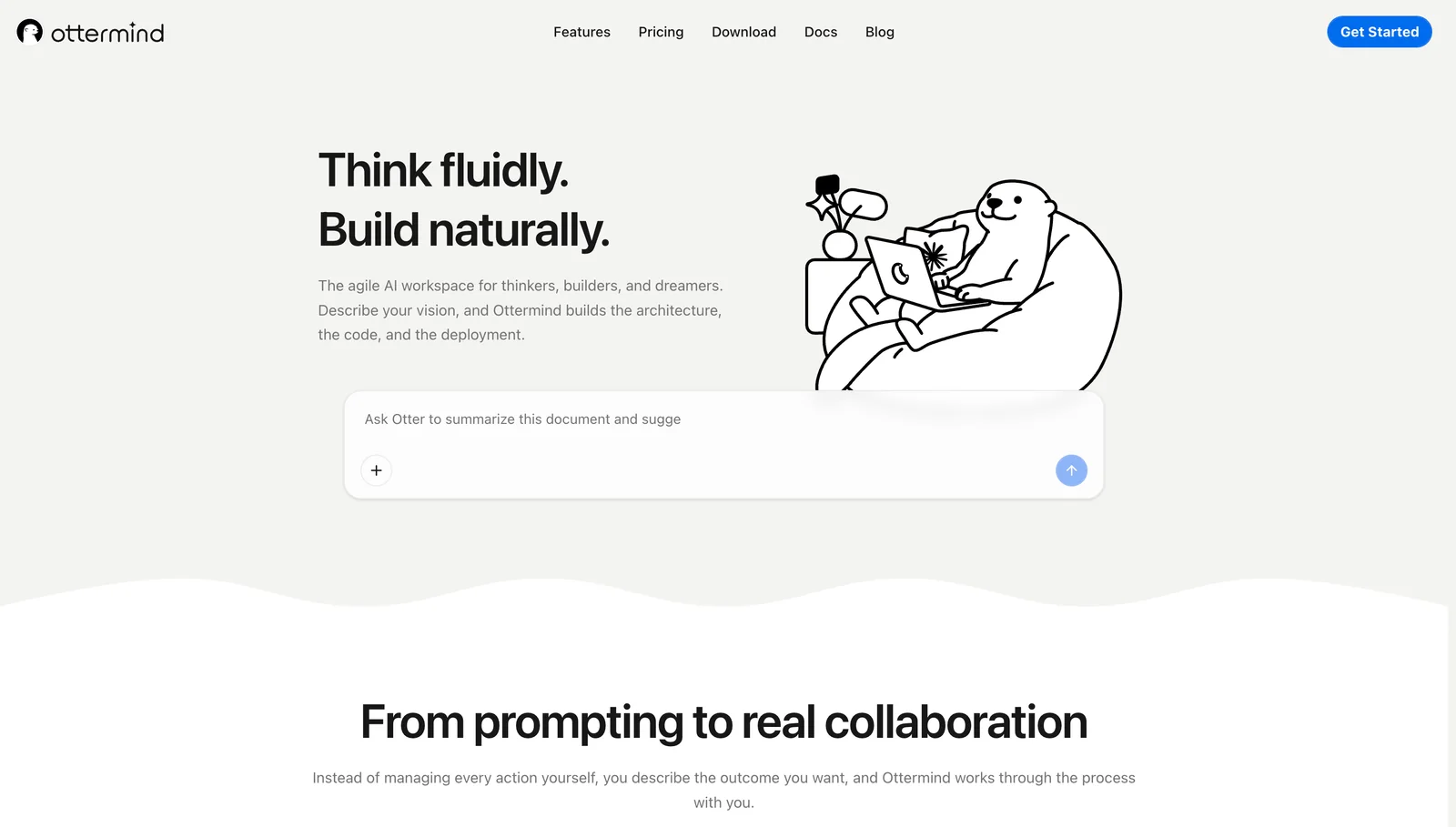
Ottermind is the first choice for teams that want agents to complete real project work without building the runtime, orchestration, storage, evaluation, and user interface around them. Files, links, notes, requirements, tools, and related tasks stay connected as the work moves toward a reviewable result.
Choose Ottermind when the output should be research, a report, presentation, plan, website, or follow-up task rather than agent infrastructure. It is not an open-source framework or self-hosted runtime. People remain responsible for source verification, permissions, consequential actions, and final approval.
2. CrewAI: best for role-based multi-agent workflows
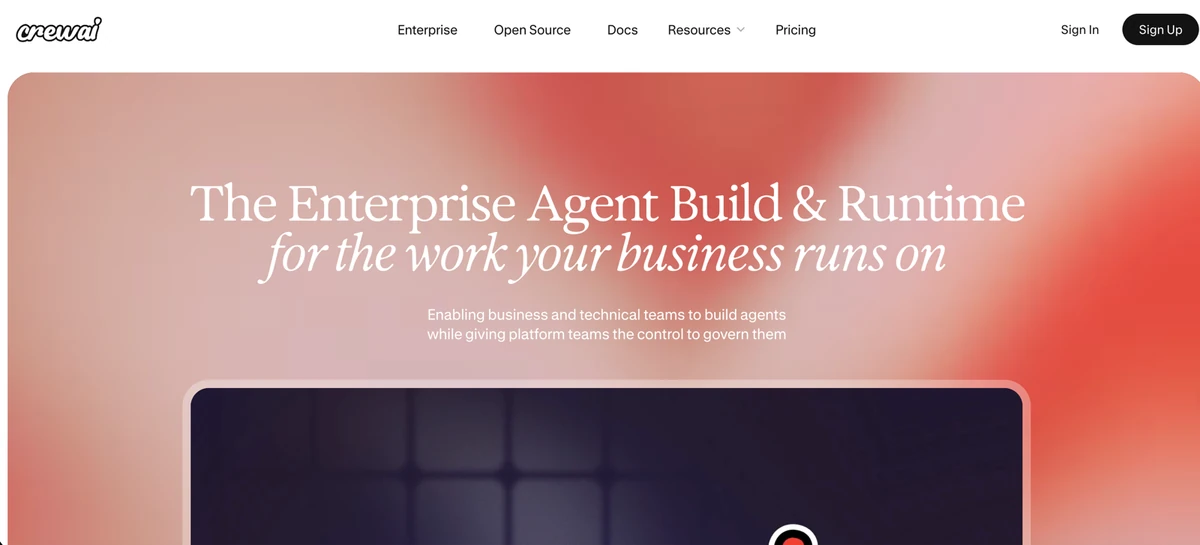
CrewAI organizes specialized agents into crews and flows. The mental model is approachable for work that naturally separates into research, drafting, review, and approval roles.
Do not add agents only to make a system look sophisticated. Each handoff can introduce latency, token cost, contradictory instructions, and another failure path. Compare a crew against one well-equipped agent plus deterministic workflow steps.
3. Microsoft Agent Framework: best for Microsoft-oriented agent systems
Microsoft Agent Framework provides SDK concepts for agents, workflows, tools, and enterprise integration. It is relevant to teams already using Microsoft identity, cloud, development, and governance surfaces.
Confirm the current support status, package versions, language coverage, migration guidance, and hosting path before standardizing. A familiar vendor ecosystem helps operations, but it does not remove the need for evaluation or least-privilege tool design.
4. Semantic Kernel: best for plugins across .NET, Python, and Java
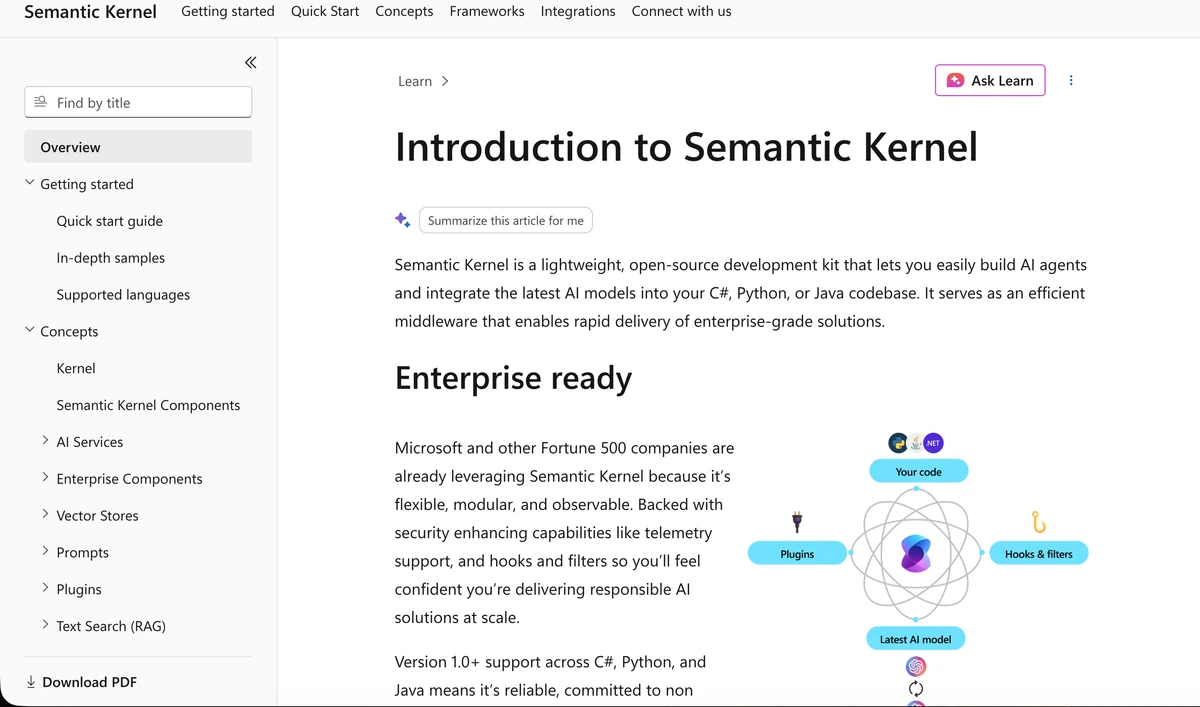
Semantic Kernel is a model-integration SDK with plugins, planning, agents, and process-oriented building blocks. It fits organizations that want agent capabilities inside existing applications rather than a separate autonomous product.
Its flexibility means the team still owns product behavior, memory design, tool contracts, authentication, and monitoring. Use the smallest set of abstractions that supports the application instead of adopting every agent feature at once.
5. Pydantic AI: best for typed Python agent applications
Pydantic AI brings model and tool interactions into a typed Python development style. It is useful when structured outputs, dependency injection, validation, testing, and provider flexibility matter more than a visual agent builder.
Typed schemas reduce ambiguity at software boundaries, but they cannot prove that a factual answer is correct. Add domain evaluations, fixture-based tool tests, error handling, and output review for high-impact decisions.
6. OpenHands: best finished agent for repository tasks
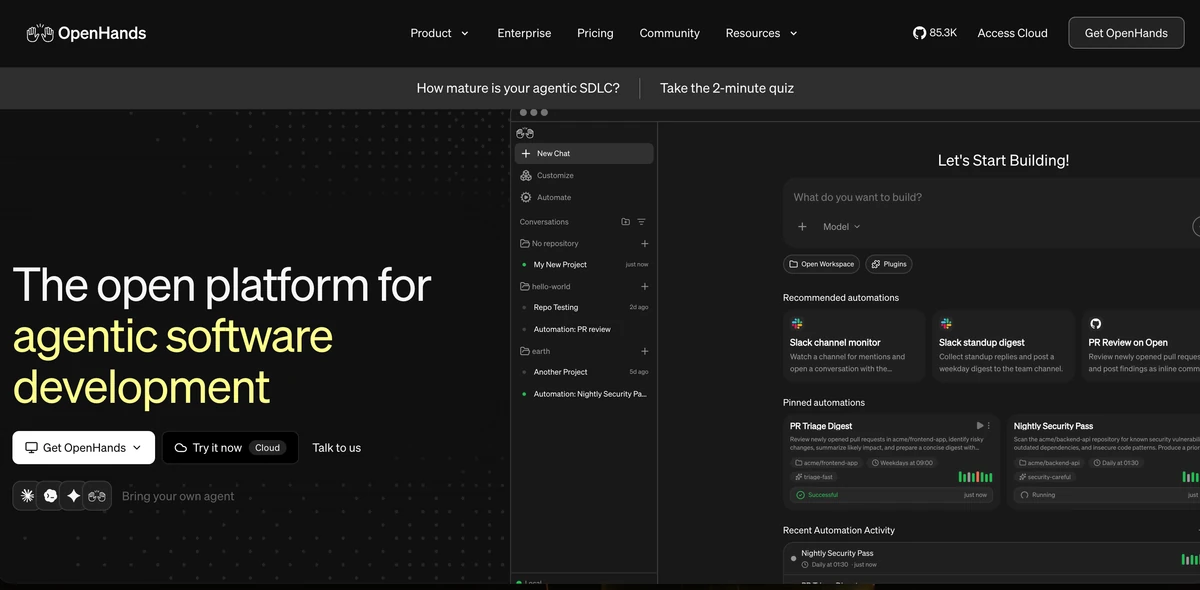
OpenHands is a software-development agent that can inspect repositories, edit files, and run commands in a controlled environment. It is closer to an end-user agent than a general framework.
The main evaluation surface is the runtime boundary: repository access, network access, secrets, command execution, sandbox isolation, generated diffs, and tests. Use disposable environments and require review before changes reach protected branches.
7. OpenCode: best for model-flexible coding workflows
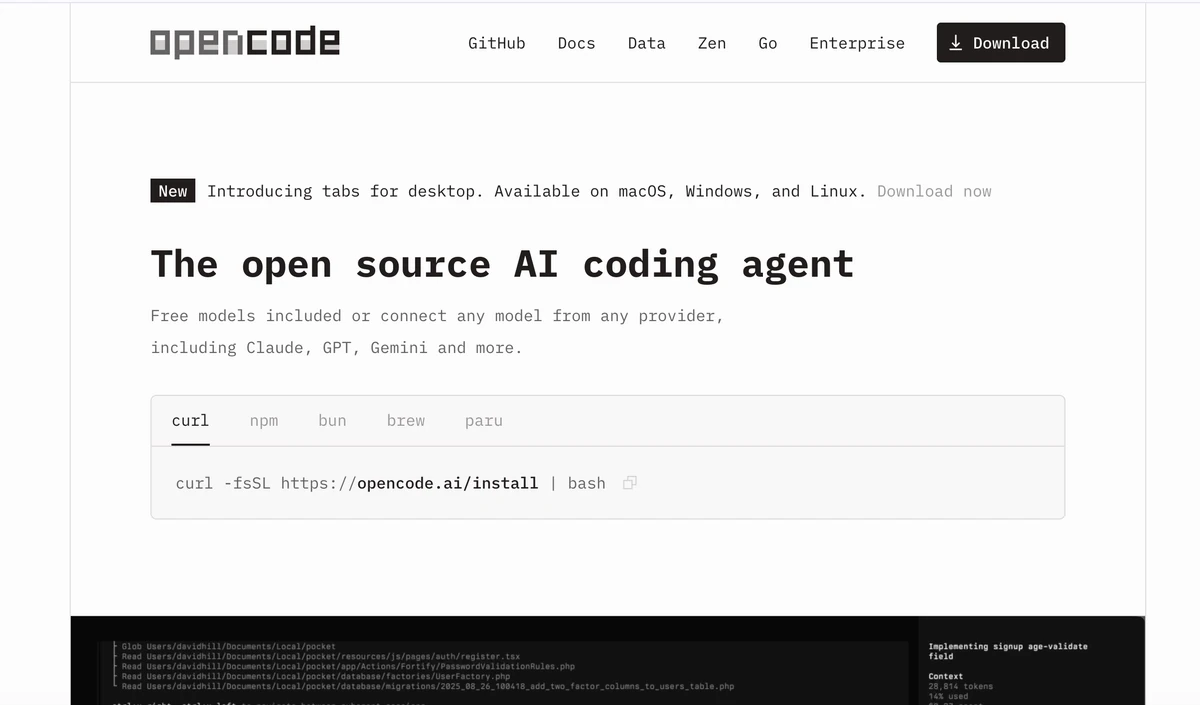
OpenCode is an open-source coding agent available across terminal, IDE, and desktop surfaces. It appeals to developers who want provider choice and a coding-focused interface without building an agent application from primitives.
Provider flexibility shifts model selection, API credentials, usage cost, and data-policy decisions to the operator. Evaluate it on a representative repository task and inspect every command, diff, and verification result.
8. n8n: best for agents connected to business workflows
n8n combines visual workflow automation with AI nodes, tools, triggers, and application connectors. It fits teams that want agent reasoning only where input varies, while keeping important business actions in visible workflow steps.
Review its license and deployment terms rather than assuming every source-available project has the same freedoms as an OSI-approved license. Self-hosting also transfers patching, credentials, backups, availability, and incident response to your team.
How to evaluate an open-source AI agent
Use a bounded pilot with real failure cases. For a research agent, include a missing source and conflicting evidence. For a coding agent, include tests and a protected secret. For an operations agent, include an ambiguous customer record and an unavailable API.
Score each finalist on:
- Control flow: can developers see why the system continues, retries, or stops?
- State: can a run resume safely, and can state schemas be migrated?
- Tools: are inputs validated, permissions narrow, and side effects idempotent?
- Human review: can consequential steps pause for an identified owner?
- Observability: are prompts, model responses, tool calls, costs, and failures traceable?
- Evaluation: can the team replay representative cases after a change?
- Security: are secrets, files, subprocesses, browsers, and networks isolated appropriately?
- Operations: who owns upgrades, queues, storage, backups, and incident response?
Do not benchmark only the happy path. A production agent is defined as much by how it fails and recovers as by the quality of its best run.
Which project should you choose?
| Requirement | Start with |
|---|---|
| Connected context and finished deliverables | Ottermind |
| Role-based multi-agent collaboration | CrewAI |
| Microsoft-oriented enterprise development | Microsoft Agent Framework or Semantic Kernel |
| Typed Python agent services | Pydantic AI |
| A ready-to-run software agent | OpenHands or OpenCode |
| Self-hosted business workflow automation | n8n |
Frequently asked questions
What is the best open-source AI agent framework?
LangGraph is a strong choice for stateful graph orchestration, CrewAI for role-based multi-agent patterns, Microsoft Agent Framework or Semantic Kernel for Microsoft-oriented systems, and Pydantic AI for typed Python development. The right choice depends on the application architecture and operating model.
What is the difference between an open-source AI agent and a framework?
A finished agent performs a defined job through an interface. A framework gives developers components for building their own agents. OpenHands and OpenCode are closer to finished coding agents; LangGraph and Pydantic AI are frameworks.
Can open-source AI agents run locally?
Many projects can run application code locally, but the model or connected tools may still use remote services. Verify every network dependency, model endpoint, telemetry setting, connector, and data store before calling a deployment local or private.
Are open-source agents free?
The repository may be free to download, but model inference, hosting, storage, observability, browsers, sandboxes, and maintenance can cost more than a managed product. Review the exact license and all service dependencies.
Are open-source AI agents safe for production?
They can be part of a safe production system, but the repository alone does not provide that guarantee. Use narrow permissions, isolated execution, validated tools, approval gates, evaluation suites, monitoring, and a clear incident-response owner.
The best open-source choice is the smallest system that makes the required behavior visible, testable, and operable. Start with one workflow, instrument it thoroughly, and add autonomy only when the evidence justifies it.
Further reading: What is DeepSeek Harness?, AI agent vs chatbot vs automation, Best AI assistant for developers