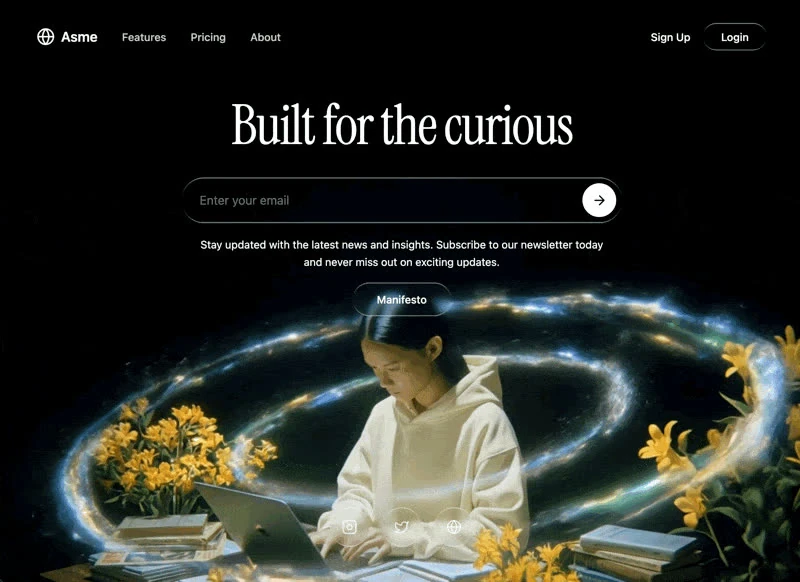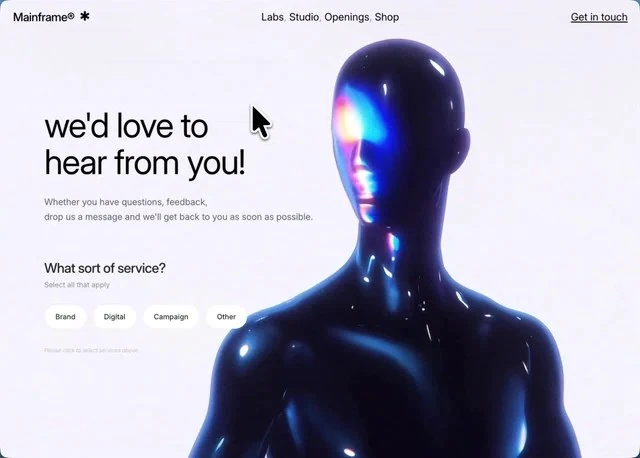
About this template
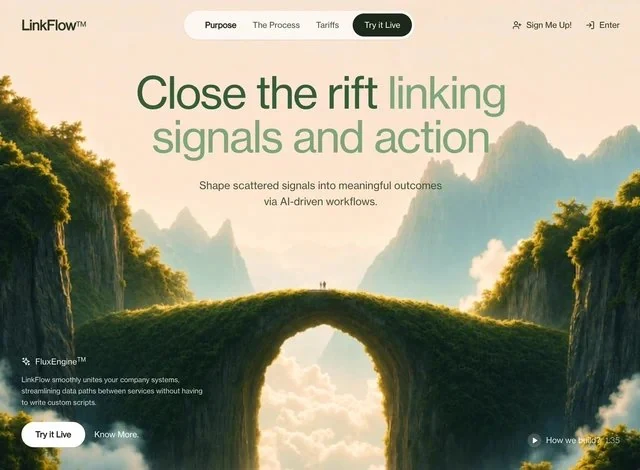
Contact Cybernetic solves the hero section problem for an AI or SaaS product with a single captured brief. The page's own headline reads “). Inside, display an acknowledgment banner reading”, and the composition is built around those exact words. The palette is white #F1F3F1 underneath and deep green #1C2E1E for the type, set in Inter. The reference is built with React and Tailwind CSS, and the layout decisions are stated independently of it. Motion comes down to 1s transitions. Keep it open while you write: the 6,423-character brief is the part that transfers to your own page.
Designed for
- Anyone using an AI builder who wants a brief that already contains a 640x458 frame instead of leaving it to the model.
- Designers who need the numbers first: type from 21px to 76px and 23px spacing steps, all of it quoted from the brief.
- Made for content leads rewriting a hero section whose headline has to stay as long as Contact Cybernetic's.
What's included
- The nav is deliberately thin. Navigation is a single row with no second level under it. A mobile overlay takes over below the tablet breakpoint. The bar sits over the 640x458 composition without a background of its own, so the media runs edge to edge underneath it. Test the bar over your own media before giving it a background.
- A pill for the one thing that is new. One badge, one message: the pill sits above the headline in Inter at the smallest step, and nothing else competes for that slot. It is positioned so the headline keeps the centre of the composition. Keep it above the headline, never beside it.
- Top row, one action. One action per bar. The reference was captured at 640x458.
- The brief names the steps. Sizes were read off the render at 640x458: type from 21px to 76px, 23px spacing steps and 1s transitions. The frame proportions are recorded with the sizes, so a rebuild gets the aspect right as well.
Motion & interaction
A small interactive surface
The interactive layer is small and predictable: hover states on the buttons and links rather than on every card. Everything else stays still, which keeps the emphasis on the composition. Interactive targets are large enough to tap and the pointer treatment is consistent across them. If a state does not confirm an action, drop it.
The whole animation budget
The animation budget is small and explicit: 1s, applied to state changes rather than to entrances. Easing is specified alongside the duration (1s), so a rebuild cannot quietly substitute a different feel.
How the hero section reflows
Compared with a mobile layout that hides sections, this one keeps them and changes their shape: the navigation collapses into a mobile menu. The mobile version is a decision, not a fallback.
The order behind the hero section
When a SaaS reader lands on a single screen, they scan before they read. The layout answers that: navigation, the headline, the announcement badge, the stats row and the background clip are sized to be scanned, with type from 21px to 76px and 23px spacing steps keeping each stop distinct. A SaaS reader gets the offer before the options.
Reading Contact Cybernetic as a spec
The page has more numbers in it than it appears to. type from 21px to 76px, 23px spacing steps and 1s transitions are the ones a rebuild has to keep; the rest can move. Nothing in this hero section depends on a default.
Frequently asked questions
What do I get when I copy the Contact Cybernetic brief?
The captured brief runs 6,423 characters and covers the frame, the type scale, the palette and the transitions. Copying it gives you that text, and sending it to Studio stages the same request with the page already described.
How much of Contact Cybernetic depends on React and Tailwind CSS?
Contact Cybernetic was built in React and Tailwind CSS, and the entry says so for provenance. The brief describes positions, sizes and timings, so it rebuilds in any framework that can set type and place elements.
How much of Contact Cybernetic is animated?
The motion is specified at the same level of detail as the layout: state changes settle in the 1s range. Port the composition first and the timings second, because they are easier to match once the layout holds.