Explainer
What Is Human-in-the-Loop AI? Review and Approval Explained
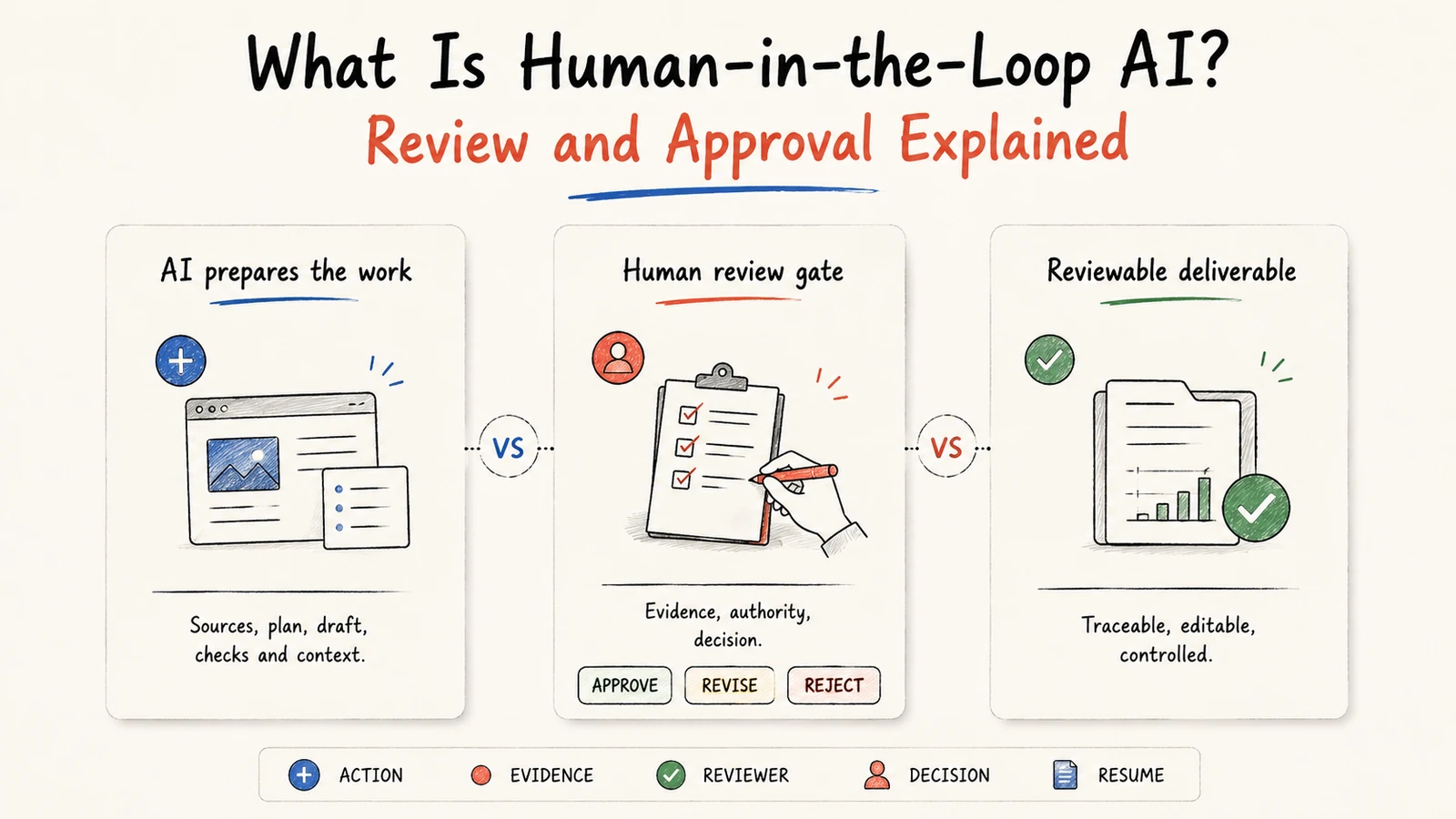
Human-in-the-loop AI is a way of designing AI-assisted work so a person provides judgment or authorization at defined points before the process continues. A useful review gate pauses a specific action, shows the evidence and expected effect, gives an authorized reviewer real choices, and records how the task resumes after approval, revision, rejection, or escalation.
The goal is not to make a person click Approve after every AI step. It is to keep human authority where context, consequences, or accountability require it while allowing low-risk work to move forward.
Research and disclosure: Ottermind publishes this explainer. We reviewed primary guidance from NIST, Anthropic, and Microsoft on August 26, 2026. The review contract and campaign example below are original editorial frameworks, not a measured Ottermind benchmark.
What does human-in-the-loop AI mean?
Human-in-the-loop, usually shortened to HITL, describes a system in which AI performs part of a task and a person participates at one or more decision points. The person may supply missing context, choose between options, correct an interpretation, approve an action, reject a proposal, or take over the work.
The defining feature is not that a human used the software. It is that the system has an explicit path for human judgment to change what happens next.
Consider an AI preparing a customer announcement. It can organize approved product facts, draft the message, and check required sections. Before anything is sent, a communications lead reviews the claims, audience, timing, and final recipient list. The lead can approve, request changes, reject the draft, or stop the task. That is a runtime human-in-the-loop design.
By contrast, placing a disclaimer under an automatically sent message does not put a person in the loop. Neither does collecting feedback that cannot affect the current outcome.
Training feedback and runtime review are different loops
The term is used for two related but different forms of human participation.
| Loop | When people participate | What their input changes | Example |
|---|---|---|---|
| Model-development loop | During labeling, training, evaluation, or model improvement | Future model behavior or measured performance | Reviewers label examples or compare model responses |
| Runtime task loop | While a real task is being executed | The current decision, action, or deliverable | A manager approves a campaign brief before assets are produced |
This article focuses on runtime task loops. They matter because an AI system can be well evaluated in development and still face missing context, unusual inputs, changing policies, or consequential actions in real work.
Runtime HITL is an execution-control pattern. It does not replace model evaluation, automated checks, access controls, or organizational accountability.
Human-in-the-loop, on-the-loop, and out-of-the-loop
These terms describe where a person sits relative to an AI system's actions.
| Mode | How work proceeds | Human role | Suitable use |
|---|---|---|---|
| Human-led | A person directs each material step | Operator | Ambiguous or novel work where the route is still being discovered |
| Human-in-the-loop | Work pauses at defined gates | Reviewer or authorized decision-maker | Consequential decisions, external communication, and important judgment |
| Human-on-the-loop | Work proceeds while a person monitors and can intervene | Supervisor | Bounded, observable, and recoverable operations |
| Human-out-of-the-loop | Work proceeds without routine human participation | Policy owner remains outside execution | Narrow, low-risk, well-tested automation |
The right mode can change within one task. An AI may read supplied files automatically, ask a person to resolve conflicting sources, continue drafting, and then require authorization before publishing. Human oversight is a step-level design choice, not a permanent label for the whole system.
For the broader execution model that connects planning, tools, memory, and review, see What Is an Agentic Workflow?.
For the broader category definition, start with What Is Agentic AI?.
When should AI stop for human review?
Use the consequence of the next step, not the novelty of the technology, to decide where a gate belongs.
Intent is unresolved
Pause when the request supports several materially different interpretations. A person should choose the audience, priority, recommendation, or trade-off rather than letting the system silently commit to one.
Evidence is weak or conflicting
Escalate when a material claim lacks a source, current documents disagree, or a recommendation depends on an assumption. The reviewer should see the conflict and its downstream effect, not just a confidence label.
The output represents a person or organization
Public copy, customer messages, proposals, resumes, legal drafts, and executive recommendations carry reputational or professional consequences. Review the claims, tone, commitments, and audience fit before release.
The next action changes the world
Sending, publishing, purchasing, deleting, paying, granting access, changing production systems, or updating an official record requires more control than reading a file or preparing a draft. The reviewer should authorize the exact action and payload, not a vague goal.
Policy requires accountable judgment
Some decisions belong to a named role because of law, regulation, contract, or internal policy. AI can organize evidence and prepare options, but it should not impersonate the accountable decision-maker.
Use risk to choose the review mode
Reviewing everything is not automatically safer. Repeated low-value prompts create delay and can train people to approve without reading. Anthropic describes this practical problem and recommends controls such as scoped permissions and reviewing a plan before execution rather than interrupting every harmless step.
Use four questions to set the level of oversight:
- Impact: What happens if this is wrong?
- Reversibility: Can the effect be undone quickly and completely?
- Detectability: Will an error be visible before it causes harm?
- Authority: Does the action require a person's judgment or formal permission?
| Risk pattern | Recommended control | Example |
|---|---|---|
| Low impact, reversible, easy to inspect | Automatic execution with logs | Organize duplicate notes into a working outline |
| Moderate impact or uncertain interpretation | Review the intermediate artifact | Select a positioning direction before drafting assets |
| High impact but reversible | Explicit approval of the exact action | Schedule a customer email with a reviewed recipient list |
| High impact and difficult to reverse | Human-led execution or prohibit the AI action | Approve payment, delete records, or make an employment decision |
Confidence alone should not decide. An AI can be confidently wrong, and a low-confidence output can still be harmless. Consequence and authority remain independent reasons to require review.
The five-part human review contract
“Add human review” is not an implementable instruction. Define every gate with five fields:
| Field | Question | Required information |
|---|---|---|
| Action | What exactly is waiting? | The proposed change, destination, timing, and scope |
| Evidence | What does the reviewer need to judge it? | Sources, assumptions, diff, preview, checks, and known risks |
| Reviewer | Who is authorized and qualified? | Named role, ownership, backup, and response deadline |
| Decision | What can the person choose? | Approve, revise, reject, take over, or escalate |
| Resume | What happens after each choice? | Saved state, next step, expiry behavior, and decision record |
This Action–Evidence–Reviewer–Decision–Resume contract makes the loop testable. If any field is missing, the reviewer may be unable to understand the request, exercise authority, or return the task to a usable state.
NIST's AI Risk Management Framework emphasizes clear human-AI roles, documented responsibilities, ongoing review, and mechanisms to deactivate systems that behave outside their intended use. The contract above turns those governance concerns into a task-level artifact; it is not a substitute for an organization's policies or legal obligations.
Worked example: review a campaign package
Suppose a marketing team gives an AI product notes, customer interviews, approved claims, and brand guidance. The requested deliverables are a campaign brief, landing-page draft, three emails, and an internal presentation.
The AI can organize sources and produce connected work, but three decisions should remain visible.
| Gate | Action | Evidence | Reviewer | Decision and resume path |
|---|---|---|---|---|
| Source-of-truth gate | Use one of two conflicting product descriptions | Both documents, dates, owner, and affected claims | Product lead | Choose a source, request clarification, or remove the disputed claim; resume from the evidence map |
| Strategy gate | Carry one positioning direction into all assets | Audience evidence, two options, trade-offs, and unsupported assumptions | Marketing lead | Approve or revise one direction; resume from the approved campaign brief |
| Release gate | Publish or send customer-facing assets | Final preview, claim check, links, recipients, schedule, and rollback plan | Channel owner | Authorize the exact release, return edits, or cancel; drafting remains intact |
This example is illustrative. It does not claim that Ottermind or any model completed a measured production run.
The important design choice is where work resumes. If the product lead changes the source of truth, every downstream artifact derived from the old claim must be marked stale. If the marketing lead rejects the positioning, the task returns to the brief rather than patching every final asset independently.
For the complete marketing sequence, read How to Build an AI Marketing Workflow.
Approval, revision, rejection, and takeover
A binary approve/reject button is too narrow for many knowledge-work decisions.
- Approve: Continue from the reviewed state without changing the proposal.
- Revise: Return structured feedback and continue from the earliest affected artifact.
- Reject: Stop the proposed path while preserving sources, intermediate work, and the reason.
- Take over: Let the person complete the pending action directly, then return the resulting state to the task.
- Escalate: Route the decision to someone with the required authority or expertise.
- Expire: Stop safely if nobody responds before the decision becomes stale.
Microsoft's Agent Framework models HITL as a request that pauses execution and later resumes with an external response. That pause-and-resume behavior is essential. A workflow that asks for approval but loses its context, ignores rejection, or cannot continue after correction has a notification, not a functioning loop.
What makes human oversight meaningful?
A reviewer needs more than a place in the interface.
Context
Show the source material, proposed effect, assumptions, previous decisions, and relevant checks together. Do not make the reviewer reconstruct the task from chat history.
Competence
The person must understand the domain and the decision. A random approver cannot validate a legal interpretation, financial recommendation, accessibility requirement, or technical deployment.
Time and attention
Set a manageable review scope. A concise claim table or visual diff can support judgment; a hundred-page transcript encourages rubber-stamping.
Authority
The reviewer must be able to say no, change the route, or stop the system without being punished for delaying it. Nominal oversight without practical control is not meaningful.
Traceability
Record what was proposed, what evidence was shown, who decided, what changed, and which state resumed. The record supports later learning and accountability without exposing hidden model reasoning.
NIST also warns that people can introduce bias and that human-AI combinations do not always outperform either one alone. Human presence is therefore not proof of correctness. Review design itself must be evaluated.
Common human-in-the-loop failures
Approval comes too late
Reviewing only the final deck does not help if the source selection or strategy was wrong. Put gates before errors multiply across downstream work.
Every action requires approval
If reading a file, sorting notes, and applying an approved format all trigger prompts, reviewers stop distinguishing important decisions from routine work. Use scoped permissions and reserve blocking gates for material boundaries.
The reviewer sees a summary, not the pending action
“Approve campaign?” hides the actual copy, audience, timing, links, and expected effect. Show the payload or change that will execute.
There is no rejection branch
Real reviewers disagree. Define whether rejection stops the task, requests new evidence, returns to an earlier artifact, or transfers control.
The wrong person approves
Availability is not authority. Name the role that owns the decision and a valid backup before the gate is reached.
Feedback never improves the process
Track recurring corrections. They may reveal a bad source, missing acceptance criterion, overly broad permission, weak automated check, or misplaced gate.
How to design a human-in-the-loop AI task
- Name the final deliverable and accountable owner.
- Map the task into decisions, drafts, checks, and external actions.
- Rate each step by impact, reversibility, detectability, and authority.
- Automate low-risk preparation and validation where appropriate.
- Place review before ambiguous decisions and representative outputs.
- Require exact authorization before consequential actions.
- Define the Action–Evidence–Reviewer–Decision–Resume contract for every gate.
- Add revision, rejection, takeover, escalation, and expiry paths.
- Preserve decisions and invalidate downstream work when an upstream choice changes.
- Measure accepted outcomes, corrections caught, review time, overrides, incidents, and abandoned gates.
For help defining the source material, constraints, and acceptance criteria before execution begins, use How to Automate Tasks with AI.
A reusable review-gate template
Pending action:
[Describe the exact decision, output, tool call, destination, and effect.]

Evidence for review:
- Trusted sources:
- Assumptions or uncertainty:
- Preview or change summary:
- Automated checks completed:
- Known risks and rollback path:

Authorized reviewer:
[Name the responsible role and backup.]

Available decisions:
- Approve and continue
- Revise from [artifact or step]
- Reject and stop
- Take over
- Escalate to [role]

Resume behavior:
[State what is preserved, invalidated, executed, or cancelled after each decision.]

Expiry:
[Stop safely or rerun checks after this date or timeout.]
How Ottermind fits
Ottermind is an AI agent workspace for tasks that begin with a goal, files, links, and project context, then develop through intermediate work into a report, brief, presentation, or other deliverable.
That structure supports meaningful review because the decision can remain connected to its sources and downstream artifacts. A team can inspect a source map, approve a plan or brief, revise the direction, and continue without treating every response as a separate conversation.
Ottermind does not remove the need for accountable owners or domain review. Start with one bounded, reviewable deliverable. Ask for the source map and plan first, approve the direction, and keep sending, publishing, purchasing, deleting, and official record changes outside the agent's authority unless explicitly controlled.
Frequently asked questions
Is human-in-the-loop AI the same as human oversight?
HITL is one form of oversight in which work pauses for human input. Oversight can also include monitoring, sampling, audits, policies, automated checks, and the ability to intervene while work continues.
Does every AI output need human approval?
No. The control should match impact, reversibility, detectability, and authority. A private outline may only need later inspection; a public claim, payment, deletion, or official decision may require explicit authorization.
What is the difference between human-in-the-loop and human-on-the-loop?
In a human-in-the-loop design, the system waits at defined gates. In a human-on-the-loop design, it continues within boundaries while a person monitors and can intervene. One task can use both modes for different steps.
Can human review make AI output correct?
Not by itself. Reviewers can lack context, expertise, time, or independence, and people have biases too. Meaningful review improves control only when the role, evidence, decision rights, and feedback path are designed well.
How many approval gates should an AI workflow have?
Use the fewest gates that still protect material decisions and actions. Too few can allow errors to compound; too many create delay and approval fatigue. Start with intent, evidence, external representation, consequential action, and formal authority boundaries.
What should happen when a reviewer rejects an AI action?
The system should preserve the evidence and decision record, stop the proposed action, and follow a defined branch: revise from the affected artifact, gather more information, transfer control, escalate, or end the task safely.
Bottom line
Human-in-the-loop AI is not a promise that “a person checks the work.” It is a specific control design: the right action pauses, the right evidence is visible, the right person has real choices, and the task has a safe way to continue or stop.
Put people where judgment, consequence, and accountability concentrate. Let bounded, low-risk preparation move without constant interruption. Then evaluate whether the loop catches meaningful problems rather than merely collecting approvals.