Guide
AI Fact Checker Guide: What Tools Can Verify and What Humans Must Review
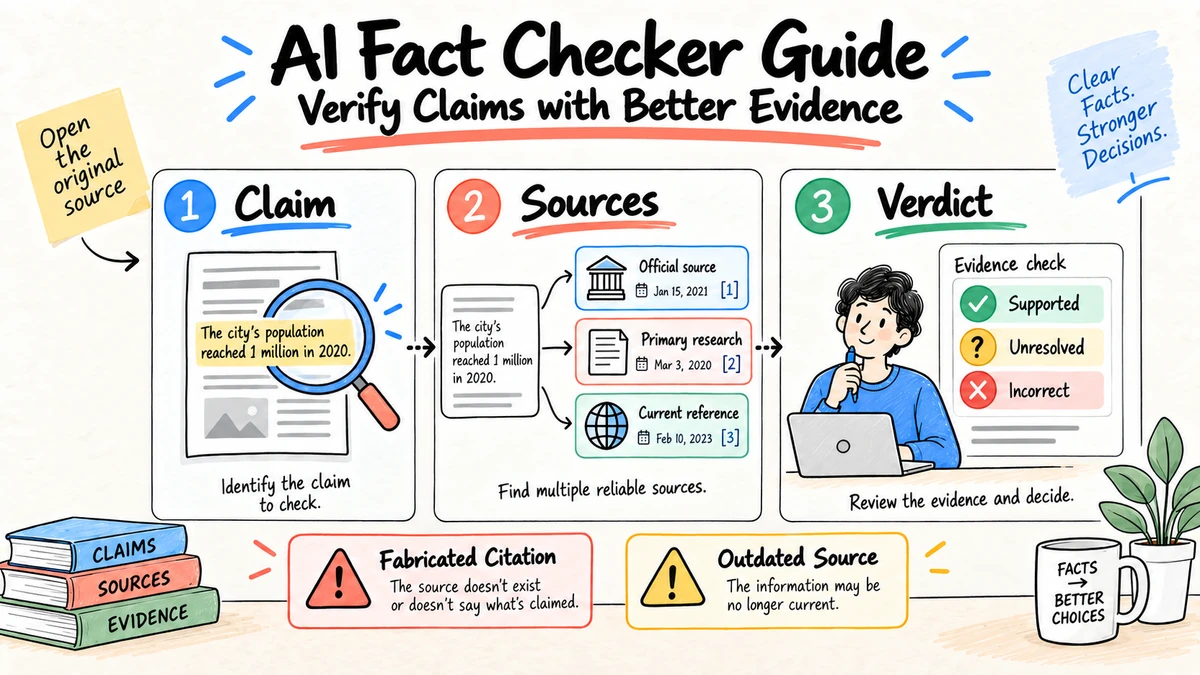
An AI fact checker can help extract checkable claims, search for evidence, compare sources, and flag unsupported statements. It cannot guarantee truth. Search coverage, source quality, time sensitivity, ambiguity, and model reasoning can all fail, so consequential claims still need a person to inspect the original evidence and record a verdict.
Research and disclosure: This guide draws on Google Fact Check Explorer, the Google Fact Check Tools overview, NIST's Generative AI Profile, and university lateral-reading guidance surfaced in the September 4, 2026 Google US SERP. Ottermind does not claim to provide an authoritative truth database, and no vendor was benchmarked for this article.
What an AI fact checker actually does
Most tools combine four operations:
- Claim detection: split prose into statements that could be verified.
- Retrieval: search the web, a database, or supplied documents.
- Comparison: estimate whether evidence supports, contradicts, or does not resolve the claim.
- Presentation: return a verdict, explanation, confidence, and links.
Each operation can introduce error. A compound sentence may be checked as one claim. Search may favor copied articles over the original source. A source may be credible but outdated. The final label may sound certain even when the evidence is mixed.
Features that matter
| Capability | What good looks like | Warning sign |
|---|---|---|
| Claim splitting | One precise proposition per row | Whole paragraphs receive one verdict |
| Source visibility | Direct links, dates, authors, quoted context | A score without retrievable evidence |
| Source control | Domain, date, and supplied-source filters | No way to prioritize primary evidence |
| Uncertainty | Supported, contradicted, mixed, or unresolved | Forced true/false labels |
| Freshness | Search date and publication date are visible | Current claims checked against old pages |
| Audit trail | Claims, evidence, verdicts, and reviewer edits export | Results disappear after the session |
| Privacy | Sensitive inputs can be excluded or protected | All submitted content is retained by default |
Four types of fact-checking product
The label covers products with different evidence models. Identify which one you are evaluating before comparing features.
Claim-search tools
These tools search published fact checks for a person, phrase, image, or topic. They are useful when a recognized fact-checking organization has already investigated the same claim. They do not verify a novel internal claim or guarantee that an unmatched statement is true.
Open-web verification assistants
These accept a claim or document, search public pages, and produce evidence-linked assessments. Test whether they find original sources, distinguish publication from event dates, and preserve uncertainty. Search quality and source selection matter as much as the model that writes the explanation.
Source-bounded checkers
These compare a draft with a supplied source pack. They are often better for reports, policies, contracts, and internal research because the evidence boundary is explicit. They still need location-level citations and a way to surface conflicting or missing documents.
Editorial verification workspaces
These organize claims, evidence, reviewers, statuses, and final corrections. They may use AI for extraction and matching, but their main value is the audit trail. For high-impact publishing, workflow can matter more than a one-click truth score.
How evidence matching should work
A citation is correct only when it passes several tests:
- Existence: the page or document is real and accessible to the reviewer.
- Identity: the author, publisher, and document are what the result claims.
- Entailment: the cited passage supports the exact proposition, not a nearby topic.
- Authority: the source is appropriate for that kind of claim.
- Currency: its date is suitable for a claim that may change.
- Independence: corroborating sources do not all repeat the same origin.
- Context: qualifications, population, geography, and exceptions are preserved.
A tool should show enough evidence for a reviewer to apply these tests. Confidence without inspectable support is presentation, not verification.
A 25-claim evaluation set
Before adopting a tool, build a balanced test:
- five stable public facts with strong primary sources;
- five time-sensitive facts such as roles, prices, or policies;
- five false claims with plausible wording;
- five mixed or context-dependent claims;
- five internal claims whose evidence exists only in supplied files.
Score claim extraction, source quality, citation correctness, verdict accuracy, uncertainty calibration, and review time. Do not let the same model generate the test claims, evidence, and final grade without independent review.
Add adversarial cases that reveal shortcuts:
- a true statistic attached to the wrong year;
- a real quotation assigned to the wrong speaker;
- an official page that has been superseded;
- three articles that all cite one press release;
- a correct number with the denominator removed;
- a claim that is partly true but materially misleading;
- an internal fact that cannot be verified on the public web;
- a source whose title supports the claim but whose body does not.
Claim:
Claim type: stable / current / quantitative / attributed / internal
Required source class:
Evidence retrieved:
Evidence date:
Supports / contradicts / unresolved:
Missing context:
Reviewer correction:
Final disposition:
Scoring the test
Use separate measures so a strong retrieval feature cannot hide unsafe verdicts.
| Measure | Calculation | Why it matters |
|---|---|---|
| Claim recall | Material claims extracted / material claims present | Missed claims receive no review |
| Citation precision | Supporting citations / citations returned | Measures mismatched evidence |
| Primary-source rate | Claims with suitable original evidence / verifiable claims | Reveals dependence on summaries |
| Verdict accuracy | Correct dispositions / reviewed claims | Tests the final classification |
| Abstention quality | Correct unresolved calls / truly unresolved cases | Rewards honest uncertainty |
| Reviewer time | Minutes to verify and correct the output | Measures operational value |
Set thresholds by use case. A newsroom, legal team, product marketer, and student research desk should not share one acceptance threshold. High-risk claims can require perfect citation inspection even when low-risk background claims are sampled.
Worked evaluation example
Imagine testing a checker on this claim: "The NIST AI Risk Management Framework is a mandatory U.S. regulation introduced in 2024."
A useful result should split the proposition. It should identify that the framework is voluntary, distinguish the 2023 release of AI RMF 1.0 from the 2024 Generative AI Profile, link the official NIST material, and explain that a framework is not automatically a regulation. A weak result might find the right NIST page but label the entire sentence supported because the words "AI Risk Management Framework" and "2024" both appear.
This example tests entailment, date handling, document identity, and compound-claim splitting with one sentence.
Tool-assisted does not mean tool-decided
Assign explicit roles:
| Role | Responsibility |
|---|---|
| Author | Provides draft, intended meaning, and known sources |
| AI checker | Extracts claims, retrieves candidates, and structures evidence |
| Researcher | Finds original material and resolves source chains |
| Subject reviewer | Judges specialized or consequential claims |
| Editor | Aligns wording with evidence and preserves uncertainty |
| Publisher | Confirms sign-off, disclosures, and retained records |
One person may hold several roles on low-risk work, but the responsibilities should remain distinguishable. The author should not be able to convert a tool's confidence score directly into publication approval.
Privacy questions before uploading a draft
Drafts can contain unreleased products, customer names, allegations, legal strategy, personal information, or confidential research. Before using a hosted checker, confirm what is collected, where it is processed, how long it is retained, who can access it, whether it trains models, and how deletion works.
For restricted material, prefer an approved source-bounded environment, redact unnecessary fields, or keep the review manual. Do not trade confidentiality for a convenient score.
Integration checklist for editorial teams
An effective fact checker should fit the publishing process rather than live in a separate tab that editors forget to open.
[ ] Drafts receive stable document and version IDs.
[ ] Claims link back to sentence or section locations.
[ ] Evidence records source, author, date, passage, and access date.
[ ] Authors can respond without overwriting reviewer findings.
[ ] High-risk claims require named approval.
[ ] Unresolved claims can block publication under defined rules.
[ ] Final wording remains connected to the evidence that supports it.
[ ] Link checks run again near publication for current claims.
[ ] Corrections after publication connect to the original claim record.
[ ] Sensitive drafts follow approved access and retention rules.
Connect status with the content system carefully. A claim changing from unresolved to supported should require evidence and a reviewer, not just an API call from the same generation process.
For collaborative work, define who can edit claims, evidence, dispositions, and final copy. Preserve history so a late rewrite cannot remove a qualification while keeping the old approval badge.
Questions to ask a fact-checking vendor
- How does the system split compound and implied claims?
- Can we restrict search by source class, domain, date, or supplied files?
- Does it distinguish original evidence from pages that repeat it?
- How are publication date, event date, and page update handled?
- Can reviewers see the exact passage that supports each verdict?
- Which verdicts and uncertainty states are available besides true and false?
- Can we export claims, citations, labels, reviewer changes, and versions?
- How are private inputs retained, accessed, deleted, and used for training?
- Can high-impact or unresolved claims create a publication gate?
- How does the product behave when search or a source is unavailable?
Require the vendor to run your adversarial evaluation set. A demonstration on well-known public claims does not establish performance on current product documentation or private source packs.
When not to rely on automated fact checking
Do not delegate final verification for legal advice, medical decisions, safety instructions, financial action, allegations about people, or claims that materially affect customers or employees. A tool can organize evidence, but an accountable qualified reviewer must make the decision.
Also pause when the source is inaccessible, the claim depends on local law, the wording is ambiguous, or only circular citations appear. "Unresolved" is a useful result.
A better workflow than one-click verification
Use AI to create a claim inventory first. Prioritize claims by impact and volatility. Set an evidence standard for each type, retrieve primary sources, preserve the relevant passage and date, and have a reviewer sign off on high-impact rows. Then update the draft from the ledger instead of accepting isolated green checks.
The how to fact-check AI content guide gives the full editorial sequence. For source-heavy work, the AI research assistant guide explains how to compare retrieval, citations, analysis, and deliverables.
FAQ
Are AI fact checkers accurate?
Accuracy varies by claim, evidence access, freshness, and tool design. Treat the result as research assistance until a reviewer opens the cited source and confirms that it supports the exact claim.
Can an AI fact checker detect hallucinations?
It can flag claims lacking supporting evidence, but it may miss subtle errors, retrieve irrelevant sources, or generate an incorrect explanation. A structured claim ledger is more dependable than a single hallucination score.
Is Wikipedia enough to verify a claim?
It can help orient research, but consequential claims should be traced to suitable primary or authoritative sources. Check the cited material and its date.
What does no evidence mean?
It means the search did not resolve the claim. It does not automatically prove the claim false. Revise, narrow, escalate, or remove it based on impact.
Can one fact checker evaluate an entire long document?
It may accept the file, but evaluate whether it extracts every material claim and preserves page-level evidence. Batch review often hides omissions, so inspect coverage section by section.
Should a fact checker provide one confidence percentage?
A single percentage is rarely sufficient. Ask for evidence quality, verdict, uncertainty reason, and source coverage separately so the reviewer can understand what the number represents.
Can fact-checking tools verify images and video?
Some support reverse search, metadata, or provenance checks, but visual verification needs its own workflow. Inspect the original asset, publication history, editing signs, location, date, and corroborating evidence.
Should a fact checker rewrite unsupported claims automatically?
It may propose wording, but the revision should remain unapproved until a reviewer confirms that the new sentence matches the evidence. Automatic rewriting can introduce a new unchecked claim.
Can fact checking be fully automated for low-risk content?
Deterministic checks and sampling can reduce routine work, but define material claims, escalation, audits, and correction paths. Low risk does not mean no accountability.
Use Ottermind to keep the draft, claim ledger, source files, and reviewer instructions in one inspectable task before the content becomes a final deliverable.