How To
How to Fact-Check AI Content: A 7-Step Evidence Workflow
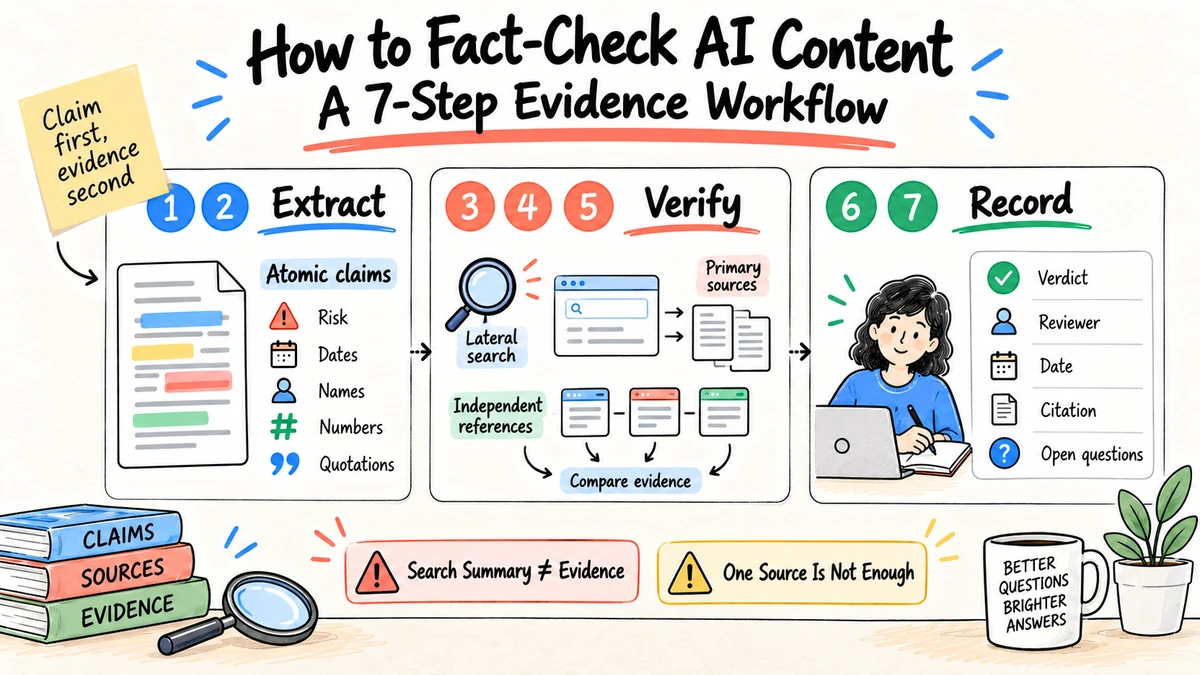
To fact-check AI content, split it into atomic claims, rank those claims by risk, define an acceptable source for each one, search outside the generated answer, record the exact evidence, and revise from that evidence. Never ask the same AI to give itself a final pass and treat the result as verification.
Research and disclosure: This workflow reflects Google Fact Check Explorer, NIST guidance on generative AI risks, and lateral-reading guidance from the University of Maryland and University of Arizona surfaced in the September 4, 2026 Google US SERP. The seven-step method and templates are original editorial frameworks.
Step 1: Freeze the draft and extract claims
Keep the generated draft unchanged as a source record. Copy every checkable statement into a claim inventory. Split compound sentences so each row can receive its own evidence and verdict.
Check names, dates, numbers, quotations, causal statements, product capabilities, laws, prices, rankings, and claims about what a source says. Pure opinion and clearly labeled suggestions do not need the same treatment, but their factual premises do.
Step 2: Assign risk and volatility
| Level | Examples | Review depth |
|---|---|---|
| Critical | Health, legal, safety, finance, allegations | Qualified reviewer and authoritative evidence |
| High | Customer promises, employment, public company claims | Primary source plus accountable approval |
| Medium | Product features, statistics, attributed advice | Direct current source and editor review |
| Low | Stable background context | Reliable source and normal editorial review |
Add volatility separately. A company founder may be stable; its current CEO, price, and product limits may change. Current claims need a dated source and a fresh check close to publication.
Step 3: Set the source hierarchy
Before searching, state what evidence can resolve the claim:
- Law, regulator, standards body, original dataset, official documentation, filing, or direct statement.
- Peer-reviewed research or a reputable institution with visible methods.
- Strong independent reporting that links its evidence.
- Secondary explainers for context, not as substitutes for an available primary source.
- Community reports as anecdotal evidence, clearly labeled.
Do not count ten pages repeating one unsupported statistic as ten sources. Follow citations until you reach the origin.
Step 4: Read laterally
Leave the page and investigate the source itself. Search the organization, author, claim wording, date, and independent coverage in separate tabs. Check whether the page has expertise, incentives, correction practices, and a publication history appropriate to the claim.
For a quotation, open the transcript or original publication and read the surrounding context. For a statistic, inspect the population, sample, method, date, and denominator.
Step 5: Build an evidence ledger
Claim ID:
Exact claim:
Risk and volatility:
Required source class:
Source URL and publisher:
Publication or update date:
Exact supporting passage or data field:
Context or limitation:
Verdict: supported / contradicted / mixed / unresolved
Reviewer and review date:
Draft change:
The ledger makes uncertainty visible and lets another editor reproduce the decision. Save the relevant passage because pages can change after publication.
Step 6: Revise from evidence
Do not force evidence to fit the draft. Correct numbers, narrow causal language, add dates, distinguish company claims from measured results, remove invented quotations, and delete claims that remain unresolved. If sources disagree, state the disagreement and explain which evidence governs.
Step 7: Run a final integrity pass
Confirm that every material claim has the right citation, every link opens the intended source, and the cited passage supports the nearby wording. Check that revisions did not introduce a new number or absolute claim. For high-impact work, have a second reviewer sign off.
Worked example: checking a product comparison
Suppose an AI draft says: "Platform A is the fastest research assistant, supports every common file type, and reduced report preparation by 60% in a university study."
That sentence contains at least three claims, not one:
| Claim | Risk | Evidence required | Likely disposition |
|---|---|---|---|
| Platform A is the fastest | High and comparative | Current independent benchmark with disclosed method | Remove unless a suitable benchmark exists |
| It supports every common file type | Medium and current | Current official compatibility documentation | Replace with a dated, enumerated list |
| It reduced preparation time by 60% | High and quantitative | Original study, population, method, and result | Attribute precisely or remove |
Search the quoted 60% wording first. If ten articles repeat it but all lead back to a vendor press release, there is still only one interested source. Open the underlying study, if it exists. Check who participated, what "report preparation" meant, which baseline was used, and whether the result is an average, a self-report, or a measured outcome.
The revised copy may become:
Platform A's documentation listed PDF, DOCX, and PPTX ingestion when reviewed on September 4, 2026. In a vendor-sponsored study of its own customers, participants reported shorter preparation time, but the study did not establish that the product is the fastest option.
That sentence is less dramatic and more useful. It separates a verified capability from a qualified study claim and removes an unsupported superlative.
How to check different claim types
Numbers and percentages
Find the original table, dataset, filing, or methods section. Verify the unit, denominator, geography, time period, sample, and whether the number is adjusted. Watch for a percentage-point change being described as a percentage change. Recalculate simple totals when the underlying values are available.
Quotations
Search an exact distinctive phrase, then open the original transcript, recording, filing, speech, or publication. Confirm the speaker, wording, date, and surrounding context. Do not convert a paraphrase into quotation marks.
Product features and prices
Use current official documentation and pricing pages, capture the review date, and name the applicable plan, region, platform, or limitation. A product page can verify what a vendor offers or claims; it does not independently prove performance.
Scientific and health claims
Prefer original peer-reviewed research and authoritative health bodies. Inspect study design, population, endpoints, uncertainty, and subsequent evidence. Do not turn association into causation or a preliminary result into settled guidance.
Laws, regulations, and policies
Use the current official text and identify jurisdiction, effective date, and applicability. Secondary legal blogs can help locate issues but should not be the final authority. Obtain qualified review before advice or action.
Claims about people or organizations
Confirm identity and use direct records or strong reporting. Avoid repeating allegations merely because they appear in generated text. Consider whether the claim is necessary, proportionate, current, and fairly contextualized.
Use AI twice, with different roles
AI can be useful in two separated passes. In the first pass, it acts as an extractor: identify claims, dates, entities, quotations, and implied comparisons without deciding truth. In the second pass, after sources are supplied, it acts as an evidence organizer: pair passages with claims, surface contradictions, and draft qualified revisions.
The reviewer remains independent of both passes. Do not ask one model to generate a claim, search for support, decide that the support is sufficient, and approve publication in a single conversation. Separation makes confirmation bias and missing evidence easier to see.
Editorial sign-off checklist
[ ] Every material factual sentence appears in the claim inventory.
[ ] High-risk and volatile claims were checked closest to publication.
[ ] Citations open and point to the intended version.
[ ] The cited passage supports the exact nearby wording.
[ ] Original data, quotations, and policy text were inspected where available.
[ ] Vendor claims and sponsored studies are labeled.
[ ] Conflicts, uncertainty, and missing evidence remain visible.
[ ] Tables, captions, FAQs, and CTA copy received the same review as the body.
[ ] A second reviewer approved critical claims.
[ ] The evidence ledger and final version were retained under policy.
Divide work across a team
For a long report, assign by claim type or section rather than letting several reviewers edit the same ledger without ownership. One researcher can check company and product claims, another can check data and methods, and a subject specialist can review high-impact interpretations.
Use a shared disposition vocabulary and require each reviewer to record evidence, date, and rationale. A lead editor resolves overlaps and verifies that different sections apply the same source standard.
Review lead: owns scope, source hierarchy, conflicts, and final sign-off.
Claim owner: finds evidence and proposes a disposition.
Subject reviewer: judges specialized or consequential meaning.
Copy editor: aligns final wording and citations with approved evidence.
Publisher: confirms current links, disclosures, and approval status.
Freeze the ledger during final copy editing or track new claims automatically. Otherwise a polished rewrite can introduce an unchecked comparison, date, or causal statement after research is complete.
Handle corrections after publication
When a published claim is challenged, reopen the exact claim record. Preserve the original wording, evidence, publication version, challenge, investigation, decision, correction, and notification. Do not silently replace consequential errors when readers or downstream users may have relied on them.
Classify whether the problem came from unavailable evidence, a mismatched citation, a stale fact, an interpretation error, or an editorial change after approval. Add the case to future review training and automated checks.
For current claims, schedule revalidation. Prices, product limits, job titles, laws, and policies can become wrong without any failure in the original fact-check.
Common shortcuts that do not work
Asking, "Is this true?" A broad question encourages another fluent answer. Ask for atomic claims and exact evidence instead.
Counting search results. Repetition can come from syndication, copied marketing copy, or one original report. Count independent evidence chains.
Trusting a familiar domain automatically. Even authoritative sites contain old pages, opinion, user content, and material outside their expertise. Match the specific page to the claim.
Checking only statistics. Names, dates, negations, plan limits, attributions, and causal wording can be just as damaging when wrong.
Adding citations after writing. Citation decoration encourages sources that merely resemble the claim. Evidence-led revision changes or removes claims when support is weak.
A fact-checking prompt that preserves uncertainty
Extract atomic factual claims from the attached draft.
Return a table with claim, type, risk, volatility, and required source class.
Use only the supplied sources for a preliminary verdict.
Quote the exact supporting passage and include its source URL and date.
Mark mixed or missing evidence as unresolved. Do not invent citations,
silently rewrite the draft, or make a final legal, medical, or safety decision.
The AI fact checker guide explains how to evaluate tools for this workflow. The prompt engineering guide shows how to define evidence and output contracts clearly.
FAQ
Can I use AI to fact-check AI-generated text?
Yes, for claim extraction, search assistance, and evidence organization. A person must still inspect the original sources and approve consequential conclusions.
How many sources does each claim need?
Source quality matters more than count. One current authoritative primary source may resolve a straightforward claim. Disputed, causal, or high-impact claims often need independent corroboration.
What should I do when sources disagree?
Record the disagreement, compare methods and dates, prefer the source class defined in advance, narrow the claim, and mark it unresolved when the evidence cannot support a responsible conclusion.
Should AI-generated citations be trusted?
No citation should be trusted until it opens, identifies the expected source, and directly supports the claim. Fabricated and mismatched citations are common failure modes.
How long should fact-checking take?
It depends on claim count and risk. Triage first: a short article with several legal or quantitative claims can require more review than a long opinion piece. Track time by claim type so future briefs include a realistic review budget.
Do screenshots count as evidence?
They can preserve how a page appeared, but record the URL, date, owner, and surrounding context as well. Screenshots are weak evidence when they cannot be traced to an authentic source.
How should anonymous sources be handled?
Follow the publication's editorial policy and assess access, motive, corroboration, and risk. AI cannot independently establish an anonymous source's identity or credibility from the supplied quote.
When should a published article be rechecked?
Recheck on a defined schedule for volatile claims and after a material source, product, law, role, study, or challenge changes. Stable historical claims may need no routine refresh.
Bring the draft, approved sources, and ledger template into Ottermind to produce a reviewable deliverable with evidence and unresolved questions kept together.