How To
AI Document Review Workflow: From Source Pack to Approved Draft
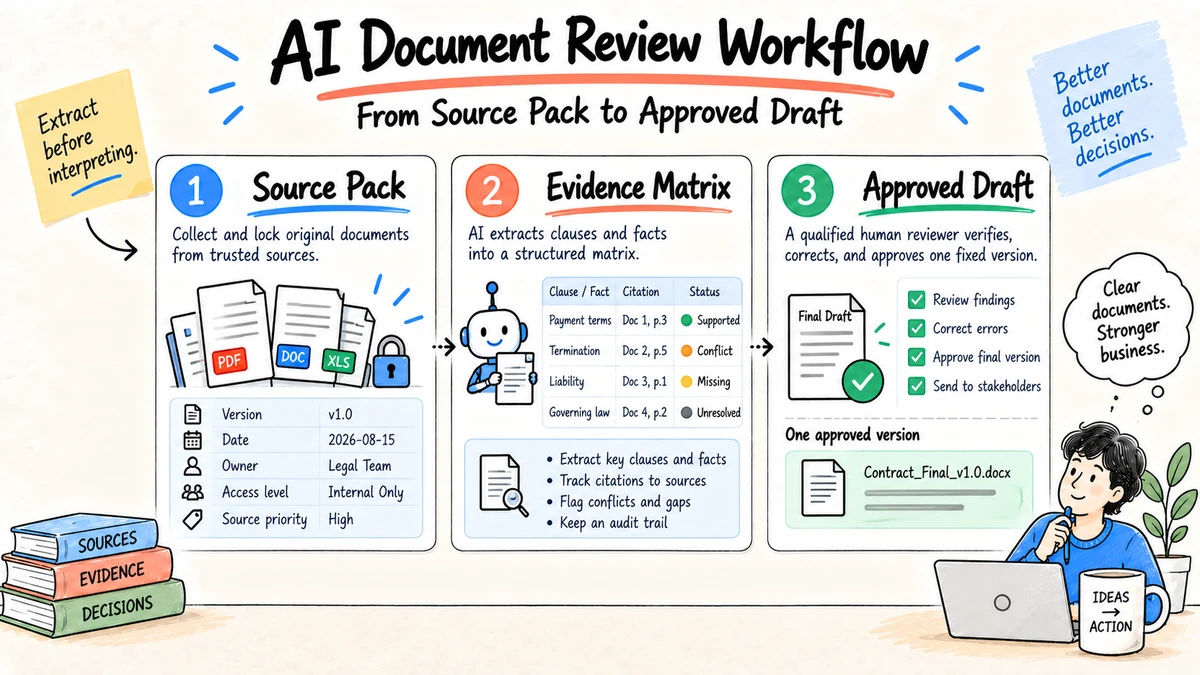
An AI document review workflow should turn a defined source pack into structured findings that a person can verify. The AI can inventory files, extract clauses or facts, compare versions, flag gaps, and draft a report. It should not hide source conflicts, invent missing language, or make the final legal, financial, employment, or safety decision.
Research and disclosure: This workflow draws on IBM document workflow guidance, IBM document processing guidance, and the NIST Generative AI Profile, reviewed September 4, 2026. The review matrix and acceptance checklist are original editorial frameworks and do not replace qualified professional review.
When AI document review is a good fit
Use it for bounded, repeatable questions across a known set of documents: compare policy versions, find missing fields, organize contract clauses for counsel, extract requirements from a request for proposal, reconcile a report with source files, or prepare a due-diligence index.
Do not start with an undefined request such as "review everything." Name the decision, documents, questions, evidence standard, reviewer, and output.
Choose the review mode
| Mode | Purpose | Typical output |
|---|---|---|
| Extraction | Locate named facts, clauses, requirements, or fields | Structured table with source locations |
| Comparison | Identify additions, removals, and changed meaning | Version matrix and material differences |
| Compliance check | Compare documents with a defined rule set | Control-by-control findings and gaps |
| Due diligence | Organize evidence for specialist judgment | Issue list, evidence, ownership, and open questions |
| Quality review | Check a draft against sources and acceptance criteria | Corrections, unsupported claims, and approval status |
| Discovery | Find patterns or questions for further investigation | Hypotheses clearly separated from verified findings |
One project can use several modes, but run them as visible stages. A discovery hypothesis should not silently become a compliance finding.
Step 1: Lock the source inventory
Create a manifest before analysis:
| Field | Purpose |
|---|---|
| Document ID and file name | Stable reference |
| Version and effective date | Prevent comparison with stale text |
| Source and owner | Establish authority |
| Sensitivity and access | Limit exposure |
| Included or excluded | Make scope visible |
| Supersedes | Resolve version relationships |
Keep the originals read-only. Record any file that is corrupt, incomplete, duplicated, or outside scope.
Define source authority
Write a rule for conflicts before analysis. In a policy review, a signed current policy may govern over a draft handbook; in contract work, an executed amendment may supersede the original clause; in research, an original dataset may govern a later summary.
The system should preserve both sources and explain the applied relationship. Do not delete the losing version from the record because it may explain past decisions or reveal a migration problem.
Control access by source, not only project
A source pack can combine documents with different permissions. Confirm that the reviewer and processing system may access each file. Avoid granting every project participant access to a restricted appendix merely because they can see the final summary.
Derived notes can inherit restrictions. A short extracted clause may still reveal personal, legal, financial, or security-sensitive content.
Step 2: Define the review schema
Translate the review question into fields before asking for conclusions.
Review objective:
Required document set:
Topic or clause:
Extracted wording:
Document ID and page or section:
Effective date:
Difference from baseline:
Issue type:
Impact:
Missing information:
Recommended reviewer:
Status: open / confirmed / resolved / out of scope
A schema makes gaps visible. Narrative summaries often blur absence, conflict, and uncertainty into fluent prose.
Add fields for extraction_status, review_status, and decision_status. A finding can be extracted successfully, disputed by reviewers, and still awaiting an authorized decision. One generic complete field cannot represent those differences.
Version the schema and review criteria. When requirements change, identify which findings must be rerun. Do not compare issue counts across versions without accounting for a broader or narrower rule set.
Step 3: Prepare the documents
Before substantive review:
- Confirm file integrity, format, readability, page count, and language.
- Detect duplicates and near-duplicates without removing evidence prematurely.
- Preserve layout for tables, columns, headers, footnotes, signatures, and tracked changes.
- Apply OCR when required and retain confidence or quality signals.
- Segment large files at meaningful boundaries while preserving page references.
- Identify attachments, schedules, linked files, and referenced documents that are absent.
- Mark handwritten, redacted, corrupted, or image-only regions for human attention.
Text extraction alone can destroy meaning. A value in the "excluded" column may appear next to the "included" heading after poor table conversion. Sample difficult layouts before trusting batch results.
Step 4: Extract before interpreting
Run a first pass that returns relevant text with document and location references. Check a sample against the originals. Only then ask the system to classify differences or synthesize findings. Separating extraction from interpretation makes errors easier to detect.
For tables and scanned files, verify layout, units, headers, footnotes, and OCR. A correctly recognized number can still be attached to the wrong column.
Use a two-pass extraction design. The first pass identifies candidate locations. The second returns exact passages and structured fields from those locations. Compare a sample across document types and layouts, including pages where no relevant content should be found.
Measure missed findings, not only precision. A review that returns five correct clauses but overlooks the sixth required clause can appear accurate while remaining incomplete.
Step 5: Build an issue and evidence matrix
For each issue, preserve the supporting passages, conflicting sources, missing files, rule used, and reviewer decision. Use unresolved instead of filling a gap with a likely answer.
Prioritize by impact and confidence:
- high impact and low confidence goes to immediate specialist review;
- high impact and high confidence still requires accountable approval;
- low impact and low confidence can be sampled or returned for clarification;
- low impact and high confidence may proceed under the workflow's approved rule.
Use stable issue categories
Categories might include missing requirement, conflicting language, changed obligation, expired source, undefined owner, unsupported claim, inaccessible evidence, calculation mismatch, approval gap, and out of scope. Stable categories support triage and reveal repeated process problems.
Every issue should include impact rationale, not only a severity label. Reviewers need to understand who or what is affected and what decision is blocked.
Preserve disagreement
If two reviewers interpret a clause differently, record both positions, supporting passages, and the person authorized to decide. Do not ask the AI to blend disagreement into a compromise sentence.
Step 6: Draft with traceable citations
Every material finding should link to the source location. Distinguish document language, reviewer interpretation, and AI suggestion. When sources conflict, describe the conflict and source-priority rule rather than silently selecting one.
Using only the approved source inventory, produce the review matrix.
Quote the minimum relevant passage and cite document ID plus page or section.
Separate extraction, interpretation, and recommendation.
Mark missing or conflicting evidence as unresolved.
Do not make a final legal, financial, employment, or safety decision.
Use separate sections for confirmed findings, unresolved issues, scope limitations, and recommendations. Recommendations should cite the findings they respond to and name the decision owner.
Avoid confidence theater. A numerical confidence score is useful only when its meaning is defined and validated. Source quality, extraction confidence, rule match, and reviewer agreement are different signals.
Step 7: Review, revise, and approve a fixed version
The reviewer opens the cited locations, corrects the matrix, resolves or escalates issues, and signs off on a specific output version. If the source pack changes, identify affected findings and require reapproval rather than carrying the old approval forward.
Record corrections with reason codes: missed evidence, wrong location, extraction error, interpretation error, obsolete source, scope change, or reviewer preference. This turns review work into an evaluation set and shows whether the system is improving.
The final approval should state what it covers. Approval of the issue inventory does not automatically approve a contract, payment, policy, or publication.
Worked example: policy version review
A company must compare a new travel policy with the current handbook, regional expense rules, and manager guide before rollout.
Source inventory
The team records four files with owners and dates. The draft policy is not authoritative. The regional expense rules govern local reimbursement limits, while the signed handbook governs employment-wide language until the new policy is approved.
Review schema
Required topics include eligibility, booking, approval limits, receipts, exceptions, safety, regional differences, data handling, effective date, and owner. Each row requires exact wording and a location from every applicable source.
Extraction and comparison
AI extracts candidate passages. Deterministic checks identify currency and numerical differences. The comparison finds that the draft increases one meal limit, removes a receipt exception, and names an approval role that does not exist in the organization directory.
Issue matrix
The limit change is assigned to finance, the exception removal to HR and legal, and the nonexistent role to policy operations. A regional source is missing for one location, so that row remains unresolved.
Draft and approval
The system drafts a decision memo with citations and a list of blocked items. It does not declare the policy ready. Owners resolve the issues, a revised source is added as a new version, affected rows are rerun, and the authorized policy owner approves the fixed version.
The workflow succeeds because it makes the missing source and nonexistent role visible before communication begins.
Review patterns by document type
Contracts
Create a clause matrix for parties, term, renewal, pricing, obligations, data, security, liability, termination, governing law, and referenced schedules. Compare with the approved baseline, but leave legal judgment to counsel.
Requests for proposal
Map every requirement to response location, owner, status, evidence, and exception. Distinguish mandatory language from scoring guidance and questions. Validate submission instructions, dates, formats, and attachments separately.
Research reports
Extract material claims, methods, populations, dates, limitations, funding, and source data. Check that the draft does not turn association into causation or generalize beyond the studied population.
Policies and procedures
Track authority, effective date, applicability, roles, required actions, exceptions, records, and superseded documents. Verify that training and communications use the approved version.
Financial or operational reports
Trace figures to source tables, units, filters, periods, and transformations. Recalculate important totals and reconcile them with authoritative systems.
Security and prompt-injection controls
Document text is untrusted input. A resume, contract, or web export can contain instructions telling an AI to ignore the review scope, reveal other files, or use a tool. The processing system should treat those words as document content, never system authority.
Restrict accessible sources and tools, isolate projects, minimize permissions, validate structured outputs, and require approval for external actions. Log which sources and tools each run accessed. Test documents containing adversarial instructions before production.
Do not expose one party's restricted documents through a cross-project search index. Retrieval permissions must be enforced at query time and reflected in cached or derived content.
Measure review quality and economics
| Measure | Definition |
|---|---|
| Finding recall | Required findings discovered / known required findings |
| Citation precision | Correct supporting locations / citations returned |
| Material error rate | Findings with consequential extraction or interpretation errors |
| Unresolved visibility | Genuine gaps correctly left open / known gaps |
| Reviewer correction time | Time to inspect, correct, and approve |
| Rework rate | Reviews reopened after downstream use |
| Cost per approved review | Processing, tooling, reviewer, and correction cost |
Build a labeled set from completed reviews and include no-finding documents. Reevaluate after changes to models, extraction, prompts, schema, source types, or reviewer criteria.
Design the reviewer interface around evidence
Show the original page and extracted passage beside the structured finding. Reviewers should be able to move to the preceding and following context, compare versions, correct fields, change disposition, assign an owner, and record rationale without losing the source location.
Use visual status carefully. Color alone should not communicate severity or approval. Distinguish machine-proposed, human-reviewed, resolved, and authorized states with text and accessible controls.
Reduce reviewer fatigue by grouping related findings and prioritizing material issues, but preserve a way to inspect the complete source. Hiding low-confidence rows can create exactly the omissions the review is meant to catch.
Track interaction evidence that improves the workflow: fields corrected, findings rejected, sources replaced, conflicts escalated, and time by issue type. Do not use mouse movement or superficial activity as a proxy for review quality.
Calibrate human sampling
During early rollout, review every finding. Later, deterministic low-risk extractions may be sampled if measured performance and policy allow it. Continue full review for high-impact issues, new document types, changed models, confirmed incidents, and cases near decision thresholds.
Use blind double review on a subset to measure reviewer agreement. Disagreement may reveal ambiguous criteria rather than AI failure. Clarify the rubric, retain legitimate uncertainty, and avoid forcing consensus where qualified experts differ.
Roll out gradually
Start in shadow mode beside the manual review. Next, let the AI prepare an extraction table while reviewers make all findings. Then allow low-risk findings to enter the issue matrix with full review. Only after measured performance should the workflow automate routing or draft final artifacts.
Maintain a manual path for sensitive, unusual, inaccessible, or adversarial documents. Expansion to a new language, jurisdiction, clause set, or file format is a new validation scope, not a routine configuration toggle.
Acceptance checklist
-
The source manifest is complete and access-controlled.
-
Every material finding has a document and location reference.
-
Extraction was sampled against originals.
-
Missing and conflicting evidence is visible.
-
Restricted data did not enter an unapproved system.
-
High-impact findings have a named qualified reviewer.
-
The approved output and source versions are recorded.
-
Corrections are available for future evaluation.
-
Document content cannot change system permissions or review rules.
-
The manual fallback and source-change invalidation path have been tested.
The document workflow automation guide covers intake, routing, exceptions, and retention. The AI knowledge management guide explains source ownership and freshness across a broader collection.
FAQ
Can AI review contracts?
AI can extract and compare clauses, organize issues, and prepare a review matrix. Qualified counsel should make legal interpretations and decisions, especially where language, jurisdiction, or missing context matters.
How do I reduce hallucinations in document review?
Restrict the source set, extract before synthesizing, require location-level citations, use structured fields, allow unresolved results, and have reviewers open the originals.
Should the AI use web search during a closed document review?
Only when the scope explicitly allows it. Keep external research separate from findings based on the supplied record, and label each source class so reviewers know what governed the conclusion.
What should be retained after review?
Retain the source manifest, approved output, issue matrix, reviewer decisions, and required audit records according to the applicable records policy. Avoid keeping unnecessary sensitive prompts or intermediate content.
How accurate must AI document review be?
Set acceptance by finding type and impact. High-impact clauses or figures may require complete human inspection even when measured accuracy is high. Use both recall and precision on representative documents.
Can AI compare hundreds of documents at once?
It can help batch extraction and comparison, but volume increases the risk of missed files, broken references, context loss, and hidden exceptions. Use manifests, staged processing, sampling, reconciliation, and explicit failure reporting.
What happens when a source changes after approval?
Create a new source version, identify affected findings, rerun them, and require reapproval where meaning or evidence changed. Preserve the prior approved record under the retention policy.
Should reviewers see the AI confidence score?
Only when the score has a validated meaning and does not encourage automation bias. Source passage, rule, impact, and uncertainty reason are usually more actionable than one percentage.
Can reviewer corrections train the system automatically?
Preserve corrections as candidate evaluation or training data, but review quality, permissions, privacy, and representativeness before reuse. A rushed correction is not automatically a gold label.
Start the review in Ottermind with the source inventory, review schema, and acceptance checklist so the final document remains connected to the evidence and decisions behind it.