Case Collection
One-Pager Examples: 12 Templates for Real Business Work
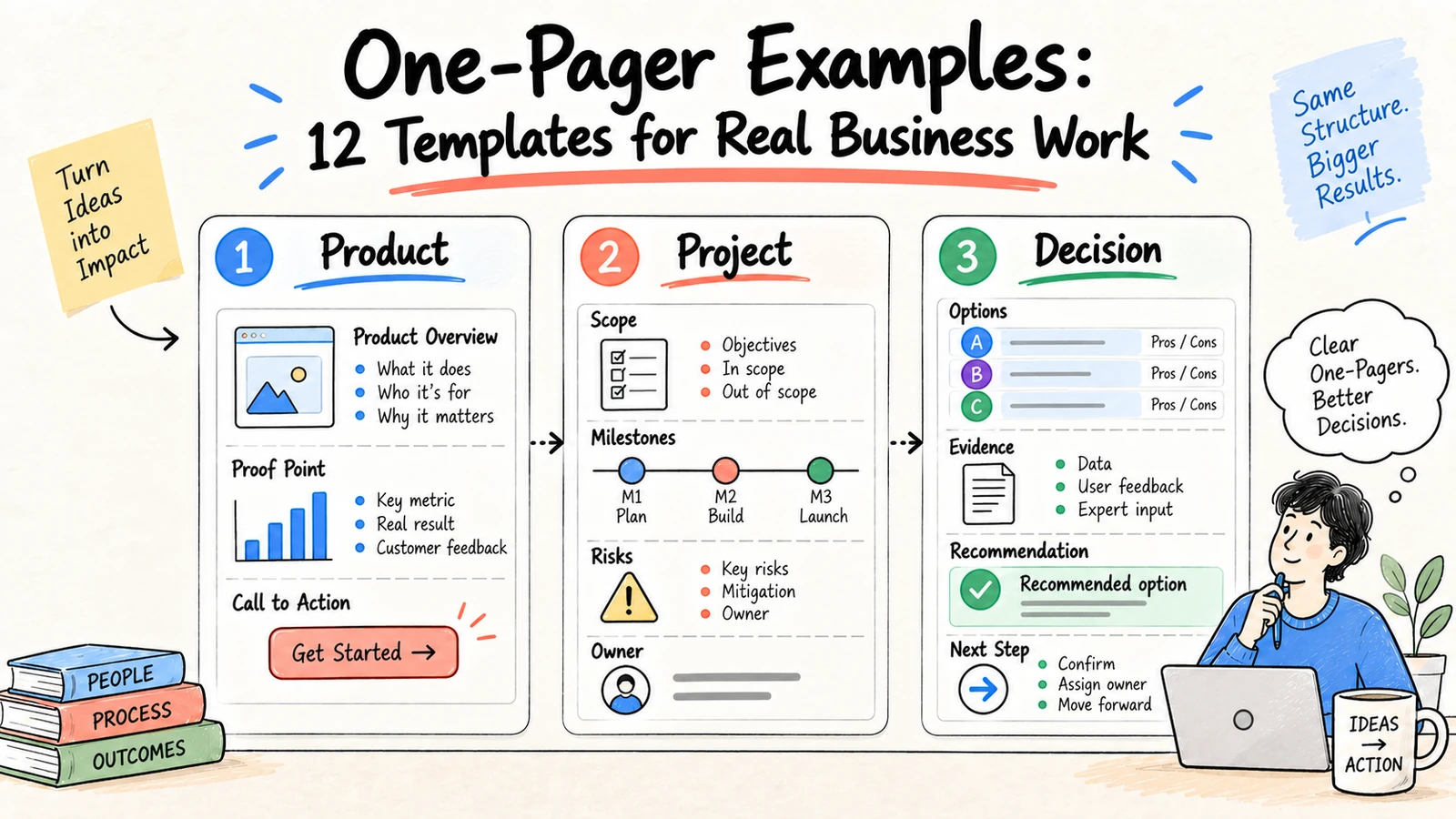
A one-pager is a single-page document built to help a specific reader understand, decide, or act. The best one-pager examples do not squeeze an entire report onto one sheet. They select one audience, one decision, the minimum evidence that decision requires, and one clear next step. Use the examples below as structures, then replace every placeholder with verified source material.
The format can support external work such as a product overview or client proposal, and internal work such as a project brief, decision memo, or research summary. What changes is not just the design. The audience, decision, proof, and next action change with the job.
One-pager guidance reviewed August 2026: Zapier's examples and templates, Adobe's business guide, LogRocket's product-management guide, Grammarly's writing guide, and Dock's sales collection
Five real one-pager examples worth studying
These are public assets from existing companies. Use them to study information hierarchy, audience fit, and the relationship between claims and visuals. Do not copy their branding, wording, customer evidence, or layouts into your own document.
Caterpillar MineStar Detect product one-pager
Caterpillar's MineStar Detect Object Detection one-pager starts with an operational problem: blind spots around large mobile equipment. It combines a problem-led headline, concise capability bullets, a diagram comparing visibility conditions, selected proof points, and a direct product CTA.
What to study: The page gives the visual comparison a real job. It helps the reader understand the operating problem before asking them to process feature detail. Any safety or performance metric used in a similar document would still need its original context and approval.
Threekit and Salesforce integration one-pager
The Threekit and Salesforce one-page PDF focuses on one integration and one outcome: helping buyers visualize configurable products. It uses a short value proposition, product-format examples, browser and API details, and clearly separated capability blocks.
What to study: An integration one-pager does not need the entire platform story. It needs to show what the combination enables, where it works, and which capabilities matter to the intended user.
Pendo Validate product one-pager
The public Pendo Validate one-pager archive shows a product overview aimed at product teams. Its central workflow is explained in three stages: idea input, customer engagement, and data analysis.
What to study: A short workflow can explain a product more clearly than a long feature list. The asset keeps one audience and one risk-reduction story in focus.
Scale AI search relevance one-pager
The public Scale AI Search Relevance and Ranking one-pager archive organizes a technical offering around concrete search-quality problems and the methods used to address them.
What to study: For a technical audience, specificity can build credibility. Pair each named capability with the problem or use case it supports instead of presenting isolated technical vocabulary.
WordPress VIP product one-pager
The public WordPress VIP one-pager archive addresses several stakeholders evaluating an enterprise CMS. It gives marketers, developers, and IT leaders different reasons to continue the evaluation while keeping the document under one product narrative.
What to study: A multi-stakeholder one-pager can work when every section supports the same buying decision. When the stakeholders need different decisions, split the document rather than shrinking more content onto the page.
Choose the one-pager by the decision it must support
Start with the reader's decision, not a favorite template. A founder deciding whether to fund a project needs different evidence from a buyer deciding whether to book a technical review.
| One-pager type | Primary reader | Decision or action | Evidence that matters most |
|---|---|---|---|
| Product | Buyer or internal team | Evaluate or explain a product | Problem, use case, differentiation, proof |
| Project | Sponsor and contributors | Approve or align on a project | Outcome, scope, milestones, risks |
| Executive decision memo | Leadership | Choose among options | Recommendation, evidence, tradeoffs |
| Feature launch | Product, sales, support | Prepare for release | User change, value, readiness, owner |
| Marketing campaign | Cross-functional campaign team | Approve a campaign direction | Audience, message, proof, channels |
| Sales solution | Prospective buyer | Continue the buying process | Buyer problem, solution fit, proof, next step |
| Client proposal | Client stakeholder | Approve a scoped engagement | Deliverables, approach, responsibilities, terms |
| Startup | Investor or partner | Continue evaluation | Problem, solution, market, traction, ask |
| Research summary | Decision-maker | Use findings in a decision | Question, findings, sources, limitations |
| Meeting decision record | Attendees and affected teams | Act on an agreed decision | Decision, rationale, owners, deadlines |
| Onboarding or process | Employee or collaborator | Follow a repeatable process | Steps, owner, exceptions, escalation |
| Event brief | Speakers, vendors, internal team | Deliver a coordinated event | Audience, run of show, requirements, owners |
The 12 templates below are original, adaptable structures. Their sample openings are fictional and demonstrate content shape, not customer results or verified business performance.
1. Product one-pager example
Use when: a buyer, partner, or internal team needs a fast product overview.
Reader's decision: Is this product relevant enough to investigate or recommend?
Suggested structure:
- Headline naming the product and its concrete job
- Reader problem in two or three sentences
- Three important use cases or capabilities
- Two to four verified proof points
- Fit and non-fit boundaries
- One next action
Example opening:
Atlas turns approved field notes into a weekly operations summary for regional managers. It is designed for teams that already collect reliable site data but lose time reconciling formats before leadership review.
This opening identifies the input, output, audience, and boundary. It is stronger than a slogan such as "Transform your operations with intelligence" because a reader can test whether the product fits.
Leave out: a complete feature catalog, unsupported superlatives, roadmap promises, and more than one primary CTA.
2. Project one-pager example
Use when: a sponsor and delivery team need to align before detailed planning begins.
Reader's decision: Should this project proceed with the proposed scope and ownership?
Suggested structure:
- Current problem and why it matters now
- Intended outcome and success measures
- In-scope and out-of-scope work
- Three to five milestones
- Owners, dependencies, and top risks
- Approval needed
Example opening:
The support knowledge refresh will replace 84 outdated help articles before the October release. Success means every affected product flow has an approved article, an assigned owner, and a verified link from the application.
The one-pager should establish the project contract. A detailed task plan, resource schedule, and issue log can follow after approval.
Leave out: every task, a daily schedule, and unresolved estimates presented as commitments.
3. Executive decision memo example
Use when: leadership needs to choose among a small number of consequential options.
Reader's decision: Which option should the organization approve?
Suggested structure:
- Decision required and deadline
- Recommended option
- Two or three alternatives considered
- Evidence supporting the recommendation
- Tradeoffs, risks, and reversible assumptions
- Decision owner and immediate next step
Example opening:
Decision requested by September 15: choose the customer-feedback system for the 2027 planning cycle. The working group recommends Option B because it meets the required data residency and export criteria at the lowest verified migration effort. Pricing remains subject to procurement confirmation.
This format puts the recommendation first while keeping uncertainty visible.
Leave out: a chronological retelling of the research process and evidence that does not affect the decision.
4. Feature launch one-pager example
Use when: product, sales, support, and marketing need one shared release reference.
Reader's decision: Are we ready to release and explain this feature consistently?
Suggested structure:
- What is changing and for whom
- User problem and value
- Availability and verified limitations
- Launch date and readiness status
- Customer-facing message
- Support, analytics, and escalation owners
Example opening:
Scheduled for the November 4 release, saved report views let account admins store a filtered table for repeat use. The first release supports shared workspace data but does not include scheduled delivery. Support and sales should use the approved availability language below.
The boundary statement prevents the launch narrative from quietly expanding beyond the shipped capability.
Leave out: internal debate that has already been resolved, unapproved pricing, and speculative future features.
5. Marketing campaign one-pager example
Use when: a campaign needs one approved direction before channel production starts.
Reader's decision: Should the team produce the campaign from this audience, promise, proof, and offer?
Suggested structure:
- Objective and target audience
- Trigger or problem
- Campaign promise
- Approved proof points
- Offer and CTA
- Channels, owners, review gates, and success measures
Example opening:
This campaign targets operations managers preparing quarterly business reviews. It will show how a verified reporting brief can become a consistent memo, table, and presentation outline without claiming that review can be fully automated.
For the full upstream method, use the AI marketing workflow guide to connect source research, message approval, asset production, and human review.
Leave out: unapproved channel copy, decorative mood-board language, and metrics without a baseline.
6. Sales solution one-pager example
Use when: a buyer needs a shareable explanation after a discovery call.
Reader's decision: Does this proposed solution address our specific problem well enough for the next evaluation step?
Suggested structure:
- Buyer's confirmed problem in their language
- Proposed workflow or use case
- Relevant capabilities and boundaries
- Verified evidence or reference architecture
- Evaluation requirements
- One next step with owner and date
Example opening:
Your regional teams submit weekly updates in four formats, and operations spends two days reconciling them before review. The proposed pilot standardizes the intake fields and tests one review workflow with the East region before any wider rollout.
The document should feel like a continuation of discovery, not a generic product brochure.
Leave out: unrelated capabilities, invented customer quotations, and pressure language that skips the buyer's evaluation process.
7. Client proposal one-pager example
Use when: a bounded engagement can be evaluated without a long proposal.
Reader's decision: Should the client approve this scope, approach, and commercial next step?
Suggested structure:
- Client objective and current constraint
- Proposed deliverables
- Approach and timeline
- Client and provider responsibilities
- Assumptions and exclusions
- Fee or next commercial step
Example opening:
Over four weeks, the engagement will produce a verified content inventory, a keyword-to-page ownership map, and a 90-day update queue. The client will provide analytics access and approve the final owner map; implementation is outside this scope.
Leave out: vague promises such as "drive exponential growth" and deliverables that cannot be reviewed or accepted.
8. Startup one-pager example
Use when: a founder needs a concise introduction for investors, partners, or early customers.
Reader's decision: Is this opportunity worth a deeper conversation?
Suggested structure:
- Specific problem and affected customer
- Product and why now
- Business model or adoption path
- Verified traction and market evidence
- Team relevance
- Precise ask
Example opening:
Northline helps independent clinics identify missed insurance follow-ups from existing billing exports. The pilot currently covers two claim categories; the company is seeking three design partners to validate the review workflow before expanding coverage.
This is a fictional example. In a real startup one-pager, every number, customer reference, and market claim needs a source.
Leave out: inflated market totals, logos without permission, and traction metrics that mix signups, active users, and paying customers.
9. Research summary one-pager example
Use when: a decision-maker needs the answer and evidence without reading the full research archive.
Reader's decision: How should these findings change a decision or next investigation?
Suggested structure:
- Research question and scope
- Three to five findings
- Evidence strength for each finding
- Limitations and conflicting signals
- Recommendation or next research step
- Links to the source ledger
Example opening:
Across 18 onboarding interviews conducted in July, the clearest repeated obstacle was uncertainty about who approves workspace access. The sample covers new administrators at companies with 20–200 employees and should not be generalized to enterprise deployments.
The useful constraint is visible: the reader knows what was observed and where the conclusion stops.
Leave out: raw notes, unsupported causality, and findings that do not answer the stated question.
10. Meeting decision record example
Use when: a meeting produced decisions and obligations that people must remember.
Reader's decision: What changed, and what must I do next?
Suggested structure:
- Meeting purpose and date
- Decisions made
- Rationale that future readers will need
- Action, owner, deadline, and dependency
- Open questions and escalation path
- Link to full notes or recording
Example opening:
On August 26, the launch group moved the beta from September 8 to September 22 because accessibility review is incomplete. Product owns the revised release plan; design must close the three blocking issues by September 5.
Leave out: a transcript-style summary, comments with no consequence, and action items without owners.
11. Onboarding or process one-pager example
Use when: someone needs to follow a short, repeatable process correctly.
Reader's decision: What do I do, in what order, and when should I stop or escalate?
Suggested structure:
- Purpose and intended user
- Prerequisites
- Five to seven numbered steps
- Expected result
- Common exception or failure state
- Owner and escalation contact
Example opening:
Use this checklist when adding a new analytics property. Do not begin until the data owner and retention setting are confirmed. Stop and contact Security if the property may contain regulated personal data.
Leave out: every edge case, unexplained internal vocabulary, and screenshots that no longer match the interface.
12. Event brief one-pager example
Use when: internal teams, speakers, and vendors need the same operating summary.
Reader's decision: What must I prepare and deliver for the event to run as planned?
Suggested structure:
- Event objective, audience, date, and location
- Core message or experience
- Short run of show
- Speaker, venue, production, and accessibility requirements
- Owners and contact method
- Contingency trigger
Example opening:
The customer workshop will help 30 workspace administrators build a reviewed reporting workflow. The session runs from 09:00–12:00 on October 18; facilitators must submit accessible materials by October 4.
Leave out: the entire project plan, vendor negotiation history, and details that belong in individual production checklists.
The ONE framework for building a useful one-pager
Use this original framework to decide what earns space on the page:
- Outcome: What should this reader understand, decide, approve, or do?
- Necessary evidence: What is the minimum verified information required to support that outcome?
- Execution: What happens next, who owns it, and where does the detailed work continue?
The framework is deliberately restrictive. If a section does not support the outcome, strengthen necessary evidence, or enable execution, move it to a linked source document.
Before drafting, complete this sentence:
After reading this one-pager, [specific audience] should be able to [single decision or action] because they can see [minimum necessary evidence].If the sentence needs two audiences or three decisions, you probably need separate documents or a longer brief.
Reusable one-pager template
This template works for most business one-pagers. Rename or remove sections according to the decision rather than filling every box mechanically.
ONE-PAGER TITLE
[Name the subject and the job this page supports.]

AUDIENCE AND OUTCOME
- Primary reader:
- Decision or action required:
- Decision deadline, if any:

CONTEXT
- What is happening?
- Why does it matter now?

RECOMMENDATION, OFFER, OR CORE MESSAGE
[State the central point in one short paragraph.]

NECESSARY EVIDENCE
- Verified fact or proof point 1:
- Verified fact or proof point 2:
- Verified fact or proof point 3:

BOUNDARIES AND TRADEOFFS
- What is not included?
- What remains uncertain?
- What risk requires review?

NEXT STEP
- Action:
- Owner:
- Date:
- Link to detailed source or working document:
How to create a one-pager with AI without losing the source
AI is most useful after you define the decision and assemble reliable material. It should help compress and structure evidence, not manufacture the missing proof.
1. Build a source pack
Collect only material relevant to the one-pager: an approved brief, product documentation, research notes, verified metrics, decision history, brand guidance, and known constraints. Mark which source wins if two sources conflict.
For research-heavy inputs, the AI document analysis guide explains how to evaluate extraction, citations, comparison, and human review.
2. Separate facts from open questions
Ask AI to extract confirmed facts, possible claims, conflicts, and missing information before it writes prose. Review that ledger against the sources. Remove anything you cannot support.
3. Draft for the decision
Give the model the audience, outcome, necessary evidence, boundaries, and output structure. A clear task brief is more dependable than asking it to "make a professional one-pager." The AI prompt guide provides a reusable structure for goals, context, input material, constraints, and acceptance criteria.
4. Review content before visual design
Check the headline, evidence, logic, and next step in a plain text draft. Then establish hierarchy with short sections, descriptive headings, whitespace, and restrained visuals. Decorative design cannot repair an unsupported argument.
5. Compare the page with its sources
Review every number, name, date, quotation, product statement, and commitment. Confirm that the page still fits on one page at the intended size and that the CTA goes to the correct owner or destination.
Reusable AI prompt for a one-pager draft
You are creating a one-page business document from verified source material.

Audience:
[Who will read it?]

Required outcome:
After reading, the audience should [understand, decide, approve, or do one thing].

Source material:
<materials>
[Paste the approved brief, facts, notes, and constraints.]
</materials>

Instructions:
1. Extract confirmed facts, conflicts, and missing information first.
2. Do not invent metrics, quotations, customer evidence, capabilities, dates, or commitments.
3. Draft a one-pager with:
   - A specific headline
   - Context or problem
   - Recommendation, offer, or core message
   - Up to four necessary proof points
   - Boundaries, risks, or exclusions
   - One next action with an owner
4. Keep the draft concise enough for one page with readable spacing.
5. If the source material cannot support a section, mark it [NEEDS SOURCE] instead of filling the gap.

Return:
- Source ledger
- One-pager draft
- Claims to verify
- Information intentionally left out
One-pager quality checklist
Before sharing the document, verify:
- One primary reader and one primary outcome are named
- The main point is understandable without a presentation
- Every material claim is traceable to a source
- The most important evidence is visually easy to find
- Assumptions, exclusions, and uncertainty are visible
- The next action has an owner and destination
- The page remains readable at its intended size
- Detailed material is linked instead of compressed into tiny text
- Accessibility, privacy, brand, legal, and regional requirements were reviewed where relevant
- A human accountable for the decision approved the final version
Where Ottermind fits
Ottermind can carry a prompt, supported reference material, and task context into Studio for conversational generation and revision. For a one-pager, start with the audience, decision, approved source pack, and ONE framework. Generate a text-first draft, compare it with the sources, and revise the hierarchy before treating it as ready to share.
Ottermind does not remove the need to verify claims, approve commitments, or perform legal, privacy, accessibility, and brand review. It also should not replace the detailed project plan, product requirements, research archive, or source documents that sit behind the page.
Bring one bounded brief and its source material to Ottermind Studio, then create a reviewable one-pager draft for a real decision.