Prompt Guidance
Dutch Angle: The Tilt, the Degrees, and the Prompt That Holds It
A dutch angle is a camera roll, and the degree is the decision. Here is the tilt, the prompts that hold it, and the check that catches a fake one — then take the brief into Ottermind Studio with an optional reference frame.
Optional
JPG / PNG / WebP
This is Ottermind's composer. Filling the brief and sending are separate actions: nothing is generated until you continue in Studio.
November 12, 2026 · 11 min read
A dutch angle is a shot where the camera is rolled around its own lens axis, so the standing world leans inside the frame. The camera does not move up or down, the lens does not change, and the subject does not move: the frame rotates around the line of sight, which leaves verticals no longer parallel to the sides of the picture and the horizon no longer parallel with its top edge (Wikipedia, NFI, both checked November 12, 2026).
That single rotation is the whole technique, and it is also why the technique is easy to misuse. Tilting a camera does not make a picture more interesting; it removes the cue the eye uses to decide which way is down. Use it when something in the scene has already gone wrong — a decision, a room, a person's footing — and leave the frame level when nothing has. Roger Ebert, reviewing Battlefield Earth, wrote that its director "has learned from better films that directors sometimes tilt their cameras, but he has not learned why", which remains the best one-line warning about the technique.
What follows is the part most guides skip. We generated the same prompt at four requested angles with OpenAI's gpt-image-2.5-flare image model, measured what came back, and wrote the prompts around the difference. The results below are from this article's own frames, not vendor claims.
How this guide was prepared: Official and reference pages checked November 12, 2026: Wikipedia's Dutch angle article (revision 1367683136), the Nashville Film Institute explainer, Dreamina's two Dutch-angle guides (published April 21, 2026 and May 20, 2026), and Ottermind's Image to Video and Photo to Video pages. The four ladder frames, the three failure frames and the cover photograph were generated for this article on November 12, 2026 with gpt-image-2.5-flare from the prompts quoted below; the angles printed on the figures were read off those frames by us, not measured by the model. Lines, labels and crops on the figures are editorial. The composer image is a real screenshot of this page. No video was generated inside Ottermind for this article.
What a dutch angle actually changes
Three things move together, and it helps to name them before writing a prompt:
- The horizon. A level shot keeps the horizon parallel with the bottom edge of the frame. A dutch angle breaks that parallelism by a stated number of degrees.
- The verticals. Door frames, mullions, poles and standing people stop being parallel with the sides of the frame. In a real roll they lean by the same number of degrees as the horizon — this is the detail that separates a rolled camera from a rotated picture.
- Nothing else. Camera height, lens, subject position and lighting stay put. A dutch angle is not a high angle or a low angle; those change where the camera is, and they change the subject's relationship to the viewer. The roll changes only the frame's relationship to gravity.
The name is a historical accident rather than a national style. "Dutch" is widely held to be a corruption of Deutsch, because the shot was used heavily in German expressionist cinema; the alternative reading is that "Dutch" here means out of line, as it does in the aeronautical "Dutch roll" (Wikipedia, checked November 12, 2026). Cinema has called the same move a dutch tilt, a canted angle, an oblique angle; photographers usually say slanted camera angle. All four describe one rotation, so treat them as synonyms in a brief and let the number do the work.
How many degrees should you ask for?
Published guidance is loose, and honestly so. The Nashville Film Institute puts the range at "as subtle as 5 degrees or as substantial as 90 degrees". Dreamina's own guide splits it into a slight lean of 5–15 degrees for tension and a radical 45 degrees for disorientation. Neither says what to do when a generator gives you something in between.
So we tested it. One prompt, one room, four rolls, one variable changed each time. The full prompt is in the first box below; these are what came back.
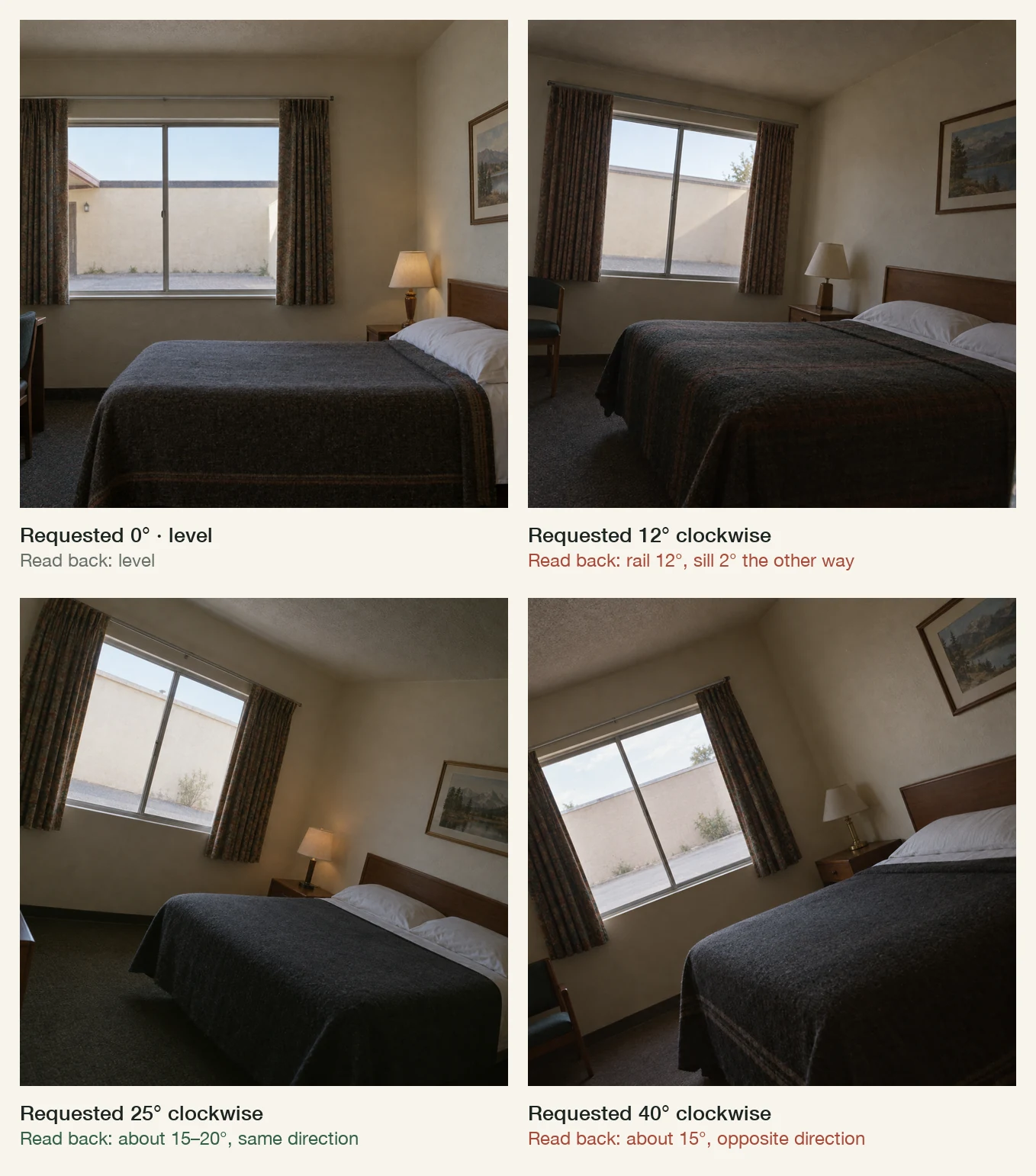
Same scene, same prompt, one number changed. Generated with gpt-image-2.5-flare for this article on November 12, 2026; the "read back" notes were measured on the window sill and the curtain rail of each frame. These are four samples from one model, not a benchmark.
| Asked for | What the frame shows | Use it as |
|---|---|---|
| Level (control) | Level. Sill and rail horizontal. | The reference every other frame is judged against |
| 12° clockwise | The rail leans 12° down, the sill 2° up — two parallel lines, 14° apart | Proof that a degree in a prompt is not a degree in the file |
| 25° clockwise | Roughly 15–20°, direction correct, rail and sill agree | The usable band: unmistakably a choice, room still readable |
| 40° clockwise | About 15°, and in the other direction | A reminder that the number is a hint, not a setting |
The practical reading: ask for 10–25 degrees, verify, and expect to iterate. Below about 8 degrees a reader cannot tell intent from accident, which is the worst place to land. Above roughly 45 degrees the room stops being a room and the frame becomes an abstraction — powerful once, exhausting in a sequence.
| Band | What it reads as | Where it earns its place |
|---|---|---|
| 0° | Normal. The default against which everything else is read | Everything that has not gone wrong |
| 3–8° | "Is this a mistake?" | Almost nowhere — too weak to be a choice, strong enough to look sloppy |
| 10–20° | Deliberate unease. The workhorse band | A room where a character is losing an argument |
| 20–35° | The world is off its axis | One beat, not a scene |
| 45° | Disorientation as the subject | A title card, a poster, a single frame |
| 60–90° | The image stops being a scene | Stylised work only; the reader has to work to read it |
The two-line check that catches a fake tilt
A generator can produce something that looks tilted without ever rolling the camera. The quick test costs about thirty seconds and needs no tools beyond a straight edge.
1. Measure the number. Pick one line in the frame that you know is horizontal in the real world — a window sill, a counter edge, a sea horizon, the top of a wall — and measure it against the top edge of the frame. Then ask: is it within about 5 degrees of what I asked for? On the 12-degree frame above, the answer is no twice over: the rail came back at the angle requested while the sill came back nearly level.
2. Check that parallel lines stayed parallel. This is the check almost nobody runs. In a real roll every horizontal in the same plane rotates by the same amount, so two of them must still agree. When they splay apart, the model has not rolled a camera — it has redrawn the room with sheared geometry, which is why the frame looks "tilted" and wrong at the same time.
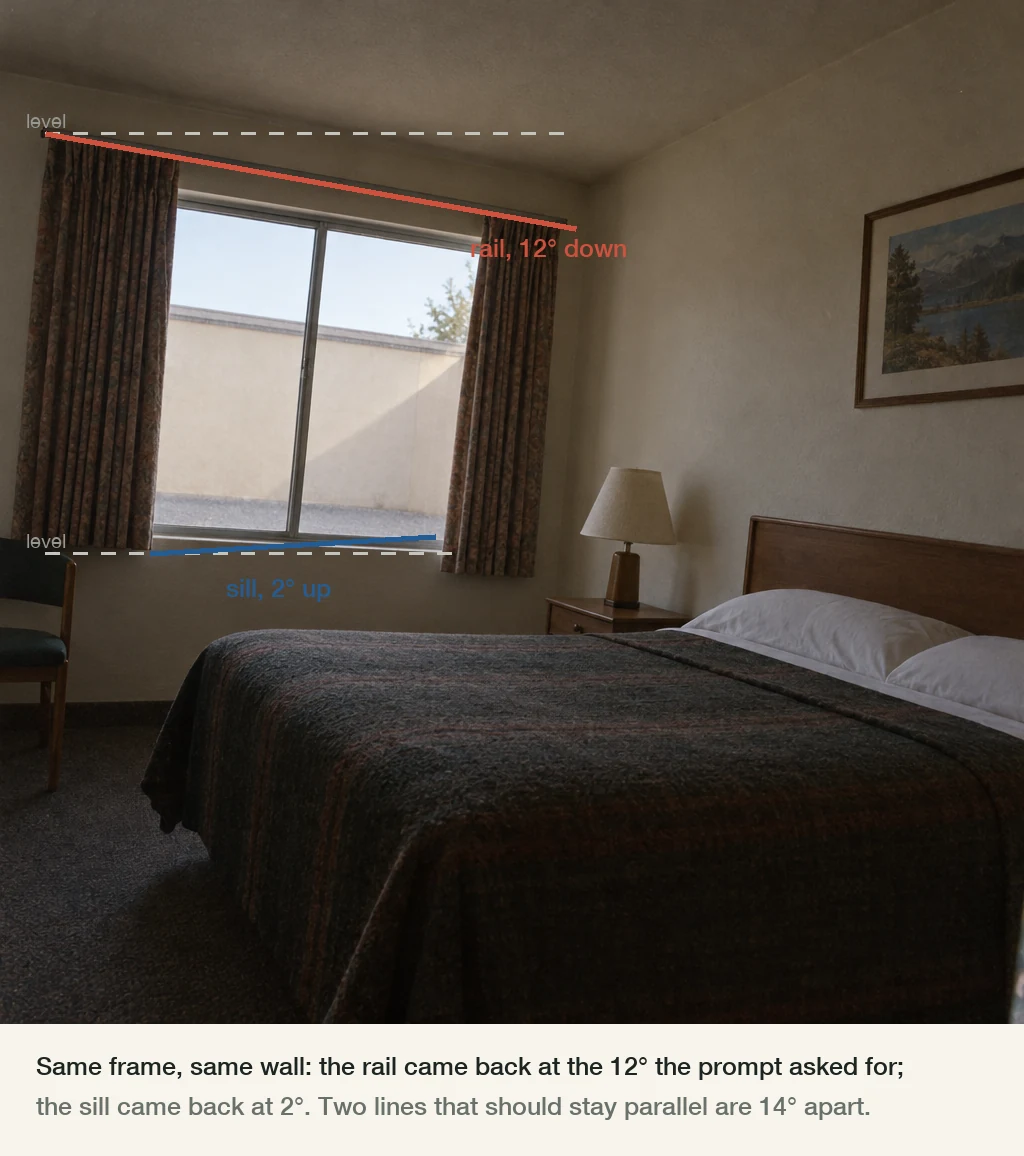
Measured on our own generated 12° frame: a level reference drawn through each line's left end, then the line read against it. A single line is only good to about a degree or two of reading error; the 14° gap between the two is not that. Lines and labels drawn by us.
3. Check the axis of the subject. In a genuine roll, a standing person leans by the same number of degrees as the room. If the room leans 20 degrees and the person is plumb, you are looking at a composite: a rotated background with an upright figure pasted in. It usually survives a thumbnail and falls apart at full size, around the feet and the contact points.
4. Check the corners. A rolled frame changes what fits. Faces, hands, logos and product labels that sat comfortably at the edge of a level shot can end up half out of frame. Decide before generating what must stay inside.
Five prompts, one variable each
Each box changes one thing about the image. Keep the rest fixed, or you will not know which instruction did the work.
1. The degree, written as a roll
This is the control. It names the axis, the direction and the number — the three facts a model needs to treat the tilt as a camera move rather than a mood.
Photograph of a quiet motel room in late afternoon: a made bed with a dark wool blanket, a window with a straight curtain rail looking onto an empty courtyard wall, a small bedside lamp, plain plaster walls, eye-level camera. Roll the camera 18 degrees clockwise around the lens axis, so the window rail, the sill and the bed edge are all tilted 18 degrees from the edge of the frame. Keep the room's geometry square: parallel lines in the room stay parallel. No text.This changes: the angle. Swap 18 for 10 or 25 and nothing else. Expect the returned angle to be shallower than requested; the check above tells you by how much.
2. The direction, chosen for a reason
Clockwise and counter-clockwise are not interchangeable, because the tilt decides which diagonal the viewer travels along. Lean the frame so the subject's eyeline runs with the rising diagonal, and the shot pulls attention toward whatever sits at the top of it; lean the other way and the subject appears to slide out of the bottom corner.
Portrait of a woman at a kitchen table, phone face down beside a cooling cup. Tip the frame 15 degrees counter-clockwise, so the table edge drops away from her toward the right of the frame and the empty wall rises behind her left shoulder. Keep her upright relative to the room, not to the frame. Natural window light, no text.This changes: the direction of the roll, and therefore which side of the frame carries the weight.
3. Parallel agreement
Use this when a straight-on attempt came back with warped walls. It asks for the one property the earlier frames failed: a single rigid rotation.
Interior of a small laundromat at night, seen from the doorway. Roll the camera 20 degrees clockwise around the lens axis and treat the room as rigid: every horizontal line — machine tops, the floor tile line, the ceiling strip — rotated by the same 20 degrees and staying parallel to each other; every vertical — door frame, machines, the light box — rotated by the same 20 degrees and staying parallel. Do not bend or shear the architecture. Fluorescent light, no text.This changes: geometric consistency. If the returned frame still splays, drop the angle to 12 and try again before rewriting the scene.
4. The reference line
A tilt is only legible against something that should have been level. In a forest, a fog bank or a close-up face there is no such line, and the image reads as "crooked" rather than "chosen". Keep one known horizontal in the frame.
Close-up of hands kneading dough on a floured counter, shot from the side. Tilt the frame 12 degrees clockwise and keep the counter's front edge visible across the lower third as the level reference; the hands stay the subject, the floured surface fills the rest. Hard side light, no text.This changes: legibility of the tilt. The named horizontal is what tells the viewer the angle was intended.
5. Holding the roll (video)
In a still, a tilt is a fact. In a clip, it is a behaviour: the roll has to hold, or drift for a reason. State which.
Animate this motel-room frame as a held 18-degree dutch angle: keep the camera rolled 18 degrees clockwise around the lens axis for the whole clip, so the window rail and the sill stay at the same diagonal in the first and last frame. Add only a slow push-in and a curtain moving slightly. Do not level the horizon, do not add a roll, do not move the frame. Keep the room's parallel lines parallel throughout. No text.This changes: whether the tilt survives motion. A horizon that quietly re-levels over two seconds undoes the shot.
The button fills the video brief into the composer at the top of this page. Filling and sending are separate: nothing is generated until you continue in Studio.
Where generation gets the tilt wrong
Four failures account for most of the bad dutch angles we produced and most of the bad ones in circulation. The first three are in the strip below, generated on purpose.
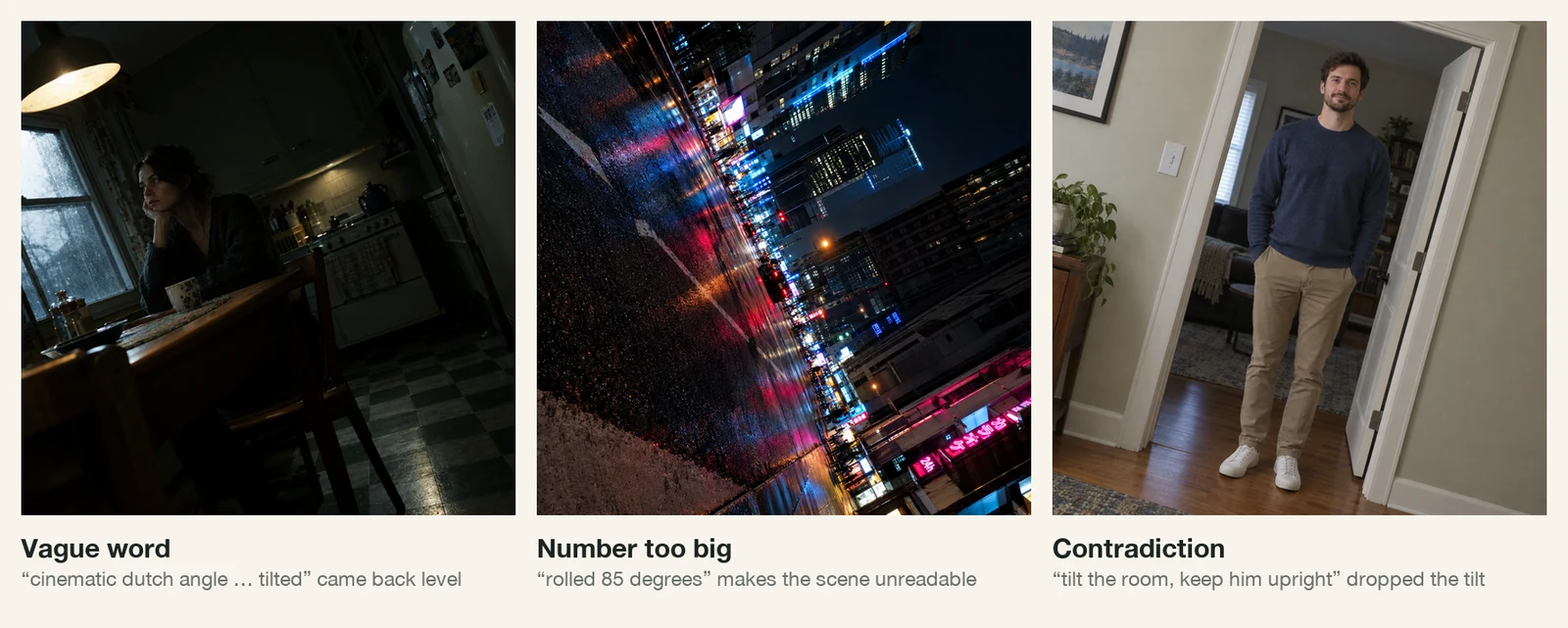
Left: "cinematic dutch angle … tilted" came back level. Middle: "rolled 85 degrees" makes the scene unreadable. Right: "tilt the room, keep the man upright" dropped the tilt instead of doing something impossible. Generated with gpt-image-2.5-flare for this article; labels added by us.
| What you see | Why it happened | What to change |
|---|---|---|
| A level frame from a prompt containing the word "dutch" | The adjective was read as a mood word, not an instruction | Name the axis and the number: "roll the camera 18 degrees clockwise around the lens axis" |
| A tilt far shallower than asked | The number is treated as a hint; models compress extremes | Accept the compression and ask for the upper end of the band you want, or re-prompt with the measured target |
| The room leans, the person does not | The instruction set a contradiction, so the model dropped the tilt | Roll the whole frame and say the figure leans with the room, by the same amount |
| Walls bend or shear; two horizontals splay | The model drew a tilted picture instead of rolling a camera | Add the rigid-rotation instruction and lower the angle |
| A horizon that re-levels during a clip (video) | Not verified in this test; watch the first and last frame | Ask for a held roll, then check both ends before accepting the take |
The pattern is consistent: models respond to the idea of a tilt more reliably than to its measurement. That is not a reason to avoid the number — it is a reason to check the frame after generating instead of trusting the prompt.
Dutch angle vs high angle vs "slanted camera angle"
Three terms get mixed together constantly, and the mix-up produces briefs that cannot be followed.
| Term | What changes | What it does to the subject |
|---|---|---|
| Dutch angle (dutch tilt, canted angle, slanted camera angle) | The camera rolls around the lens axis | Nothing physically; the viewer loses the cue for "which way is down" |
| High angle | The camera moves above the subject and looks down | Makes the subject smaller, more exposed, less powerful |
| Low angle | The camera moves below and looks up | Makes the subject larger, more dominant |
| A photo rotated in an editor | The whole picture turns; the frame is cropped to fit | Identical to a rolled frame in a still; expensive in video, and it loses corners |
A dutch angle and a high angle can be used in the same shot, and often are — the tilt supplies unease, the height supplies power. What separates them is that only one of them moves the camera. The other just turns it.
If the tilt is going into motion rather than a still, the phrasing of the camera instruction matters as much as the angle; the image-to-video prompting tutorial covers how much camera direction a clip will actually accept before the subject starts drifting, and the prompt engineering guide covers the general habit of changing one variable at a time.
Doing it in Ottermind
The composer at the top of this page is the real request surface: one text field for the brief and one optional attachment for a reference frame. There is no angle slider, which is why the degree belongs in the sentence — and why the two-line check matters more here than it would on a camera with a spirit level.
Two entries cover the usual starting points:
- Image to Video takes an image you have and a direction for its motion. Attach the approved frame, describe the roll and the hold, then review the take and rerender with a corrected angle. Ottermind's own page tells you to expect "a new interpretation of the reference" rather than "a pixel-identical animated copy", so check the framing against your source every time rather than assuming the tilt carried over.
- Photo to Video AI Free is the same workflow for photographs specifically. Current trial and credit terms are listed on that page; check them there rather than treating any number here as fixed.
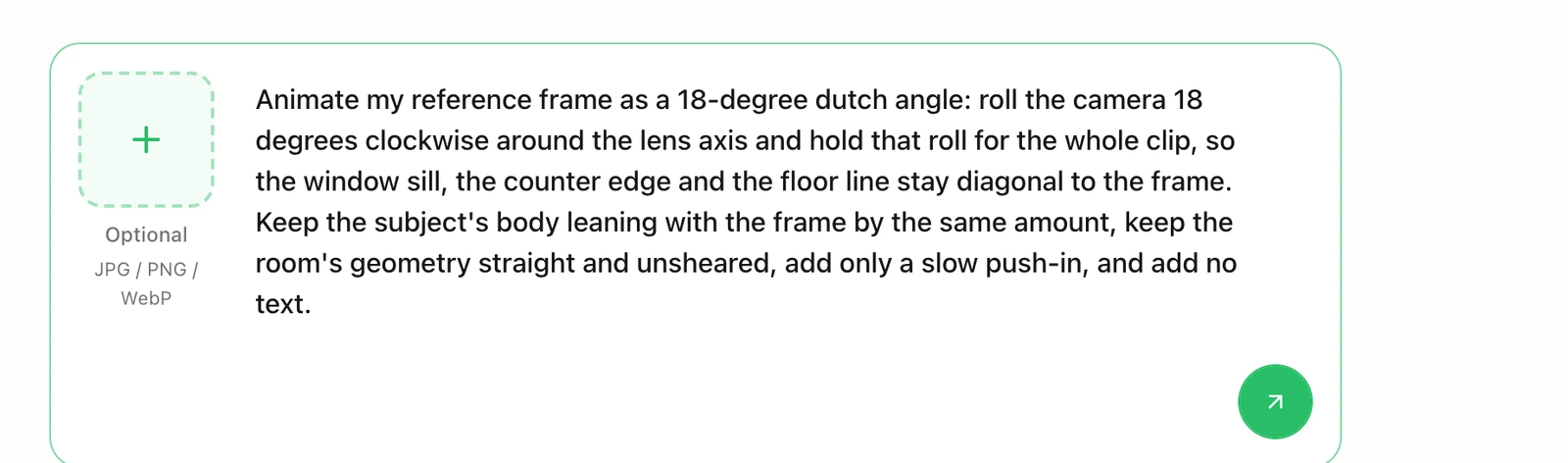
The composer on this page after filling the video brief. This is request preparation, not a generated shot: sending continues the brief into Studio, where the take is produced and reviewed.
Nothing about that path guarantees a fixed duration, resolution or output format, and nothing about it makes the tilt correct. It shortens the distance between "I know the number I want" and "I can see whether I got it", which is the only part of this workflow worth optimising.
Dutch angle questions worth answering
Is 45 degrees still a dutch angle?
Yes. It is the outside edge of the useful range rather than a different technique. Dreamina's guide uses 45 degrees as its example of radical disorientation, and the NFI puts the ceiling at 90 degrees. Past roughly 45 the scene stops being readable as a scene, so use it where the frame itself is the message.
Can I fix a dutch angle in post instead?
For a still, rotating the picture and re-cropping gives the same result as rolling the camera, minus the corners the crop eats. For video it means re-rotating every frame and losing the same corners on all of them, which is why rolling at capture — or asking for the roll explicitly — is cheaper. Neither route fixes a sheared room.
Do I need a horizon in the frame?
You need something the viewer knows should be level: a sill, a counter edge, a waterline, a row of windows. Without it the tilt reads as a crooked photograph rather than a decision. The fourth prompt above exists for exactly this case.
Which way should it lean?
Choose the diagonal the subject's eyeline or movement should follow, and lean the frame so that line rises toward whatever you want looked at. When several tilted shots run together, alternating the direction keeps the sequence from feeling like one long accident — a convention noted in the Wikipedia entry and visible in any montage that uses the technique well.
Is a slanted camera angle the same thing?
Yes. Slanted camera angle, canted angle, dutch tilt and oblique angle all name the same roll. If a client asks for a "slanted angle", ask for the number of degrees next; that is the only part of the request that changes the picture.
A dutch angle is one number and one check. Decide the number from the job — 10 to 20 degrees for unease, more only when the frame is the point — then measure what came back and fix the geometry before you fix the mood. A tilted frame that keeps its parallel lines reads as a decision; one that does not reads as an accident, however good the lighting is.