Prompt Guidance
Chibi Style: Proportions, Prompts, and How to Check a Result
Chibi is a head count before it is a look: two to three head-heights for the whole figure, eyes set low, one shadow tone. The brief below is the one this guide starts from — fill it, check the ratio on the result, then adjust one sentence at a time.
Optional
JPG / PNG / WebP
This is Ottermind's composer. Filling the brief and sending are separate actions, and no image is generated until you continue in Studio.
November 12, 2026 · 12 min read
Chibi style is a proportion decision: the whole figure is two to three head-heights tall, and everything else follows from that number. Big eyes, a round face and flat shading are consequences of the ratio, not the definition. A drawing with enormous eyes on a seven-head body is a cartoon; it is not chibi.
Use it when the job needs a character that reads at a glance and survives being small: stickers, emoji, an avatar, a mascot, a product tag-along, a joke panel inside a longer strip. Do not use it when the character has to be believed as a real person, carry a costume's real construction, or match a photograph someone will compare side by side. The right question before opening a generator is not "cute or not" but "how many heads is this figure, and who is measuring".
How this guide was prepared: Ottermind's AI Character Generator and Photo to Anime Converter pages were checked against the local marketing checkout (origin/main at 500ab56e) on November 12, 2026: upload types and limits, the composer fields, and the published style examples named below all come from that checkout. External pages could not be opened from this environment on that date — including the competitor page named in the brief, pollo.ai's chibi generator — so no claim here depends on any of them, and none of their copy was reused. The proportion thresholds are drawing conventions, stated as numbers so you can measure a result instead of arguing about it; they are not a rule any illustrator is obliged to follow. The cover art and the three comparison figures were generated for this article with GPT Image 2.5 Flare on November 12, 2026; the cover's type was set over that art afterwards, and the three panels come from briefs that differ only in the head count and the body geometry written for them; every generated image is labelled where it appears. The measurement diagram is assembled for this article, not generated. No generation was run inside Ottermind for this page, and no output is presented as a guaranteed result.
What chibi describes, precisely
The word comes from Japanese slang for a short person or a small child, and it entered fandom use as shorthand for a drawing that shrinks a character into an exaggerated small body while keeping them recognisable. That is the whole idea. Nothing in it requires a particular palette, line style, age or level of cuteness.
So the useful definition is arithmetic. Pick the head as your unit — from the top of the skull to the chin, hair included. Count how many of those units fit into the standing figure. A realistic adult sits near seven to seven and a half. A stylised child sits near four. Chibi starts at three and goes down to two, and below two you are drawing a head with limbs rather than a figure.
That single number predicts most of what people recognise as the style: how thick the limbs are relative to the head, how much shoulder there is, whether the hands can hold anything, and how much detail the face can carry before it turns muddy.
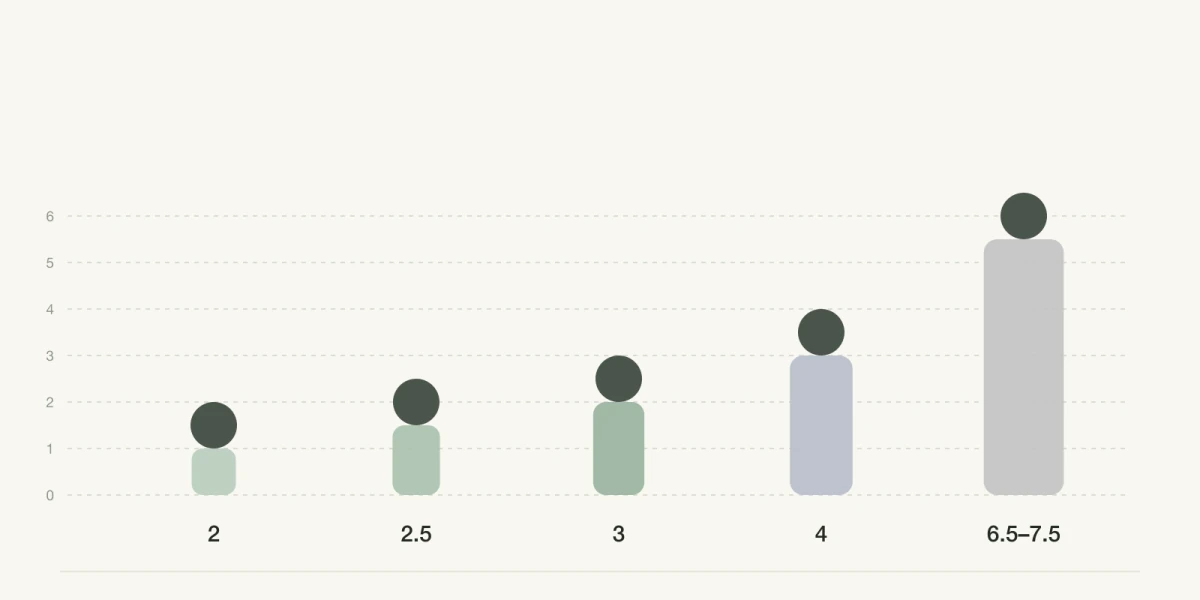
The counting method. The head is drawn once at the top and counted; the body is whatever remains. Diagrams assembled for this article from the convention described in the text — a measurement reference, not generated artwork and not a product screenshot.
The six things worth measuring
You cannot judge "chibi" by feel across two different images, and you certainly cannot judge it by a model's own opinion. Measure these instead. Each row is checkable on a finished image in about a minute, and each one fails in a recognisable way.
| Measure | Chibi reading | What it looks like when it fails |
|---|---|---|
| Head height ÷ total height | Between 1/3 and 1/2, i.e. 2–3 heads tall | At 4 heads it reads as a stylised child; at 6 it is an adult with a large head |
| Eye line, as a share of head height from the top | Roughly 55–65% down, clearly below the middle | Eyes at or above the midline give an adult face on a small body — the single most common miss |
| Each eye's width ÷ head width | About 1/4 to 1/3 | Below 1/5 the face looks realistic and starved; above 1/2 the eyes collide and the nose disappears |
| Shoulder width ÷ head width | About 1.2–1.5 head widths | Two or more head widths means the body was never re-scaled |
| Upper arm thickness ÷ head width | About 1/4, tapering a little at the wrist | Hair-thin arms under a big head produce the "bobblehead" look instead of a body |
| Distinct shading values on skin | Two, plus at most one highlight | Three or more soft steps, or airbrushed gradients, push the result toward a doll or a 3D render |
Two more that are not arithmetic but decide whether the image is usable. Line weight should hold up at the final size: a 1024-pixel image with hairlines disappears at 96 pixels, while lines that are too heavy close up the face. As a starting point, a line around 1.5–2% of the short edge — roughly 15–20 pixels at 1024 — stays visible when the image is scaled down. Detail budget: one focal detail per figure, and no more than two background elements. A chibi is read in a fraction of a second or it is not doing its job.
None of these numbers are laws. They are the reason two chibi drawings by different artists can look like the same style, and they give you something better than "make it cuter" to type into a prompt.
When chibi is the right answer
| The job | Why the ratio helps | What to watch |
|---|---|---|
| Sticker or emoji set | The silhouette still reads in a chat bubble at 96 px | Fewer than three colours; no background; consistent ratio across the set |
| Mascot or avatar | A face that is legible at the top of a page or a profile | Do not ask the same prompt for lettering; set the name in type afterwards |
| Explainer or joke panel | An expressive face carries a reaction without a paragraph | Keep the pose extreme and the background empty |
| Merch or packaging | A friendly character next to a product without competing with it | Check the hands and any prop, which are the first things to lose scale |
| A softer version of a brand character | Rounds off a design that is too severe for a casual channel | Approve the reference first; the model will not preserve a licensed design's details |
Three jobs where it is usually the wrong tool. A portrait someone will recognise from a photograph — say, a gift for a specific person — because a two-and-a-half-head figure cannot carry a likeness and a bad likeness is the complaint, not the style. A costume or product that has to be built from the image, because chibi compresses construction detail by design. And any comparison shot next to a real photograph, where the mismatch is the point of the picture rather than the charm.
Five prompts, one variable each
Everything below is a natural-language brief. The two Ottermind pages this article connects to expose a prompt box and, on the character page, an optional photo — there is no ratio slider or style menu to name, so the ratio has to be written into the words. Copy a block, then change one sentence at a time.
1. The ratio lock
This is the prompt to start every chibi job with. It fixes the unit, the limb scale and the detail budget in one pass, so later edits have something to hold on to.
Chibi character illustration, exactly two and a half heads tall: the head is two fifths of the total figure height and everything below the chin is one and a half head units. Rebuilt for that ratio: shoulders one and a quarter head widths wide, upper arms a quarter of a head wide, hands a third of a head wide, short thick legs, no adult anatomy. Design: a child with a straight dark bob, round cheeks and a mustard raincoat. Standing three-quarter view, full body from the top of the head to the soles, even empty margin above and below, plain warm cream background. One confident outline of even weight, flat shading with one shadow tone, no gradients, no glossy highlights, no text, no logo.What it controls: the head-to-body ratio and every limb measurement that follows from it. To shift it: change "two and a half" to "two" for a mascot-first shape, or to "three" for a character with room to hold a prop. Keep the rest of the paragraph word for word so the results stay comparable. Do not assume the number will be obeyed: in the three runs shown above, the two-head and 2.5-head briefs landed close, and the three-head brief overshot to about four and a quarter heads, which means a re-run or a more explicit body geometry, not a new label.
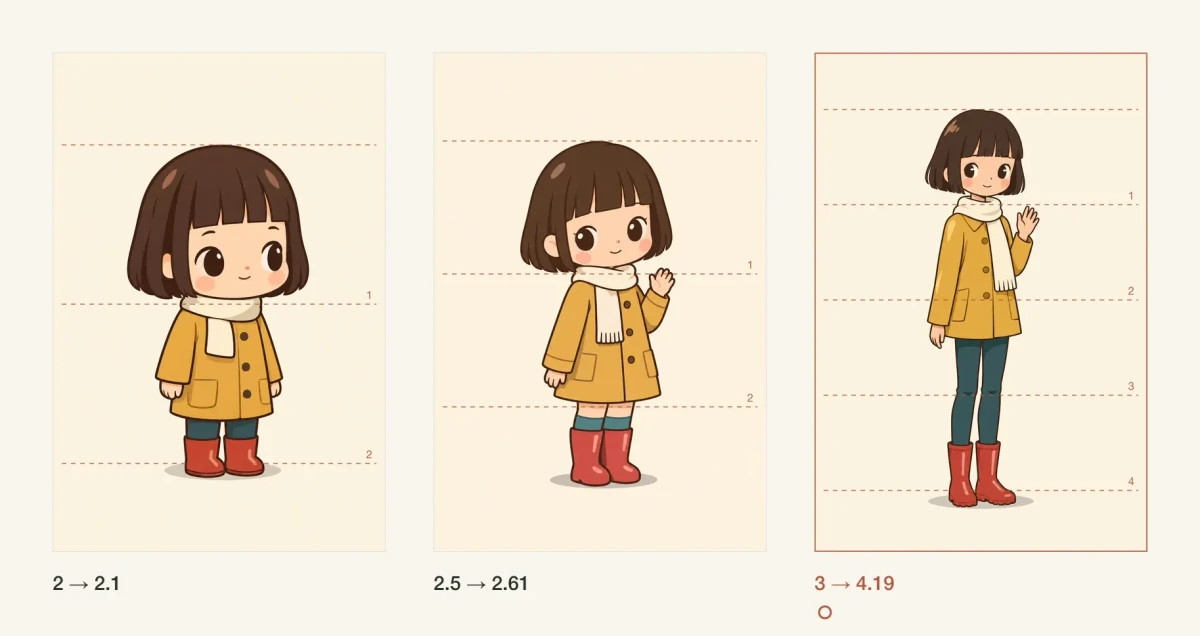
Three briefs, measured on the finished files. The character description, rendering words and background were identical; the ratio and the body geometry for it were spelled out per panel. The first two landed close to what they asked for. The third did not: briefed at three heads, it came back at roughly four and a quarter, visibly outside the chibi range, and the only fix is another run rather than a relabel. The dashed guides were added afterwards; because each panel is a separate generation, the character drifts between them, which is why a set later needs the reference-sheet prompt in step five.
2. The face layout
The ratio gets the body right; the face is where most results give themselves away. This prompt separates feature placement from feature size.
Close-up of the same chibi character's face, head filling the frame. Eyes large and low: each eye about a third of the head width, the eye line about 60 percent down the head, one eye-width of space between them. Tiny dot nose below the eye line, small mouth a quarter of a head wide sitting halfway between nose and chin, rounded cheeks, an almost flat chin, fringe covering the forehead to the eyebrows. Two shading values on the skin only, a single lash line per eye, no nostrils, no lip line, no realistic anatomical detail.What it controls: where the features sit and how large they are, independently of the body. To shift it: raise the eye line toward 50% and shrink the eyes to a quarter of the head width for an older "teen chibi" look; keep the eye line low and enlarge the eyes for a younger, sticker-bright face.
3. Line and shading for small sizes
Most chibi images are judged as thumbnails. This block trades refinement for legibility and is worth running whenever the output will end up in a feed, a chat window or a sticker pack.
Flat chibi sticker of the same character waving, two and a half heads tall, centred with an even margin that survives a circular crop. Uniform dark-brown outline about 16 pixels at 1024 pixels wide, no taper, no hatching, no texture. Two flat tones per material and one highlight, a small dark contact ellipse under the feet, plain cream background with nothing else in it. No gradient on the background, no cast shadow, no sparkle, no text.What it controls: line weight, the number of shading steps, and background complexity — the three things that decide whether the image survives being scaled to 96 pixels. To shift it: thin the outline for a print run at large size, thicken it if the sticker sits on a busy background, and never add background detail to fix a weak silhouette.
4. The photo-based version
When a real person's features have to come along, start from the photo instead of describing it. Ottermind's character page accepts a portrait — JPG, PNG or WebP, with a 12 MB ceiling in the composer — and passes it into Studio with the written brief.
Use the attached portrait as the only reference for this person's face and redraw them as a chibi character exactly two and a half heads tall. Keep these anchors: face shape, eyebrow shape, eye colour, hairstyle and hair length, and any distinctive feature such as glasses or freckles. Simplify everything else, drop the original background, and keep the clothing neutral. Flat cel shading with one shadow tone, even outline, plain warm cream background, full body with margin, no text.What it controls: how much identity survives the stylisation. To shift it: add or remove anchors from the list, one at a time; each anchor you add buys resemblance and costs some of the style's softness. Expect drift in the parts you did not name — the tool's own page is explicit that stylisation can change faces, poses, small details and text, so compare the result with the source before using it for anyone else, and get permission before publishing a recognisable person.
5. The set that stays consistent
A single good chibi is easy. Six that belong together is the actual job, and it fails because each generation is a separate run.
Character reference sheet on one cream sheet: the same chibi character in four views — front, three-quarter, side and back — each exactly two and a half heads tall, same outfit, same three-colour palette, same line weight, evenly spaced on a single sheet with generous margins. Neutral standing pose in every view, no props, no extra poses, no text labels, no background.What it controls: consistency across poses and, later, across images that use the sheet as a reference. To shift it: drop to two views for a sticker set, or add a face close-up view when the character will be used at avatar size. Feed the sheet back in as the reference for every later image instead of re-describing the character from memory.
What goes wrong, and the cheapest fix
These are the failures that look like style problems but are specification problems. Fix the sentence before you regenerate.
| What you see | What caused it | The cheapest fix |
|---|---|---|
| The ratio drifts between images in a set | The head-unit sentence was paraphrased or dropped | Paste the same sentence verbatim every time, and keep the ratio in the reference sheet |
| Enormous eyes on an adult body | "Cute" and "chibi" pulled the eyes but nothing re-scaled the body | Lead with the unit, then state shoulder, arm and hand sizes in head widths |
| Doll-like gloss, plastic skin | The renderer defaulted to a 3D or airbrushed look | Name the shading explicitly: flat, one shadow tone, no glossy highlights |
| Hands too large, props the wrong size | Hands inherited adult scale from the reference photo | Give hand size in head widths and allow at most one prop |
| Two characters in one frame, two different ratios | Both figures were generated in one pass without a shared unit | Generate them separately and composite, or ask for the same unit twice in the same sentence |
| Lettering, names or logos turn to mush | Text was asked of an image model | Generate the character clean, then set type in your layout tool |
| The image reads well large and disappears small | Line weight and detail were tuned at full size only | Judge at the final size, then re-run prompt 3 |
One more, specific to photo-based work: the result is a new drawing, not a retouch. Freckles may consolidate, a distinctive jaw may soften, glasses may become generic. That is the style working, not a bug — but it means a chibi version of a photo is a separate image to approve, not a pass on the original.
Chibi is not the same as cartoon, super-deformed, Q-version or kawaii
These five terms are used as synonyms in search results and are not synonyms in practice. The difference matters as soon as you are writing the brief, because three of them change proportions and two of them do not.
| Term | What it actually changes | How to tell it apart |
|---|---|---|
| Chibi | Proportion, plus compressed features | 2–3 heads; eyes low on the face; limbs rebuilt to suit |
| Cartoon | Rendering and simplification; proportions often untouched | A recognisable adult figure with flat colour and clean line work |
| Super-deformed (SD) | The same exaggeration applied to games, toys and mecha | Used for figures and model kits; usually 3–4 heads, more costume detail retained |
| Q-version (Q版) | The Chinese-language umbrella for this exaggeration | Common in comics and marketing; spans 2–4 heads and often keeps more detail than chibi |
| Kawaii | A mood and a design language | Can be perfectly realistic and still kawaii; says nothing about head count |
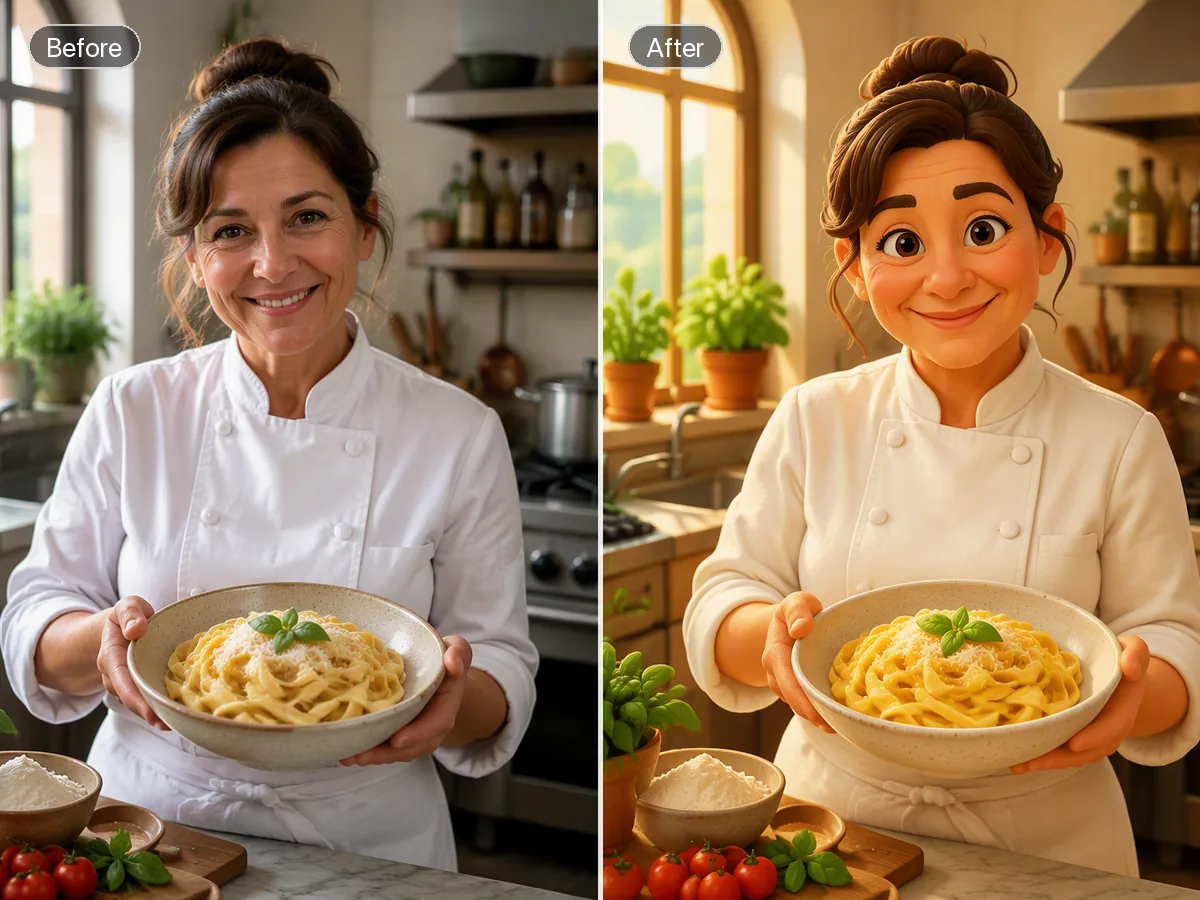
A published example from Ottermind's Photo to Anime Converter page, listed there as "Clay 3D Cartoon" (checked November 12, 2026). The face is rounded and the eyes enlarged, but the body keeps adult proportions — the head stays roughly a sixth of the standing figure. This is the halfway result to watch for: it reads as a stylised cartoon, not as chibi, and no amount of extra eye size will change that.
The practical consequence: if you ask for "cartoon" or "anime" you will usually get this halfway version, because those words describe rendering. If you want chibi, the brief has to move the ratio, and the ratio sentence has to be there from the first prompt.
Where to make one
Ottermind has two entries that fit different halves of this job, and neither is a chibi-specific preset — the ratio comes from your brief.
- AI Character Generator — the better starting point for a set. You can begin from a portrait or from a written description, and the page's character library builds a reusable reference set from that input: a full-body view with the head and shoes visible, a face close-up with the whole hairstyle, and headless body views from the front, true side and back. Put the head-unit sentence in the description field and the set inherits it.
- Photo to Anime Converter — the better fit for a one-off stylised interpretation of a photo, where the photo carries the likeness and your words carry the direction. Its page shows six published style examples, from cinematic anime to hand-painted animation, which is a useful reminder that "anime" and "chibi" are different requests.
What neither page settles for you: the result still has to be measured. Check the head unit, the eye line and the shading steps before you approve anything, and check it again at the size it will actually be seen. Ottermind's tools hand your brief to Studio, where credits, model access and available download options depend on the account; this page makes no claim about free generation, output resolution, turnaround or credit cost. If you need a transparent cutout, plan a separate removal step rather than asking the chibi prompt for transparency.
Questions that come up
How many heads tall should a chibi be?
Two to three, with two and a half the most useful default: it keeps a readable face and still leaves room for a pose. Under two heads you are drawing a head with limbs, which is a legitimate style but a different one. Above three, most viewers read a stylised child instead of chibi.
Is chibi the same as a chibi avatar?
An avatar is a use, not a style. A chibi avatar is a chibi image cropped for a profile picture, which is why the safest version is a symmetric, full-body drawing with an even margin — you can crop it square, circular or full-body later without losing the character.
Can AI keep the same chibi character across images?
Not reliably from a description alone, because every generation is a separate run. The workable method is a reference sheet you generate once and then attach to later prompts, plus the same ratio sentence in every brief. Expect small drift; check each new image rather than assuming continuity.
Can I make a chibi from a photo of a real person?
Yes, and the tool accepts JPG, PNG or WebP up to 12 MB in its composer. Treat the output as a new illustration rather than a likeness guarantee, review it against the photo, and get permission before publishing or selling an image of someone recognisable.
What size should I generate?
Generate larger than your final use and check the small version, since line weight is the first thing to fail. A 1024-pixel image is enough for an avatar or a sticker; if the image will be printed, decide the print size first and treat the prompt's line-weight number as a proportion of the final output, not of the generated file.
Chibi is one of the few styles where the definition is genuinely measurable. Decide the head count, say it in the brief, and then check it on the result with the same ruler — that is the difference between a style you can repeat and a lucky image you cannot reproduce.