How To
Agentic AI vs Generative AI: What Is the Difference?
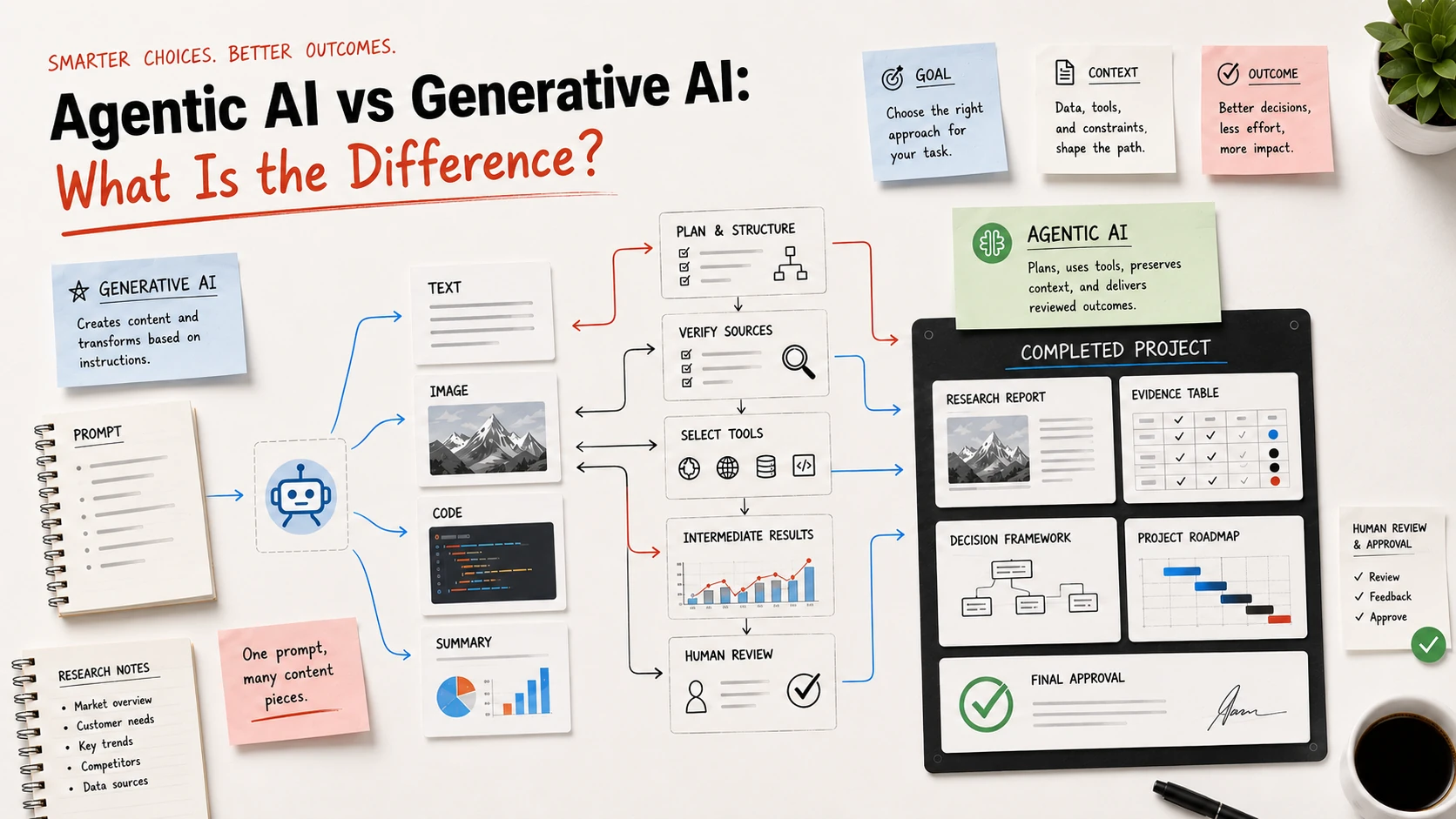
Generative AI creates or transforms content from a prompt. Agentic AI uses models, context, tools, and a control loop to pursue a goal across several steps. An agentic system may generate text, code, or images along the way, but its job is larger than producing the next response: it must decide what to do next and leave the work in a usable state.
The terms describe overlapping layers, not competing species of technology. A generative model can be the reasoning and writing component inside an agentic workflow. The useful question is whether you need a new piece of content or a bounded process that moves from an objective to a reviewed result.
Quick comparison
| Capability | Generative AI | Agentic AI |
|---|---|---|
| Primary purpose | Create, summarize, transform, or explain content | Achieve a goal through a sequence of decisions and actions |
| Typical input | Prompt, conversation, document, image, or structured context | Goal, constraints, context, permissions, and success criteria |
| Next step | Usually supplied by the user or a fixed application flow | Selected from allowed tools and steps based on what the system finds |
| Output | Text, image, audio, video, code, or recommendation | A deliverable, decision, updated system, or completed workflow |
| Memory | Prompt and conversation context | Task state, intermediate results, project context, and logs |
| Human role | Direct, refine, and review the output | Set boundaries, review evidence, and approve consequential actions |
| Main risk | Incorrect, incomplete, or unsupported content | Incorrect content plus wrong actions, permissions, or escalation |
Google Cloud describes generative AI as content-focused and agentic AI as systems that orchestrate models and tools to execute higher-level goals. IBM makes a similar distinction while noting that definitions vary across products. Those definitions are useful, but product labels alone do not tell you how much autonomy or control a particular system actually provides.
Definitions and disclosure: Google Cloud's overview of agentic AI and IBM's comparison of agentic and generative AI provide category context. Ottermind is included as an example of a workspace for connected project deliverables; this article is not an independent benchmark.
What is generative AI?
Generative AI learns patterns from data and produces a new result in response to instructions and context. Depending on the model, that result can be an email, image, video, piece of code, summary, outline, or variation of an existing asset.
Use generative AI when the main job is:
- Drafting or rewriting a piece of content
- Summarizing a document or conversation
- Exploring ideas, alternatives, or explanations
- Translating, classifying, or extracting information
- Creating a visual, audio clip, or code sample
Generative AI is often the fastest way to get a useful first version. It also keeps the user close to the decision: the person supplies the next instruction, checks the output, and decides what to do with it.
Where generative AI stops being enough
A good draft is not the same as completed work. A model can write a launch brief, but a team may still need to gather source files, compare competitor claims, check facts, create a landing page, prepare a presentation, route approvals, and record the accepted version. Repeating those instructions in a chat creates context loss and makes ownership unclear.
When the work crosses multiple artifacts, tools, or decisions, keep generative AI as a component and add a workflow that preserves state and review history.
What is agentic AI?
Agentic AI is an application or system organized around an objective rather than a single response. It can break a goal into steps, use permitted tools, inspect intermediate results, adapt its plan, and stop for clarification or approval. The agent may call a generative model for reasoning and content creation, but the surrounding system determines what actions are possible and when a person must intervene.
An agentic approach is a good fit when:
- Inputs arrive as mixed files, links, notes, and natural language
- The correct route depends on what the system discovers
- Several related outputs must share the same context
- Tools such as search, code execution, files, or business apps are necessary
- The result can be checked against explicit acceptance criteria
“Agentic” should not mean unsupervised. A reliable system has narrow permissions, visible intermediate work, approval gates for high-impact actions, and a way to recover when a tool call or assumption is wrong.
How they work together
Imagine a product team preparing a launch package from customer interviews, competitor links, and product documentation.
Generative AI version
The marketer asks for positioning ideas and receives headlines, a draft email, and a landing-page outline. This is excellent for exploration. The marketer still needs to supply the context again when asking for a deck, validate the claims, and coordinate the handoff.
Agentic AI version
The marketer gives the system the goal, source material, audience, deadline, exclusions, and acceptance criteria. The agent plans research, gathers evidence, identifies themes, drafts the brief, proposes landing-page copy, and prepares a presentation outline. A person reviews citations, product claims, and the recommendation before anything is published.
The production design is usually a combination:
- A form or chat captures the brief.
- A workflow creates the project, permissions, and review checkpoints.
- An agent performs variable research and drafting.
- Generative models create or transform the individual assets.
- Automation routes approved files to publishing and reporting systems.
- A person owns the final decision.
Agentic AI is not simply “better generative AI”
Agentic systems can handle more of a process, but that adds more ways to fail. They may choose an unsuitable source, take an unnecessary action, follow a misleading instruction in a document, or produce a plausible result that does not meet the business objective. More autonomy also means more responsibility for permissions, audit logs, data handling, and rollback.
For a one-off summary or image variation, an agent adds overhead without adding value. For a multi-step project, a plain chat may be too disposable. Choose the smallest system that can reliably complete the job, then expand only after real examples show that the controls and outputs hold up.
A decision framework you can reuse
1. Is the output the work, or a step toward the work?
If a finished paragraph, image, summary, or code snippet solves the problem, start with generative AI. If the output is a report package, approved campaign, reconciled record, or other end-to-end result, consider an agentic workflow.
2. Is the path known in advance?
Use deterministic automation when the trigger and sequence are stable. Use agentic behavior only for the variable part, and define the tools and escalation conditions it may use.
3. What is the cost of a wrong action?
Sampling and editing are reasonable for low-risk drafts. Customer messages, financial changes, legal claims, access changes, and public publishing require narrow permissions, human approval, and a clear rollback path.
4. Will someone need the context later?
If another person must continue the work, keep sources, assumptions, intermediate outputs, decisions, and accepted deliverables together. A disposable chat is a weak system of record for a project.
5. Can you measure an accepted result?
Track completion rate, correction time, review time, and cost per accepted deliverable. A shorter first draft is not a productivity gain if a person has to rebuild it afterward.
How Ottermind fits
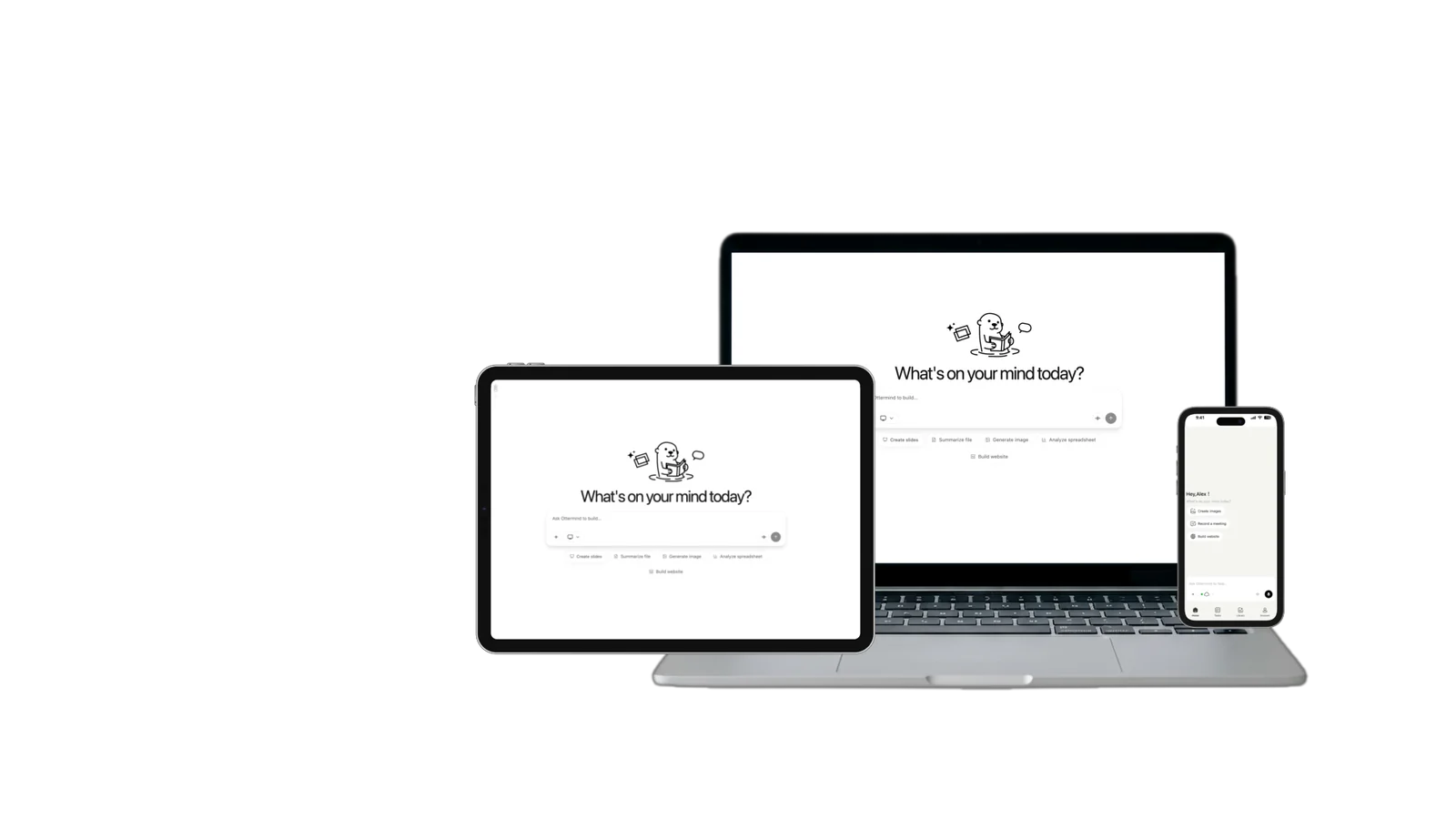
Ottermind sits between a blank chat and a fixed app automation. Give it a goal, source files, links, product context, constraints, and acceptance criteria; it can organize research and turn that context into connected deliverables such as a report, brief, landing-page copy, or presentation.
The same guardrails still apply: review sources and unsupported claims, limit tool access, and require approval before consequential work moves to customers or public channels. For specialist campaign tools and repeatable distribution tasks, see our guide to the best AI tools for marketing teams.
Start with a bounded workflow
Choose a frequent task with a clear owner, a reviewable output, reversible actions, and a small set of allowed tools. A launch-research package is a practical first project:
- Inputs: competitor links, interview notes, product facts, audience, deadline, and exclusions.
- Planning: research questions, source list, output outline, and unresolved assumptions.
- Intermediate work: evidence table, audience themes, positioning options, and claim checks.
- Human review: approve the evidence and recommendation before public copy is finalized.
- Deliverables: campaign brief, landing-page draft, ad angles, and presentation outline.
- Handoff: retain accepted outputs and create the next task from the same context.
If the agent needs repeated rescue, narrow the goal, improve the inputs, reduce its permissions, or move that step back into deterministic automation.
Frequently asked questions
Is agentic AI a type of generative AI?
Often, yes in practical product architecture: agentic systems commonly use generative models for language, reasoning, and content. Agentic AI is the broader application pattern of pursuing goals with planning, tools, state, and controls, not just the model that generates a response.
Which is better for business: agentic AI or generative AI?
Neither is universally better. Generative AI is usually enough for drafting, summarizing, and ideation. Agentic AI is justified when the work spans steps, tools, and decisions that can be reviewed against a clear result.
Do agentic AI systems work without humans?
They can run with varying levels of autonomy, but important actions should retain human ownership. Use approval gates, limited permissions, monitoring, and escalation for sensitive or irreversible work.
Are AI agents and agentic AI the same thing?
An AI agent is usually one program that can pursue a goal with tools. Agentic AI describes the larger system or design pattern, which may coordinate one agent, several specialized agents, or deterministic workflows.
What should I automate first?
Start with a frequent, low-risk task with clear inputs and a reviewable output, such as research summaries, meeting follow-up, lead-response drafts, or weekly reporting. Measure accepted work before expanding autonomy.
Bottom line
Choose generative AI when creating or transforming content is the job. Choose agentic AI when a bounded goal requires planning, tool use, state, and decisions across several steps. In dependable systems, they work together: generative models create the pieces, agentic orchestration moves the work forward, deterministic automation controls the edges, and people approve what matters.