How To
How to Use AI for Marketing: From Brief to Campaign
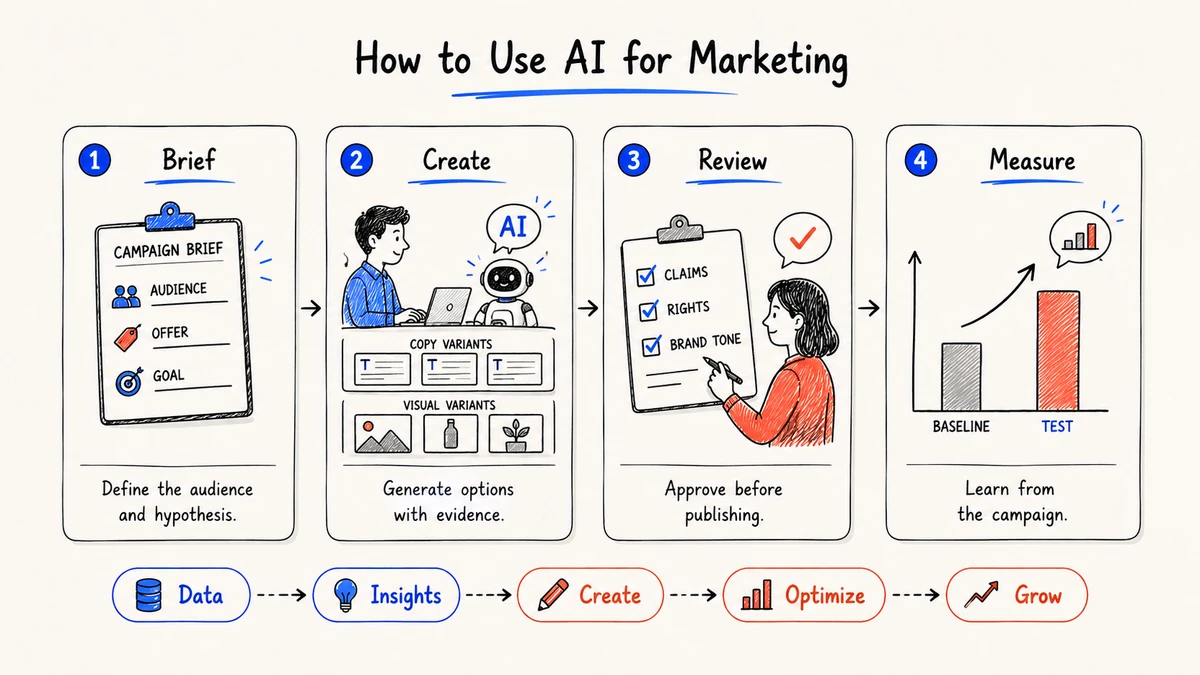
If you are learning how to use AI for marketing, start with a measurable workflow rather than a generic content prompt. AI can accelerate research, variants, creative briefs, and analysis when the team supplies evidence and reviews the result.
Research and disclosure: Process guidance reflects Google Ads measurement guidance, HubSpot AI guidance, Meta business AI resources, and OpenAI safety guidance, reviewed September 2, 2026. Results depend on channel, audience, data quality, and human review.
A six-step workflow
- Define audience, offer, channel, evidence, and one success metric.
- Ask AI to find missing information and competing interpretations.
- Generate multiple concepts tied to different hypotheses.
- Check claims, rights, accessibility, and brand requirements.
- Run a small test with a recorded baseline and metric definition.
- Feed the result into the next brief, not just the next headline.
Good uses and bad shortcuts
| Good use | Risky shortcut |
|---|---|
| Turning research notes into a brief | Inventing customer insights |
| Creating subject-line or hook variants | Publishing unreviewed copy |
| Repurposing an approved asset | Changing claims during repurposing |
| Summarizing campaign results | Treating correlation as causation |
Prompt for a campaign brief
Create three campaign directions from the approved brief below.
For each: audience, insight, promise, proof, channel adaptation, risk, and test metric.
Use only supplied evidence. Mark unsupported claims as questions.
Keep the approved brief, source links, model output, edits, and final metric together. This makes a failed test useful instead of mysterious.
For a fuller operating model, see How to Build an AI Marketing Workflow. This article stays focused on the campaign brief, test, and review loop.
Metrics that resist vanity reporting
Choose one primary outcome before generating variants. Pair it with a guardrail such as unsubscribe rate, complaint rate, qualified conversion, or correction count. Record the audience, attribution window, and exclusions so an AI summary cannot quietly change the meaning of the result.
Example: a launch email workflow
Start with the approved positioning brief, customer segment, offer terms, and exclusions. Ask AI for three message angles: a direct benefit, a proof-led version, and a problem-led version. Require each draft to quote only supplied proof, identify the intended segment, and list any claim that needs legal or product review.
An editor then chooses one angle, checks links and personalization fields, and prepares a small test. After the test, capture the actual audience, send time, delivery rate, clicks, conversions, unsubscribes, and corrections. The next prompt should use those observations as evidence, not as a reason to declare a universal winner.
Assign roles in the workflow
| Role | Owns | AI can assist with |
|---|---|---|
| Strategist | Audience, offer, and hypothesis | Brief questions and alternatives |
| Writer | Message and channel adaptation | Drafts and variants |
| Reviewer | Claims, rights, and accessibility | Checklists and issue finding |
| Analyst | Metric definition and interpretation | Tables and anomaly questions |
One person may hold several roles on a small team, but the decisions should remain explicit.
Protect brand and customer trust
Create a short prohibited-claims list, approved terminology, and examples of the brand voice. Keep consent and targeting rules outside the model's discretion. Do not use inferred sensitive attributes to personalize messages without a documented legal and ethical basis.
Governance basics
Limit access to customer data, check retention and training terms, and require approval before publishing or changing targeting. Keep a person accountable for claims, consent, and the final decision.
FAQ
Can AI write all of my marketing content?
It can draft and adapt content, but strategy, customer truth, approvals, and accountability remain human work.
How do I measure AI-assisted marketing?
Compare a defined workflow or test against a baseline. Track revision time, conversion or engagement metrics, and error corrections.
Should I use one model for everything?
Choose by task: research, writing, images, and analysis may have different context and control needs.
What should a small team automate first?
Start with low-risk briefing, repurposing, or classification. Add publishing actions only after review and rollback procedures work.