Review
Genspark Review 2026: Is the AI Workspace Worth It?
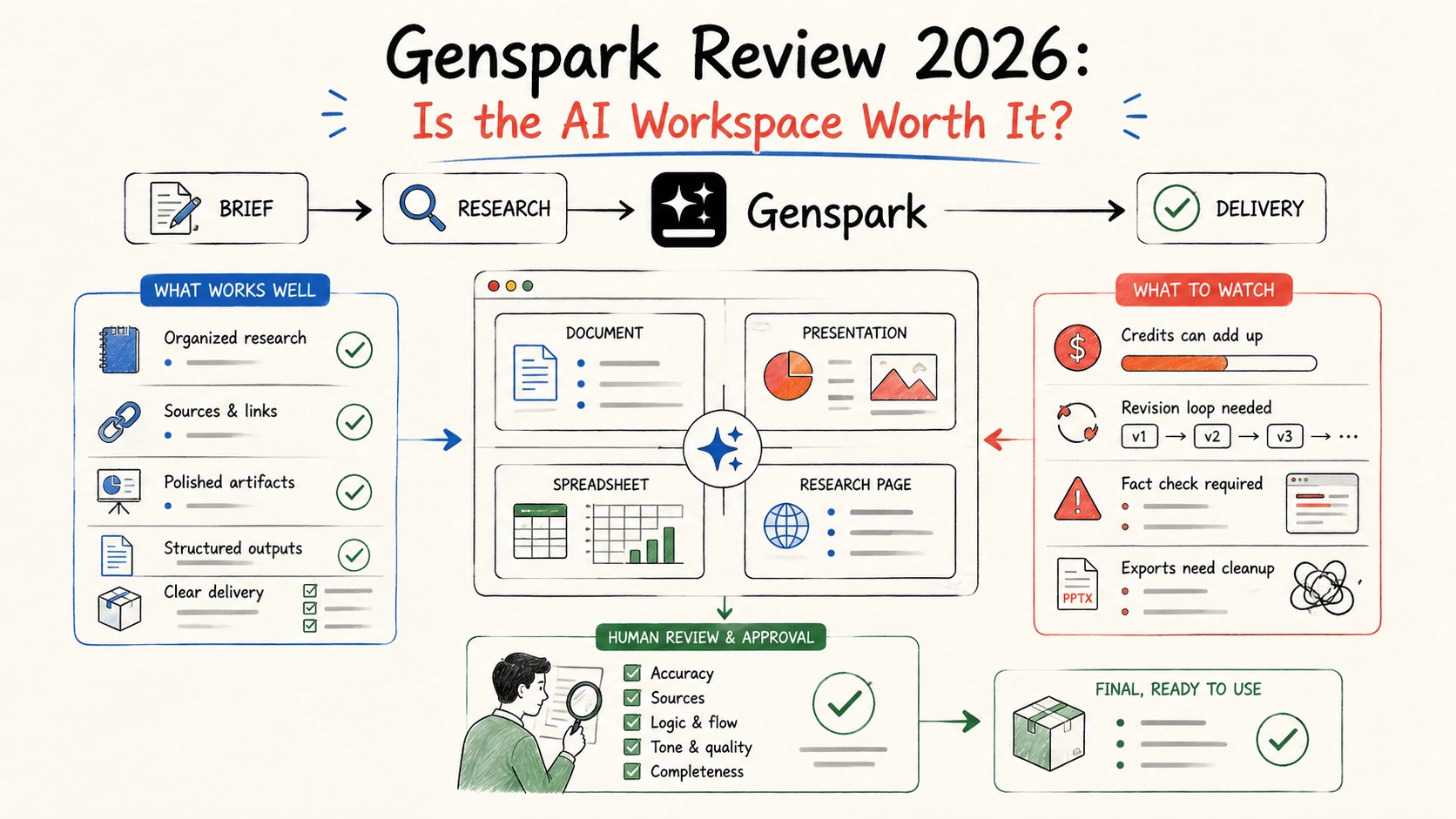
Genspark is an ambitious AI workspace built around finished artifacts rather than chat alone. Public reviews consistently praise its AI Slides output, structured research pages, broad model access, and one-workspace convenience. They also repeatedly warn about credit consumption, revision consistency, export quality, billing, and support. The fair verdict is conditional: Genspark can be valuable for people who ship visual or structured drafts often, but it should not be treated as an independent source of truth or as a frictionless replacement for every AI tool.
Verdict first
Genspark is worth considering when the job is to turn a rough brief into a presentation, research page, document, spreadsheet, or other packaged artifact. It is less compelling when the job is careful reasoning, repeated micro-edits, or unsupervised high-stakes research.
The central tradeoff is simple: the first draft can be fast and visually strong; the path to an accurate, editable, cost-predictable final deliverable still requires human review.
What Genspark is
Genspark positions itself as an all-in-one AI workspace. Its Workspace 6.0 announcement describes SecondBrain for persistent context, Super Agent for planning and execution, Build/Office/Content suites for creating work, and GenTeam for collaboration (official announcement).
The product surface includes AI Chat, Super Agent, AI Slides, AI Docs, AI Sheets, image/video/audio/design agents, AI Meeting Notes, GenMail, and connected-workspace features. This breadth explains why reviews compare Genspark with ChatGPT, Claude, Manus, Skywork, and presentation specialists. It is a collection of workflows sharing one account and credit system, not one narrowly defined tool.
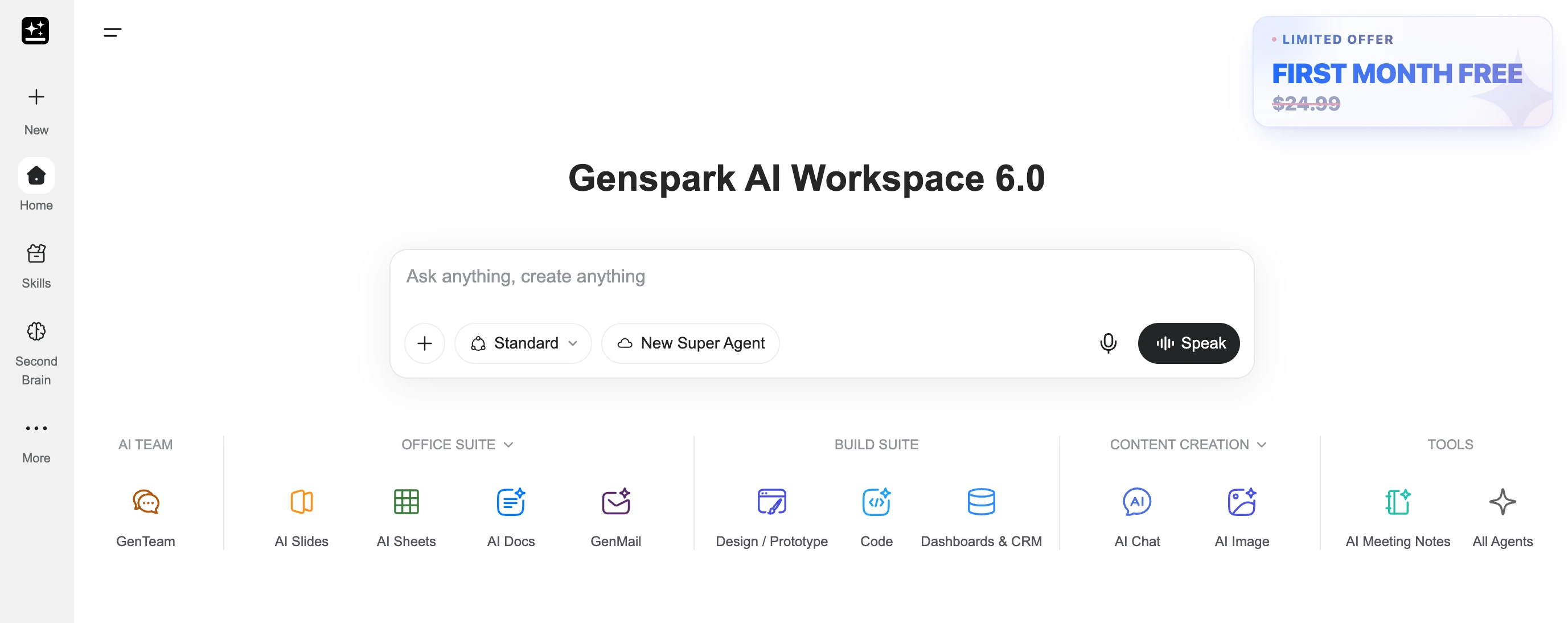
Official product screenshot: Genspark AI Workspace Agents page, accessed 2026-08-28. This is a dated interface snapshot, not a guarantee that every listed tool remains unchanged.
What professional reviews find useful
AI Slides is the clearest strength
AI Tools Radar describes Genspark as a hybrid of agents and artifact creation after examining Slides, research, image, inbox, and voice workflows. Deckary focuses on business presentations and reports attractive first drafts, while warning that exported files may need PowerPoint cleanup.
Future Stack timed Genspark Deep Research against ChatGPT Pro Deep Research and reached a useful distinction: Genspark is strong at aggregation and packaging, while ChatGPT may be stronger when the bottleneck is deeper reasoning. That is a more useful comparison than declaring one universal winner.
Multi-agent routing reduces model-selection work
Genspark says it can route requests to specialized agents and current models. Reviewers like starting with a goal instead of choosing a model first. The tradeoff is that model routing and intermediate steps can be less transparent, so important claims still need inspection.
Structured pages are more useful than a chat transcript
Cybernews reports that Sparkpages and structured research can be more useful than a standard chatbot's first response (Cybernews review). The same review warns that broad prompts can produce shallow research and that niche factual prompts can still hallucinate. Specific prompts and bounded sources help; they do not replace verification.
What users complain about most
Credits are the central value concern
Genspark's Membership Plans describe Free, Plus, and Pro by monthly credits. Plus starts from 10,000 credits per month and Pro from 125,000. The Team and Enterprise Plans page lists Team at $30 per seat per month with 12,000 credits per seat.
The Credits Guide says advanced models use more credits, credits reset without rollover, and failed generations do not deduct credits. Users still report that revisions, background operations, and high-cost modes can consume credits quickly. A Reddit user praised Genspark's slide visualization but said credits disappeared “insanely fast” (discussion). A Google Play review described an infinite loop that consumed 6,250 credits without output (Google Play). These are individual accounts, not a universal defect rate.
The responsible conclusion is not “Genspark always charges for failures.” The official rule and user reports conflict in ways that cannot be classified from the public text alone. Buyers should monitor the ledger and preserve task records when something fails.
Revisions can be less stable than first drafts
Community users describe a “one step forward, two steps back” pattern: a first deck looks strong, then a small edit changes the background, typography, or layout. Reports mention ignored instructions, inconsistent headers, and manual cleanup (Slides reliability discussion). This is not a current defect rate, but it is a serious Review criterion for stakeholder-heavy work.
Export quality is separate from preview quality
Older users report spacing, grouping, dimension, and animation differences between the native canvas and PPTX (PPTX export discussion). Current documentation says paid users can export to PPTX, PDF, or Google Slides and recommends trying another format when an export fails (AI Slides Help). A buyer should judge the file they plan to send, not only the browser preview.
Billing and support feedback is polarized
Trustpilot's summary combines praise for presentations, research, and model access with complaints about credit depletion, billing, subscription confusion, and slow support (Trustpilot). The US App Store shows about 4.7/5 from 4,000 ratings, and Google Play about 4.6/5 from 97,700 reviews at research time. Written samples still include double-charge, missing-credit, support-delay, and deployment-mismatch complaints (App Store, Google Play). Aggregate scores and detailed complaints answer different questions.
Pricing and value
Free is useful for learning the interface and testing a bounded task. Plus and Pro are more relevant to people who regularly produce artifacts. The official pages specify credit allocations, storage, commercial-use terms, and the no-rollover rule, but individual-plan dollar amounts can vary by surface and promotion. Recheck the live offer before publication.
The value calculation should include:
- Credits per accepted report, deck, or sheet.
- Human correction time.
- Cost of retries and revisions.
- Export and handoff requirements.
- Whether unused credits expire before the next cycle.
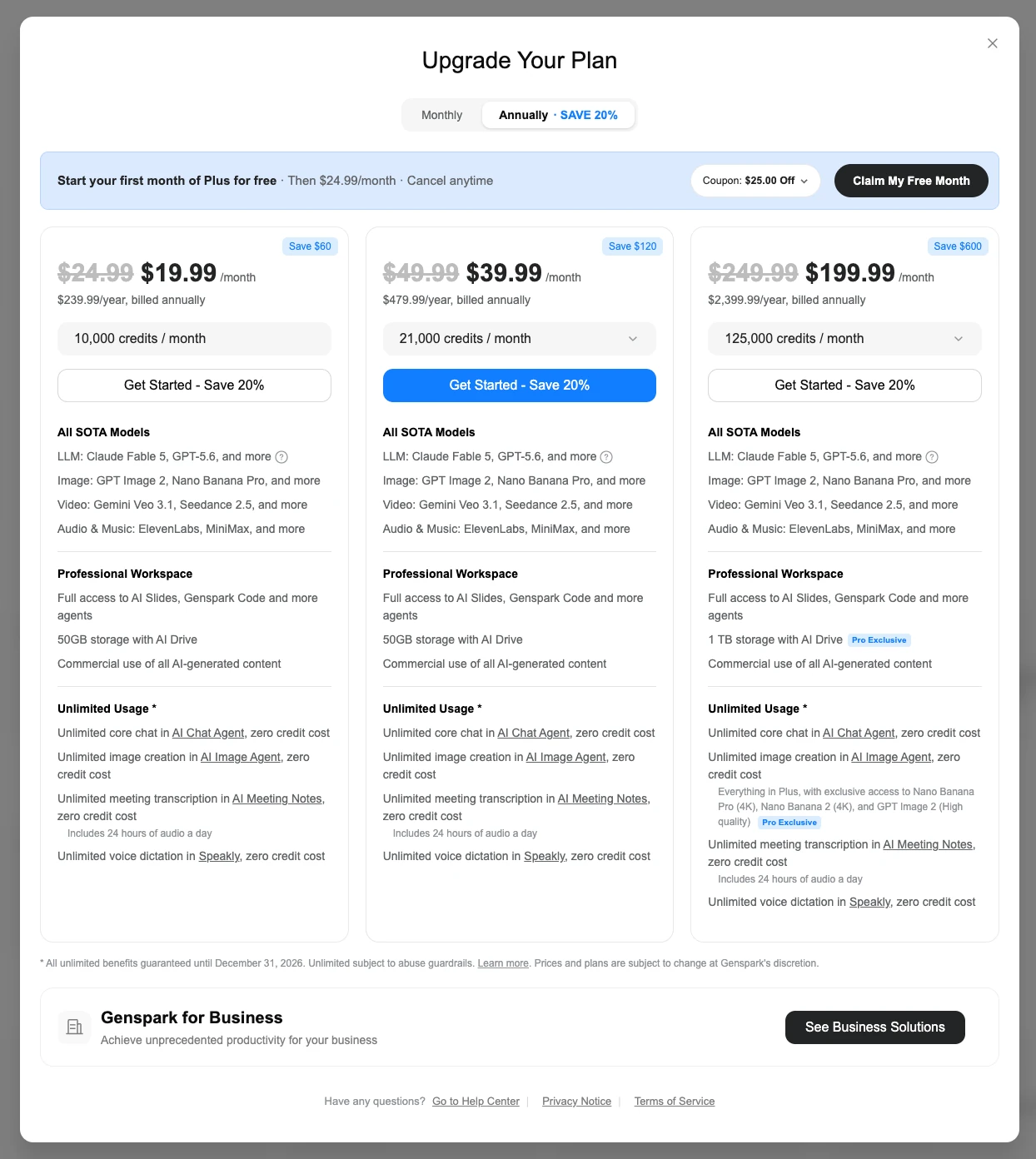
Official pricing screenshot: Genspark Upgrade Your Plan screen, accessed 2026-08-28. Prices, promotions, credits, and included features are time-sensitive and must be rechecked before publication.
Genspark versus alternatives
| Tool | Natural fit | Decision question |
|---|---|---|
| Genspark | Research packaged into native artifacts | Will credits, revisions, and export fit the workflow? |
| ChatGPT | General reasoning and analysis | Do you need a dedicated artifact workspace? |
| Claude | Long-document writing and editorial refinement | How will the final deliverable be maintained? |
| Manus | Autonomous execution in a sandboxed computer | Do you need actions more than a broad artifact suite? |
| Skywork | Multi-agent documents, slides, sheets, and websites | Are current commercial terms verifiable? |
| Ottermind | Connected project context and reviewable real-work deliverables | Does the work need to continue across research, files, tasks, and outputs? |
This is category guidance, not a controlled benchmark. Ottermind publishes this Review and competes in an adjacent category; no product-vs-product winner is claimed.
Who should use it?
Genspark is a reasonable shortlist candidate for consultants, analysts, marketers, founders, and researchers who need structured visual drafts and can assign a human reviewer. Start with bounded source material, clear output requirements, and a credit ledger.
Who should skip or delay it?
Delay a purchase if you need fully autonomous high-stakes research, predictable low-cost micro-revisions, guaranteed PPTX/PDF fidelity without a paid export test, or production connectors and governance you have not independently verified.
Final verdict
Genspark is one of the more credible all-in-one AI artifact workspaces, especially for presentation-first users. Public users are right to praise its visual first drafts and broad workspace. They are also right to question credit economics, revision consistency, exports, billing, and support.
Is Genspark worth it? Yes, conditionally. Try it if your recurring bottleneck is artifact production. Pay only after a representative workflow shows acceptable credit usage, revision behavior, and external export quality. Keep a human in the loop for sources, claims, sensitive data, and final delivery.
Sources and disclosure
This Review synthesizes official Genspark documentation, professional evaluations, App Store and Google Play listings, Trustpilot, Reddit discussions, and the supplied Manus reference article. It does not claim personal use of every Genspark feature, and it does not convert one complaint into a platform-wide fact.
Ottermind publishes this article and operates in an adjacent AI-workspace category. No Genspark sponsorship, affiliate relationship, or paid placement is implied. Product features, plan rules, promotions, prices, ratings, and user sentiment should be rechecked before publication.
Substantive update note: English Review draft rewritten from public review evidence and official documentation. Before publication, assign a real author and reviewer, update all dates and pricing, replace image notes with redacted CDN assets, validate the target query, and complete production QA.